Artificial intelligence is rapidly reshaping cybersecurity, helping organizations identify threats in real time, automate critical security functions, and respond to incidents with greater speed and accuracy.
At the same time, attackers are using AI to create more convincing phishing campaigns, automate cyberattacks, and find vulnerabilities faster.
These changes are driving investment in AI-powered security tools and changing how organizations approach risk management.
The following AI cybersecurity statistics highlight some of the most important trends shaping the industry in 2026. They cover market growth, adoption rates, emerging threats, and the technologies organizations are using to strengthen their security posture.
1. The AI in Cybersecurity Market Is Valued at $39.22 Billion[1]
The artificial intelligence in cybersecurity market is projected to hit $39.22 billion in 2026, up from $30.68 billion in 2025, according to a market report from The Business Research Company.
That is a gain of roughly $9 billion in a single year, driven by a compound annual growth rate (CAGR) of 27.8%.
North America leads in the current market size. Asia-Pacific is the fastest-growing region and is expected to maintain that position through the forecast period.
The growth reflects real demand. Security teams are outnumbered, managing attack surfaces that now span on-premises systems, multiple cloud environments, mobile devices, and AI applications.
AI-powered tools, including machine learning threat detection, deep learning-based anomaly detection, and automated incident response, let teams cover more ground without adding proportional headcount.
Data analytics plays a central role here. The ability to process and correlate security telemetry at scale is what makes AI defenses faster than human-only operations.
2. The AI in Cybersecurity Market Is Expected to Reach $104.6 Billion by 2035[1]
The AI in cybersecurity market is expected to grow to $104.6 billion by 2035 at a CAGR of 27.8%. This would increase the market to roughly 2.7 times its 2026 value of$39.22 billion, according to the same Business Research Company report.
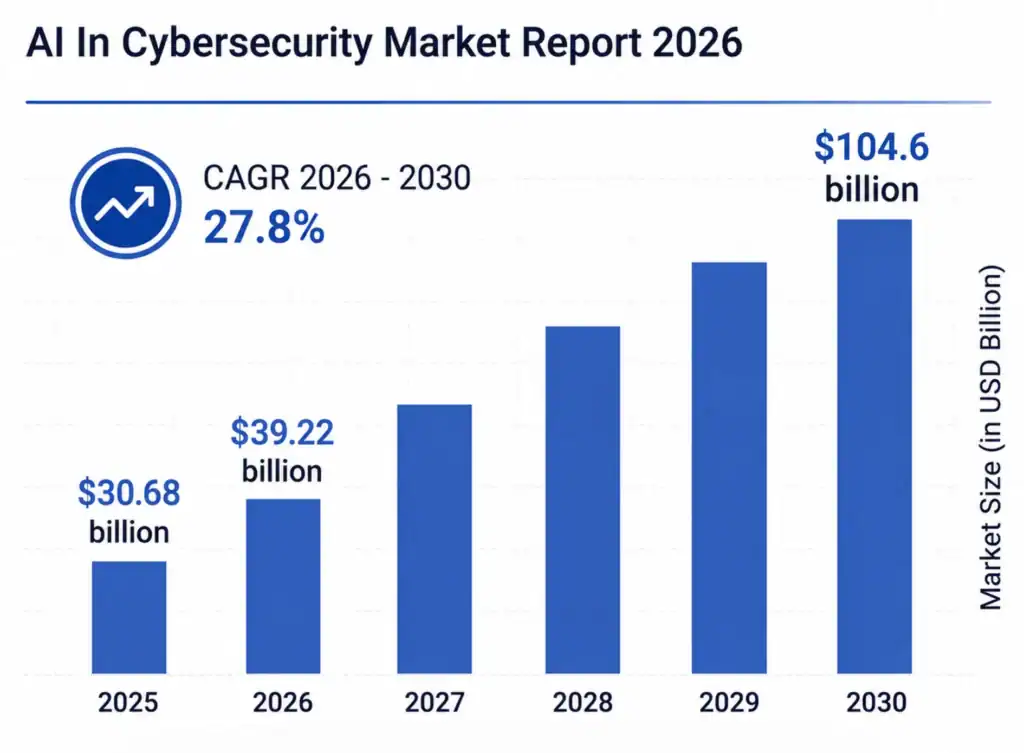
The image says 2030, but we believe this to be a typo after analyzing the details of the report, as in other places it’s mentioned to have a forecast to 2035.
Key forces behind that growth include the increasing sophistication of cyber threats, demand for real-time threat intelligence, adoption of AI-based zero-trust security models, and the broader push to automate network security operations.
AI can triage alerts, correlate signals across systems, and initiate responses in seconds. For organizations handling hundreds of thousands of security events per day, that speed matters.
Fraud detection is one of the clearest near-term beneficiaries. Financial institutions are already deploying AI models that flag anomalous transactions in real time, reducing both losses and the manual review burden on security teams.
The organizations investing now are building capabilities that will compound over time. Those that delay may find themselves playing catch-up as AI becomes a standard component of security operations.
3. 16% of Data Breaches Involve Attackers Using AI[2]
According to IBM’s 2025 Cost of a Data Breach Report, roughly 16% of data breaches involved attackers using AI.
That share will almost certainly grow. The tools attackers need are cheap, widely available, and improving quickly.
IBM has found that generative AI reduced the time needed to write a convincing phishing email from 16 hours to roughly five minutes.
Large language models (LLMs) such as ChatGPT, Gemini, and Copilot are the primary technology behind this shift. They allow attackers to produce personalized, contextually accurate messages at a volume that was previously impossible without a large team.
Generative artificial intelligence and gen AI tools have also lowered the bar for less technically skilled attackers. What once required custom tooling now runs on widely available platforms, and natural language processing capabilities make the output increasingly difficult to distinguish from legitimate communication.
AI-powered attacks have moved past the experimental stage. They are operational, and they are scaling.
4. 97% of Organizations Hit by an AI-Related Breach Have No Proper AI Access Controls[2]
Among the 13% of breached organizations in IBM’s study that reported security incidents involving their AI models or applications, 97% lacked proper access controls on those systems.
The most common entry point was supply chain compromise. This is where attackers go through compromised apps, APIs, or plug-ins connected to an organization’s AI infrastructure. Data poisoning attacks, where adversaries corrupt the training data or inputs an AI model relies on, were also among the reported incident types.
The downstream effects were significant. Among organizations that experienced AI-related security incidents, 60% suffered broad data compromise and 31% experienced operational disruption.
Privacy concerns were a major driver of the damage, given that customer personally identifiable information was the most frequently compromised data type.
The pattern is consistent: AI tools are being adopted as productivity software and not secured as infrastructure. Access controls, audit logging, least-privilege principles, and anomaly detection are standard practice for protecting databases and financial systems. They are largely absent from AI deployments.
AI systems have access to sensitive data and, increasingly, the ability to take autonomous actions. Treating them as low-risk tools is a significant miscalculation.
5. 63% of Breached Organizations Have No AI Governance Policy[2]
IBM’s research found that 63% of breached organizations either had no AI governance policy or were still in the process of building one. Only 37% had policies they were actively using.
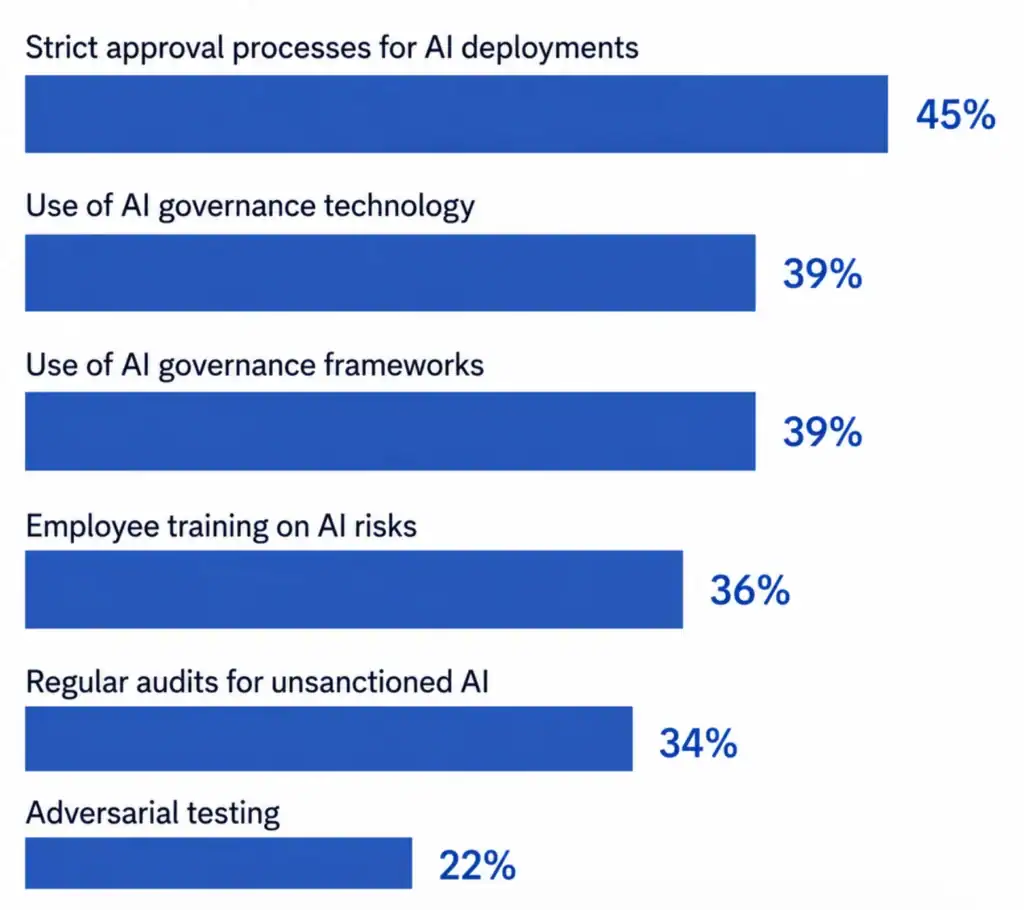
Even within that 37%, the policies were frequently incomplete:
- Fewer than half (45%) had a formal approval process for new AI deployments.
- 61% had no AI governance technologies in place.
- Only 34% performed regular audits to find unsanctioned AI tools.
That last gap is particularly consequential. Without regular audits, organizations have no reliable way to detect shadow AI, where employees introduce AI tools without IT review or approval. This creates a significant insider threat that potentially exposes sensitive data.
Shadow AI is now one of the top three factors that increases the cost of a data breach, according to IBM’s analysis. It has displaced security skills shortages, which had been a consistent top-three cost driver for years.
Regulatory exposure compounds the governance problem. Frameworks like GDPR impose strict requirements on how personal data is processed and stored. An unsanctioned AI tool that ingests customer data without review can create compliance violations that an organization does not discover until after a breach.
A governance policy does not need to be complex. At minimum, it should define which AI tools are approved, establish an intake process for new deployments, specify what data AI systems can access, and require regular audits. Without those basics, security teams cannot know what they are defending.
6. 37% of AI-Driven Attacks Used AI-Generated Phishing; 35% Used Deepfake Impersonation[2]
Of the breaches that involved attackers using AI, IBM found two dominant methods:
- AI-generated phishing or other communications: 37% of AI-driven attacks.
- Deepfake impersonation: 35% of AI-driven attacks.
Both methods target people rather than systems. That is not a coincidence. Years of investment in technical defenses, including penetration testing programs, network security hardening, and endpoint protection, have made direct system intrusion harder.
Manipulating the humans who operate those systems is often the more practical path.
Generative AI and LLMs
AI-generated phishing has become highly targeted. Attackers use generative AI and LLMs to scrape public information about a target, including job title, recent projects, colleagues’ names, and writing style, and produce a message that reads as genuine correspondence.
Spam filters tuned to catch generic blasts miss these. There are LLMs like FraudGPT or GhostGPT that have no ethical safeguards in place.
Deepfakes
Deepfakes extend the same social-engineering approach to voice and video. Computer vision and audio synthesis technologies have advanced to the point where voice cloning requires only a short audio sample.
Attackers are using cloned executive voices to impersonate leadership in phone calls, requesting wire transfers, credential sharing, or bypasses of security procedures. Some campaigns have incorporated video as well.
Defending against both requires layered responses. Technical controls help: email authentication standards, phone verification protocols, and multi-person authorization for high-value transactions.
But training matters just as much. Employees need to understand that a convincing voice or face on a screen is not sufficient verification, and that any unusual request warrants a callback through a known, separate channel.
7. The Average American Now Encounters 3 Deepfake Videos Daily[3]
Research from McAfee suggests the average American now encounters roughly three deepfake videos daily across social platforms, messaging apps, and video content.
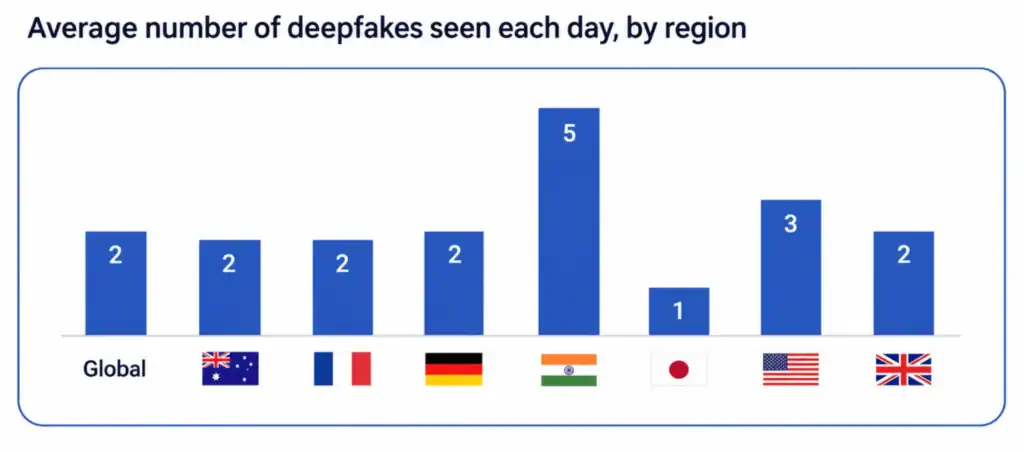
That volume has implications for enterprise security, but the larger concern is accessibility. Deepfake technology is improving rapidly. What once required specialized hardware and deep learning expertise now runs on consumer software with a few photos as input.
As production costs fall, the volume of deepfake content will continue to rise, and enterprise-targeted attacks will become a larger share of it.
Organizations should include deepfake awareness in required security training. The key messages are straightforward: video and audio can be fabricated, any high-stakes request that arrives through unusual channels deserves verification, and verification should always happen through a pre-established, separate contact method regardless of how credible the original communication appears.
What Steps Can Organizations Take to Protect Themselves From AI Cyberattacks?
Run penetration testing that accounts for AI attack surfaces.
Standard penetration testing scopes need to be extended to cover AI-specific attack vectors. This includes testing AI models for prompt injection vulnerabilities, evaluating the APIs and plug-ins that connect to AI systems, and simulating supply chain compromise scenarios.
Third-party AI delivered as SaaS requires particular attention, as the attack surface extends beyond the organization’s own infrastructure into vendor systems and integration points that may not be subject to the same security controls.
Inventory every AI tool in use across the organization.
A complete inventory should cover IT-sanctioned tools, tools deployed independently by business units or individual employees, open-source models integrated into internal workflows, and third-party SaaS products with embedded AI features.
Many standard business applications have added AI capabilities as default features, which means AI may be processing organizational data without any explicit procurement decision having been made. Unsanctioned tools cannot be secured, audited, or governed until they are known.
Apply access controls to AI systems as critical infrastructure.
Least-privilege access, role-based permissions, audit logging, and anomaly detection are standard controls for protecting databases and financial systems. The same controls apply to AI systems, particularly those with access to customer data, employee data, or internal operational data.
The classification of an AI tool as a productivity application rather than infrastructure is what typically causes these controls to be skipped. Every AI system with access to sensitive data should go through the same security review process as any other system with equivalent access.
Establish an AI governance policy with a mandatory approval process.
At minimum, a governance policy should require pre-deployment review for all AI tools, define what categories of data AI systems are permitted to access, assign clear ownership for each deployed system, and require regular audits to surface unsanctioned usage.
Organizations subject to GDPR or similar data protection regulations face direct compliance exposure from ungoverned AI tools that ingest personal data without review. Governance and security controls are most effective when implemented together rather than managed as separate functions.
Update security awareness training to address AI-generated attacks.
Training should cover the specific characteristics of AI-generated phishing, including that it is personalized, contextually accurate, and designed to pass conventional detection.
Employees handling financial transactions, vendor onboarding, or privileged system access should be trained to treat any out-of-pattern request as requiring out-of-band verification, regardless of the apparent identity of the requester.
Voice and video should not be treated as sufficient verification for high-stakes actions. Pre-established verification procedures should be documented, communicated, and practiced.
Deploy AI-powered detection and response tooling.
Behavioral analytics, machine learning-based threat detection, and automated incident response reduce mean time to identify and contain breaches. Security information and event management (SIEM) platforms with AI capabilities improve signal-to-noise ratios in high-volume alert environments.
These tools are particularly relevant for detecting anomalous activity involving AI systems, where the volume and speed of machine-generated activity make manual review impractical. Organizations that have not yet integrated AI into their security operations are working at a structural disadvantage against attackers who have.
Conclusion
Cyber resilience requires continuous testing, ongoing visibility into what is running inside the organization, and training that reflects current attack methods. The threat environment is not static, and neither are the controls required to manage it.