ISO 27001 assumes you monitor your systems and fix what you find all year, not just before an audit. SOC 2 Type 2 checks that your controls operated across the whole reporting period, and PCI DSS turns the same expectation into quarterly scans and yearly testing. This article explains what VAPT is and how running it as an ongoing program keeps your compliance posture current instead of letting it drift between audits, while giving you permanent visibility into where you are exposed. Any IT or security team responsible for this evidence will find it useful, and it is especially valuable for small teams expected to produce it without a dedicated security staff.
Quick Answers
What is VAPT, and what is the difference between the two halves?
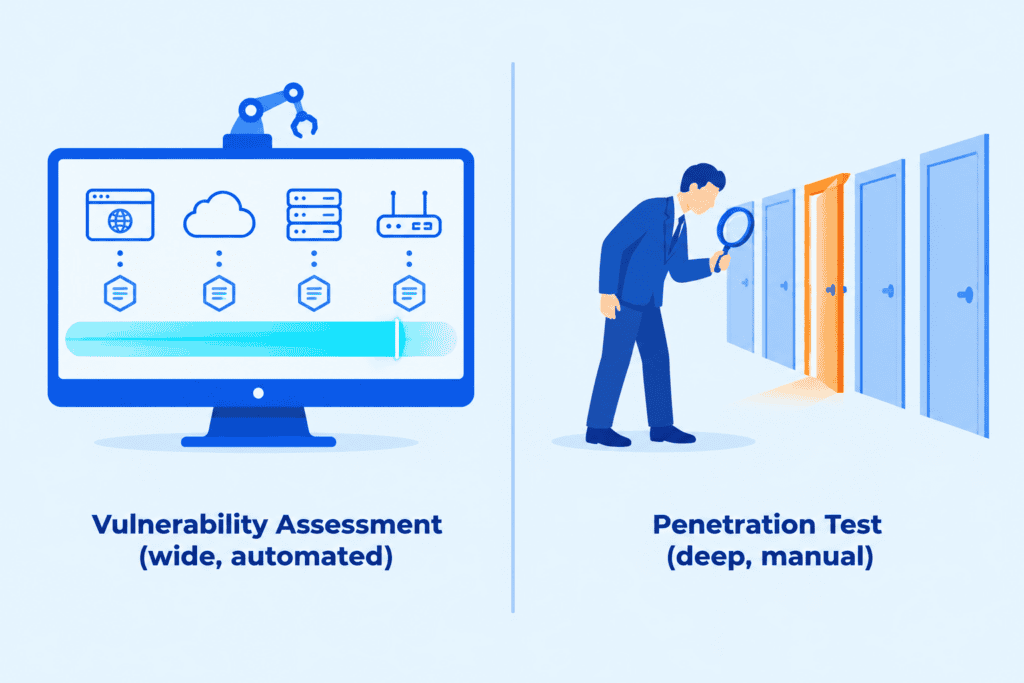
VAPT stands for Vulnerability Assessment and Penetration Testing, two security services offered together. The assessment is a wide, automated scan that lists known weaknesses across your apps, cloud, and network. The penetration test is a deep, manual check where a security expert proves which of those weaknesses a real attacker could exploit. The scan tells you what to look at; the test tells you what to worry about.
Why run VAPT continuously instead of once a year?
A single annual test is accurate only on the day it runs. Your systems change constantly, so new weaknesses appear in the months afterward when nobody is looking, and that gap is where most breaches start. Running VAPT as an ongoing program keeps checking in between, the way ISO 27001 expects security to be handled all year.
Who needs VAPT, and does it help with ISO 27001 or SOC 2 compliance?
VAPT suits any company that holds sensitive data or faces an ISO 27001, SOC 2, or PCI DSS deadline. It produces the testing evidence these frameworks expect, from ISO 27001 controls A.8.8 and A.8.29 to SOC 2 Type 2 and the scan schedule in PCI DSS. It will not make you compliant on its own, but it closes the testing requirement and keeps that evidence current. The value is highest for teams that must prove it without a dedicated security team.
Can a vulnerability scanner alone replace VAPT?
No. The scanner is doing the assessment side, and only that. It can flag something as possibly weak, but it cannot show whether an attacker could actually use it. Worse, a lot of problems tend to slip past it, like a broken access rule or logic gone sideways, the sort of thing you need a person to notice. Noticing it is the penetration test’s job.
What VAPT Actually Is
Think of VAPT as two questions asked back to back about the same systems.
The first is “where might we be exposed?” A vulnerability assessment goes looking with automated scanners. They crawl everything an outsider could reach (your web apps and APIs, the servers behind them, the cloud accounts, the network) and check it all against big databases of known flaws and dangerous settings. They move fast and cover a ton of ground. Judgment, though, is not really their thing. A scanner can tell you a door looks unlocked. It cannot tell you whether anything worth stealing sits on the other side, or whether that room has stood empty for years.
The second question is “what can an attacker actually do?” A penetration test answers that one by putting a real person on it. A tester takes the weaknesses that matter, tries to exploit them for real, and chains small issues together the way an intruder would to see how far the damage reaches. This is where business-logic and access-control mistakes surface, the kind a scanner reads straight past.
Run one without the other and you see half the picture. A scan with no human validation buries your team in alerts that may or may not be real. A lone manual test, filed and forgotten, is accurate the day it is written and stale by the next release.
A real VAPT program is the two halves working together, and it earns its value only when it runs continuously. Your attack surface shifts every week as you ship code, change a cloud setting, or add a vendor, so testing it once leaves the rest of the year unwatched.
Which Compliance Gaps VAPT Closes
VAPT will not hand you a certificate. Every framework covers far more than testing, from written policies to access control to how you vet suppliers. What VAPT does is close the testing requirements inside those frameworks and produce the evidence an auditor samples, kept current between visits.
ISO 27001 is the clearest fit, because the standard is built to run all year. It defines an Information Security Management System (ISMS), a documented way of managing risk continuously rather than at a single moment. Two of its Annex A controls map straight onto VAPT: A.8.8, management of technical vulnerabilities, which expects you to find, rank, and fix weaknesses on a schedule and re-check after each fix; and A.8.29, security testing while software is being built and before it ships. The ongoing scan-and-test record also feeds the management-review and improvement clauses, where auditors look for proof the posture is watched over time. ISO sets no fixed testing frequency, so the cadence comes from your own risk assessment. CYBRI’s ISO 27001 penetration testing page shows how this maps in practice.
SOC 2 works the same way for a different audience. A Type 2 report asks the harder question: did your controls operate across the full observation window, often several months, or only on the day someone happened to look? Auditors pull their evidence from across that whole span. An ongoing VAPT trail shows them a control that held up the entire time. A report produced the week before the auditor arrives only speaks for that week, and since they sample evidence from across the whole period, the gap is easy to spot.
For card data, PCI DSS sets the schedule for you. The external scans go to an Approved Scanning Vendor (ASV), one every quarter. The deeper penetration test only has to happen once a year. Then any significant change triggers another round. HIPAA stays risk-based, with a proposed update that would add fixed intervals still pending.
Then there is the pressure no regulation imposes. Enterprise customers and cyber insurers ask for proof of independent, human-led testing, and a reviewer can tell a scanner export from a real pentest. For a small company, that questionnaire is often the deadline that forces the purchase.
| Framework | What it asks for | What VAPT closes | What it does not cover |
| ISO 27001:2022 | Ongoing, risk-based vulnerability management, security testing, and posture reviews | Controls A.8.8 and A.8.29; feeds the Clause 9 and 10 evidence | Policies, access control, HR and supplier security, physical controls |
| SOC 2 Type 2 | Controls operating across an observation window; ongoing evaluations (CC4.1) | CC4.1 and CC7.1 testing evidence across the window | The rest of the control environment |
| PCI DSS v4.0.1 | Annual penetration test (11.4) plus quarterly ASV scans (11.3.2) | Both testing requirements directly | Encryption, logging, access control, and more |
| Enterprise and insurer reviews | Proof of independent, human-led testing | The report buyers and insurers accept | n/a |
What You’re Trying to Achieve
Most security spending gets sold on fear. For a growing company, the stronger reason to buy VAPT is growth. A prospect’s security questionnaire normally means a month of back-and-forth, but with a current, independent report already in hand, you answer it the same day. And in the middle of a live deal, sales can tell the buyer exactly what they want to hear: “independently tested, monitored year-round.” More often than not, that is what gets the budget approved.
With a specialist handling the testing and triage, each ISO 27001 or SOC 2 audit stops costing you a frantic week of prep. You also stop guessing. A ranked list says what to fix first, which is usually how a flaw gets closed while it is still minor instead of after it has become a breach you have to report. Cost settles down as well, landing in the budget as a predictable line rather than a nasty surprise at renewal. Founders notice deals closing quicker. The IT lead notices the work is no longer theirs. Finance finally has a number it can plan against. Not many security purchases cover all three.
Who This Is For: Small Engineering and Development Teams
The companies that get the most from VAPT tend to look alike. They run real software, hold data that matters, and face security questionnaires and an audit, but security rests on a small team: a lone security hire, or a couple of IT generalists who picked it up alongside the help desk and the servers. They know what needs doing. They simply do not have the hours or the specialist depth to run continuous testing, exploit the serious findings by hand, and keep the evidence current while everything else still demands attention. Not to mention, this type of experience requires years to build.
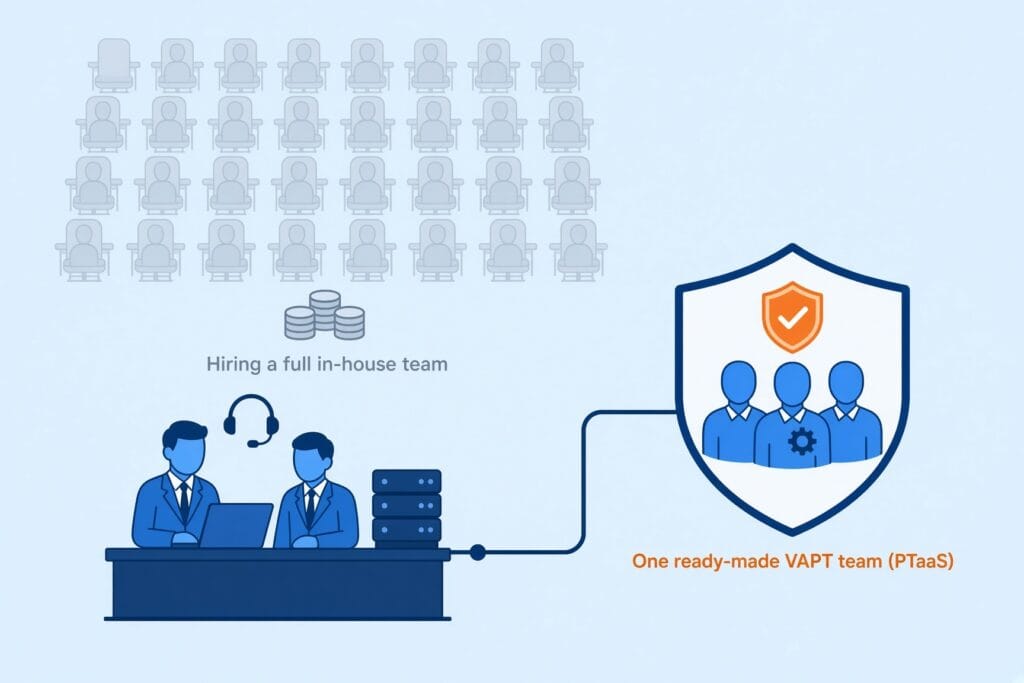
Bringing in a provider extends that team instead of replacing it. An ongoing VAPT program gives a small company the same caliber of testing a large enterprise runs in-house, without paying for a full security department. The provider owns the ongoing scanning, testing, triage, and reporting, and the internal team gets findings worth acting on and its time back.
Goals and Objectives of a VAPT Program
The goals are the outcomes you are paying for. The objectives are the concrete work the program does to reach them. Keeping the two tied together is what makes a program worth the spend: every activity should trace back to a result the business cares about.
| Goal (business outcome) | Objective (what the program does) |
| Permanent visibility into your attack surface | Continuous vulnerability assessment across apps, cloud, and network, backed by a live inventory of what is exposed |
| Separate real risk from noise | Human penetration testing confirms and exploits the high-risk findings, filtering false alarms before they reach your team |
| Stay audit-ready all year | Scans, tests, remediation, and retests recorded continuously and mapped to ISO 27001 and SOC 2 controls |
| Fix the right things first | Findings scored with CVSS (the standard 0 to 10 severity scale) and ranked by business impact, with fix guidance and a retest to confirm closure |
| Shrink the window of exposure | New weaknesses caught as releases ship and vulnerabilities are disclosed, not twelve months later |
| Extend the internal team | The provider owns testing, triage, and reporting so a small staff is not the bottleneck |
| Prove security to customers and insurers | A current, independent report ready for questionnaires, RFPs, and renewals |
VAPT vs a One-Off Penetration Test
A one-off penetration test is a photograph. It captures how your systems looked the moment the tester logged off, and nothing after. Security behaves more like a movie: every release, cloud change, new integration, and freshly disclosed flaw redraws the picture. Book another test a year later and it is looking at a system that barely matches the one in last year’s report. That is the real difference between the two. A one-off test shows where you stood on a single day; VAPT, run as an ongoing program, keeps showing where you stand as the picture changes.
Attackers live in the gap between one-off tests. Ship a weakness the week after a test and it sits wide open until the next one, maybe a year out. A fresh flaw in software you already run? That is fair game the day it goes public. The risky stretch was never the week you got tested. It is the eleven months afterward, when a point-in-time test has nothing to say.
For a small team the gap is wider still. A large company keeps people whose entire job is to watch the attack surface. On a team of one, that is much harder. An overloaded IT lead rarely catches the API that shipped on Friday without a security review, or the scanner alert that has been red for a month.
That is what a VAPT program changes. Instead of one test and a long silence after it, a scanner runs the whole time, testers come through on a rhythm that fits how the business moves, and whatever they surface lands somewhere the team will open, not buried in a tool nobody checks. A one-off test answers “were we secure that week?” VAPT answers “are we secure now?” and keeps answering as things change. That running answer is what permanent visibility means.
VA vs PT, Shown Not Told: an OWASP Example
The clearest way to see why the penetration-testing half matters is an example the whole industry agrees on.
OWASP, the Open Worldwide Application Security Project, is a nonprofit, and its lists and guides are the yardstick the whole field measures against, with no vendor’s thumb on the scale. The one everybody knows is the OWASP Top 10, a ranking of the nastiest web application risks. One risk has owned the number one slot for years running: broken access control. In practice, that is a user getting hold of data, or triggering actions, that were never meant to be theirs.
Imagine one of your clients signs in with a read-only account. It is meant to show them their own records and nothing further. Then they change a single value in a web request, and that same read-only login is suddenly editing another customer’s data, or dumping the entire list of users. By a scanner’s definition, nothing here is broken. The login works, the software is patched, no known vulnerability is present. The real flaw sits in the logic of who is allowed to do what, and a scanner has no way to reason about that. A human tester does, by trying the action and watching it succeed.
How the Program Runs
Here is what an ongoing VAPT program looks like in practice, month to month.
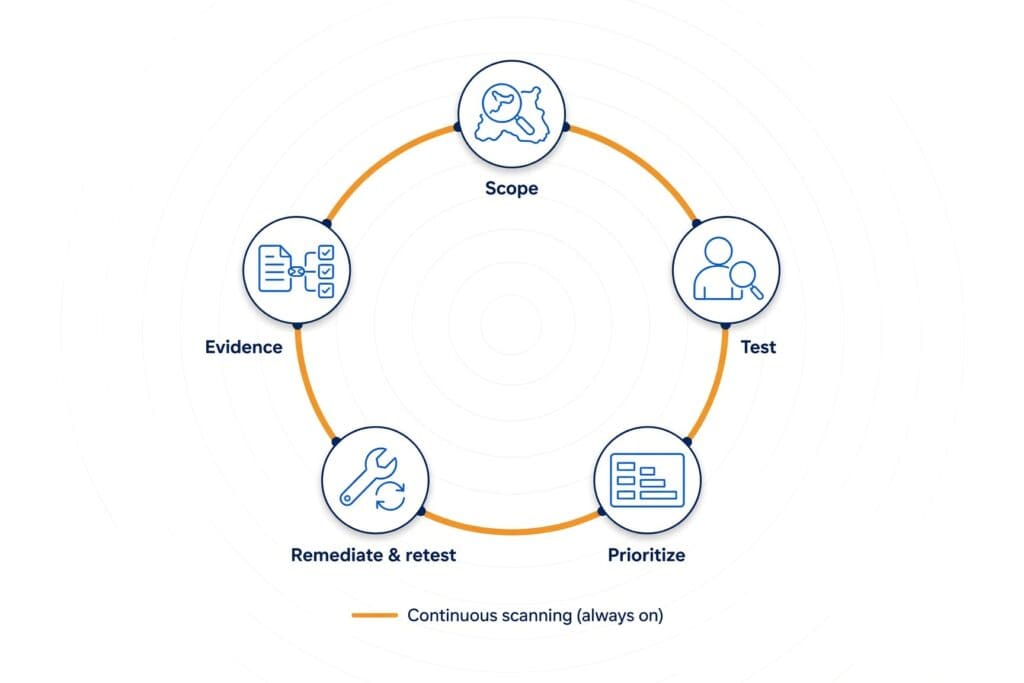
- Scoping. The provider maps what you expose, from apps and APIs to cloud accounts and network, and refreshes that map each cycle as you add features and services.
- Continuous scanning. A scanner runs the whole time, watching for known weaknesses and new exposures the moment they appear.
- Human testing on a cadence. At a set interval, a tester goes deep on the areas that matter, exploiting and chaining findings the way an attacker would.
- One place for findings. Everything lands in a single platform (CYBRI uses Blue Box), scored by severity and ranked by business impact, so the team sees a short list of what to fix first rather than a scanner’s raw output.
- Remediation and retest. Each finding comes with fix guidance and a window to resolve it, then the tester re-checks to confirm the fix held.
- Evidence, mapped. The record of scans, tests, fixes, and retests ties back to the controls your framework cares about, ready for the auditor.
Anything critical is flagged the same day, through the channel your team already uses, rather than held for the next report. A major release or architecture change can also trigger an extra test on the spot, because a big change is exactly when new risk slips in, and testing after significant change is what both PCI DSS and ISO 27001 expect.
Methodology and Standards
For a non-specialist, the credibility of a test comes from it following recognized public standards rather than a provider’s private checklist.
Each engagement follows the structure in NIST SP 800-115, the US National Institute of Standards and Technology’s guide to security testing, which breaks a test into planning, discovery, attack, and reporting. The testing itself works from OWASP’s public catalogs: the Web Security Testing Guide (WSTG) and Application Security Verification Standard (ASVS) for web apps, and the API Security Top 10 for APIs. Findings are scored with CVSS, so a “high” in one cycle means the same as a “high” in the next.
On the tooling side, a tester typically uses Burp Suite Professional to intercept and replay traffic, plus custom scripts that repeat requests across different user roles and account IDs, the checks that surface the access-control flaws from earlier.
Every finding is tied to the specific control your framework names, so the report doubles as audit evidence.
A short scoping call is enough to size your attack surface and set the first cycle in motion. Talk to CYBRI to plan your VAPT program.
Frequently Asked Questions
How much does a VAPT program cost?
Cost depends on scope: how many apps, APIs, and cloud environments are in play, how many user roles exist, and how often the manual tests run. A small single-app program sits at the low end, while a multi-system program with frequent testing costs more. See CYBRI’s pricing page for current ranges.
How often should VAPT penetration tests be done?
There is no single required interval; the right frequency comes from your own risk. A common baseline is a manual test once or twice a year with scanning running continuously in between, moving toward quarterly for frequent releases or sensitive data. CYBRI’s guide to continuous penetration testing covers how to choose a cadence.
Does VAPT replace tools like our firewall or antivirus?
They do different jobs. A firewall and antivirus defend the system day to day, while VAPT checks whether that defense holds against a real attacker. The two work together rather than replace each other.
Start With Permanent Visibility
You can’t secure what you can’t see, and no small team can watch everything by hand. A VAPT program puts year-round visibility and audit-ready evidence in place without a security hire. Book a scoping call, and CYBRI will map your attack surface and recommend a cadence that fits your release pace and next audit.