You’re a financial institution that wants to figure out what penetration testing means for you? As you’re probably already thinking, financial institution is a fairly broad term. So naturally, what it means for you depends on your type of financial institution.
So in the interest of keeping things easy to understand, let’s start with a summary. Below, we list some common financial institutions, and briefly describe penetration testing requirements / expectations for each.
- Community banks and credit unions under $10B in assets. GLBA safeguards plus FFIEC examination expectations. Annual internal and external testing is the practical floor, and core provider dependencies usually dominate the scoping conversation.
- Regional and national banks. A layered program. Annual full scope testing, targeted testing on major releases, and periodic red team work that proves detection actually fires.
- Credit unions specifically. NCUA Part 748 requires an information security program built on the same GLBA foundation. Examiners look for independent testing proportional to risk.
- Insurance carriers, brokers, and agencies. NYDFS Part 500 if you hold a New York license, plus the NAIC Insurance Data Security Model Law in states that adopted it.
- Broker dealers, RIAs, and asset managers. Regulation S-P safeguards, FINRA supervisory expectations, and SOX IT general controls if the firm trades publicly.
- Non bank lenders, mortgage servicers, and consumer finance. The FTC Safeguards Rule applies directly. Annual penetration testing is required unless effective continuous monitoring is already in place.
- Payment processors and anyone touching card data. PCI DSS Requirement 11.4 on top of everything else, including segmentation testing every six months for service providers.
- Institutions with EU operations. DORA has applied since January 2025. If a competent authority designates you as significant, threat led penetration testing every three years comes with it.
Conclude the introductory section by outlining the value the article that follows will provide.
What Counts as a Financial Institution for Security Testing Purposes
Under the Gramm-Leach-Bliley Act, the term ‘financial institution’ covers mortgage brokers, auto dealers who arrange financing, tax preparers, check cashers, debt collectors, and more. If your business does fall under the definition of a financial institution then it’s important to know who you answer to.
We cover different institution types and their responsibilities below.
Depository institutions: banks, credit unions, and thrifts
Banks and thrifts answer to the OCC, the FDIC, or the Federal Reserve depending on charter, and credit unions answer to the NCUA. All of these institutions are subject to THE GLBA Safeguards Rule, which requires them to build and maintain a written information security program. Naturally, auditors will ask for independent security testing evidence. In fact, under the revised FTC Safeguards Rule, security testing is a mandatory regulatory requirement.
Insurance carriers, brokers, and agencies
Here there are both national and local level compliance requirements. For example, if your institution holds a New York licence then you must be 23 NYCRR Part 500 compliant, which names penetration testing as a requirement. Similarly, the NAIC Insurance Data Security Model Law is a compliance requirement in the states that have adopted it. Elsewhere (in the EU for example) DORA is a requirement and is the most comprehensive equivalent to 23 NYCRR Part 500 in that part of the world.
Broker dealers, investment advisers, and asset managers
The SEC and FINRA don’t publish a testing calendar, but they do expect you to safeguard customer records, detect incidents, and to show proof of having done so. In the case of brokers, advisers and asset managers there’s Regulation S-P. The SEC rule requires financial firms to protect non-public personal information. For publicly traded firms there are SOX IT general controls to consider as well.
Non bank lenders, mortgage servicers, and consumer finance companies
The FTC Safeguards Rule covers this group of institutions and requires them to build and maintain a written security program. Auditors will check for a named qualified individual in charge and a written security plan, as well as technical controls and operational and vendor oversight.
Payment processors, money transmitters, and fintech platforms
If your institution deals with card data then there’s PCI DSS to bring into consideration. Organizations dealing with money transmissions are subject to state licensing conditions. If that includes a partnership with a bank then there’ll be their own rules to consider on top.
How often testing is required will differ here too. For example, fintech platforms carry a different testing profile from a chartered bank, as their release cadence changes the attack surface every few weeks.
Across all five groups the same pattern holds. Your regulator sets the baseline obligation. Your architecture sets the scope. The rest of this guide follows that split, starting with why the sector attracts so much attention in the first place.
We’ve covered five different groups of financial institutions. The one thing they all have in common is a regulator who’ll set their security baseline requirements.
Why Attackers Prioritize Financial Institutions
IBM’s 2026 Cost of a Data Breach Report put the average financial services breach at $6.29 million. That figure sits 26 percent above the $4.99 million global average and ranks second among the seventeen industries studied, only behind healthcare. It also climbed 12 percent in a single year, so the gap keeps widening rather than closing.
Across all financial sectors, organizations averaged 247 days to identify and contain a breach, reversing several years of gradual improvement. Attackers have moved faster every year and detection has not kept pace.
AI enabled attacks rose 56 percent year over year and now account for more than one in four malicious breaches. Phishing held its position as the leading initial access vector for a fourth consecutive year, with supply chain compromise and social engineering close behind. Help desk impersonation and repeated push notifications sit alongside classic credential phishing now, and both target people rather than systems.
So now that we’ve covered the stats, why are all these numbers rising? It’s simple, financial institutions pay out faster and offer more value than most others. For example, a compromised wire operator workstation converts to cash within hours. On the other hand, if there’s a breach of customer files, their identity data retains resale value for years.
So with the reward for a successful breach being so high, it’s easy to see why hackers are so attracted to financial institutions. It also explains why regulators wrote testing into rule instead of leaving it to professional judgement.
As you may have guessed by now, testing is more than a nice to have. Now that you know you need it, it’s important to get a few distinctions right, so that you’re properly covered.
Penetration Testing, Vulnerability Scanning, and Red Teaming Are Not the Same Thing
These terms get used interchangeably, but doing so is a trap. It’s important to use them the same way that regulators do.
Pentesting, vulnerability scanning and red teaming are three different activities.
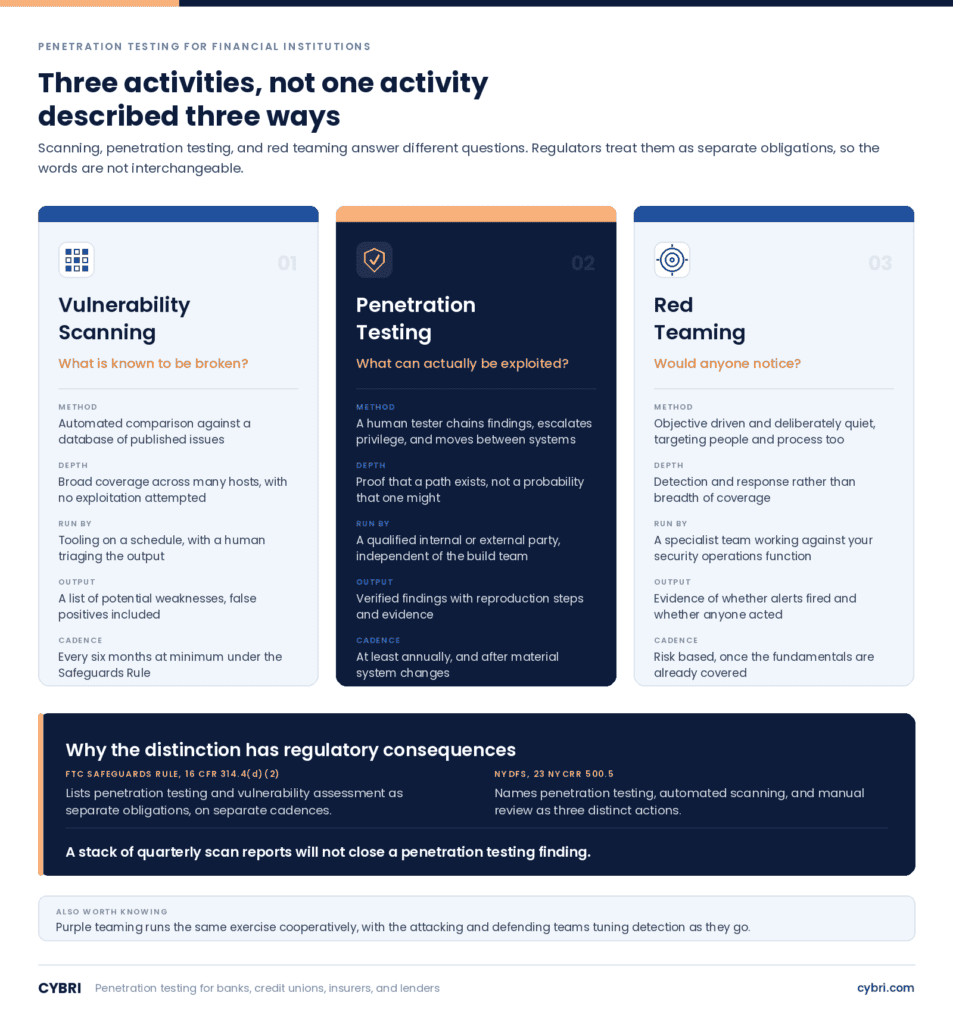
A vulnerability scan compares what it finds against a database of known issues. It covers a lot of ground quickly, it runs on a schedule, and it produces false positives that someone has to triage. What it can’t do is prove that a finding matters in your environment.
A penetration test picks up where the scan stops. A human tester chains findings together, escalates privileges, moves between systems, and demonstrates the path an attacker would take. The output includes proof, not probability. That proof is what turns a theoretical risk into a funded remediation ticket.
To completely understand the distinction between the two, you may read our comprehensive guide on Penetration Testing vs Vulnerability Scanning.
Red teaming asks a completely different question. Instead of testing what’s broken, a red team sets specific objectives, stays covert and treats your security operations team as part of the target.
Red teaming changes the question entirely. Instead of asking what’s broken, it asks whether anyone notices. A red team works toward specific objectives, stays quiet, and treats your security operations team as part of the target.
Purple teaming goes a step further and essentially runs the same exercise cooperatively i.e., the attacking (red team) and defending (your security operations) teams work in the open, tuning detection rules as they go. Institutions building out a security operations function often get more value from purple work than from a covert engagement.
As you continue reading, keep penetration testing, vulnerability scanning, red teaming and purple teaming in mind. We’re covering regulatory requirements next, for which each framework specifies which testing type it wants.
The Regulations That Drive Testing Requirements
Most institutions sit under three or four frameworks simultaneously. A community bank taking card payments answers to GLBA, FFIEC examiners, and PCI DSS at once. Add a New York license and Part 500 joins the list. Add an EU subsidiary and DORA does too.
The practical goal isn’t four separate engagements. It’s one testing calendar that satisfies all of them, which becomes possible once you can see where the requirements overlap.
The table below maps the seven frameworks most financial institutions run into, along with the specific citation each one rests on
| Framework | Who it reaches | What it specifically requires | Cadence | Where it’s written |
|---|---|---|---|---|
| FTC Safeguards Rule (GLBA) | Non bank financial institutions: lenders, mortgage servicers, tax preparers, auto dealers arranging financing. Chartered institutions inherit parallel duties through interagency guidelines. | Either effective continuous monitoring, or penetration testing plus vulnerability assessments. Additional assessments after material changes to operations. | Annual test, vulnerability assessments every 6 months | 16 CFR 314.4(d)(2) |
| FFIEC examination guidance | Banks, thrifts, and credit unions supervised by the OCC, FDIC, Federal Reserve, or NCUA. | Independent testing proportional to risk. No prescribed method. The Cybersecurity Assessment Tool was withdrawn, so institutions self assess against NIST CSF 2.0, the CRI Profile, CISA CPGs, or CIS Controls. | Not specified. Annual in practice for most | FFIEC CAT Sunset Statement; OCC Bulletin 2024-25 |
| NYDFS Part 500 | Any entity holding a New York DFS license, including banks, insurers, agencies, and mortgage servicers. | Testing from both inside and outside system boundaries by a qualified internal or external party. Automated scans plus manual review of whatever the scans miss. Risk prioritized remediation. | Annual test. Scan frequency set by risk assessment and after material changes | 23 NYCRR 500.5 |
| PCI DSS 4.0.1 | Anyone who stores, processes, or transmits cardholder data, plus their service providers. | Documented methodology, internal and external testing, remediation with retest, and validation that segmentation genuinely isolates the card data environment. | Annual for testing and merchant segmentation. Every 6 months for service provider segmentation | Requirements 11.4.1 through 11.4.7 |
| SEC, FINRA, and NCUA | Broker dealers, investment advisers, asset managers, and federally insured credit unions. | Safeguarding of customer records, incident response capability, and an information security program sized to the institution. Testing is the evidence, not the rule. | Not specified | Regulation S-P; NCUA Part 748 |
| DORA | EU financial entities, and US institutions with EU subsidiaries or EU regulated operations. | Threat led penetration testing for designated significant entities, built on TIBER-EU. External threat intelligence provider required, external red team on every third test, mandatory purple teaming at closure. Others still owe resilience testing. | Every 3 years for designated entities | DORA Articles 26 and 27 |
| SWIFT Customer Security Programme | Any institution connected to the SWIFT network. | Testing scoped explicitly to the secure zone, operator workstations, and connectors. A general corporate test that excludes them doesn’t address the control. | Scenarios covered across a 3 year cycle. Attestation annually | CSCF v2026, Control 7.3A (advisory) |
Each framework deserves a closer look, since a citation tells you what to produce without telling you how much work it represents.
GLBA and the FTC Safeguards Rule
Section 314.4(d)(2) gives you two compliant paths. Either you run effective continuous monitoring that detects changes to your information systems on an ongoing basis, or you run annual penetration testing plus vulnerability assessments at least every six months. Material changes to your operations or business arrangements trigger additional assessments either way.
FFIEC guidance and the Cybersecurity Assessment Tool sunset
The FFIEC removed the Cybersecurity Assessment Tool from its website on August 31, 2025. No FFIEC rule names a testing frequency. Examiners expect independent testing proportional to your risk profile, which in practice reads as annual for most institutions and more often for complex ones.
In place of the CAT, the FFIEC pointed institutions toward NIST CSF 2.0, the Cyber Risk Institute Profile, CISA’s Cybersecurity Performance Goals, and the CIS Controls. Only the CRI Profile was built specifically for financial institutions, which makes it the cleanest mapping for most teams.
NYDFS 23 NYCRR Part 500
Section 500.5 states that covered entities must conduct penetration testing from both inside and outside their information systems’ boundaries, by a qualified internal or external party at least annually. In addition, the same section requires automated scans plus manual review of anything those scans don’t cover, at a frequency your risk assessment determines and promptly after material system changes. Finally, remediation has to happen on a timely basis, prioritized by the risk each vulnerability poses to the entity.
PCI DSS 4.0.1 for card data environments
Like we’ve mentioned earlier on, card data environments come with their own rulebook layered on top of whatever your prudential regulator wants. Requirement 11.4.1 asks for a documented methodology. Requirements 11.4.2 and 11.4.3 cover internal and external testing, both at least every twelve months and after significant changes. Requirement 11.4.4 requires remediation followed by a retest.
Segmentation gets its own treatment. Requirement 11.4.5 calls for validation at least every twelve months, and 11.4.6 tightens that to every six months for service providers. Multi tenant providers also have to support customer testing under 11.4.7.
SEC, FINRA, and NCUA expectations
Credit unions operate under NCUA Part 748, which requires an information security program resting on the same GLBA foundation. Broker dealers and investment advisers face Regulation S-P safeguards along with incident response obligations. Publicly traded institutions carry SOX IT general controls and cybersecurity disclosure duties on top of everything else.
DORA and threat led penetration testing
DORA has applied across the European Union since January 17, 2025. It matters to US institutions with EU subsidiaries, EU regulated operations, or European counterparties who now ask about it during diligence.
Articles 26 and 27 require threat led penetration testing at least every three years for entities their competent authority designates as significant. TLPT builds on the TIBER-EU framework and runs considerably heavier than a standard engagement. The threat intelligence provider always has to sit outside your organization, every third test requires an external red team, and purple teaming is mandatory during the closure phase. Entities that escape designation still owe resilience testing and vulnerability assessments, so DORA isn’t purely a problem for the largest banks.
SWIFT Customer Security Programme
Control 7.3A covers penetration testing within the Customer Security Controls Framework and remains advisory in version 2026. SWIFT guidance sets out testing scenarios expected to be covered across a three year cycle.
One trap catches institutions repeatedly. A general corporate penetration test that excludes the SWIFT secure zone doesn’t address this control. The secure zone, the operator workstations, and the connectors all have to appear in the scope explicitly. Annual attestation runs through KYC-SA, with independent assessment of the mandatory controls.
Overall, the frameworks we’ve shared above share a common theme, being an annual internal and external test, segmentation validation on the right cadence, documented remediation, and a completed retest satisfies the core of GLBA, NYDFS, and PCI at the same time.
For testing that successfully passes your audit cycle, it’s better to plan ahead then react as the deadline for each framework draws too close.
What Belongs in Scope
Scoping is perhaps the most most costly part of security testing and institutions often make the mistake of scoping for an asset type rather than scoping for what can be exposed.
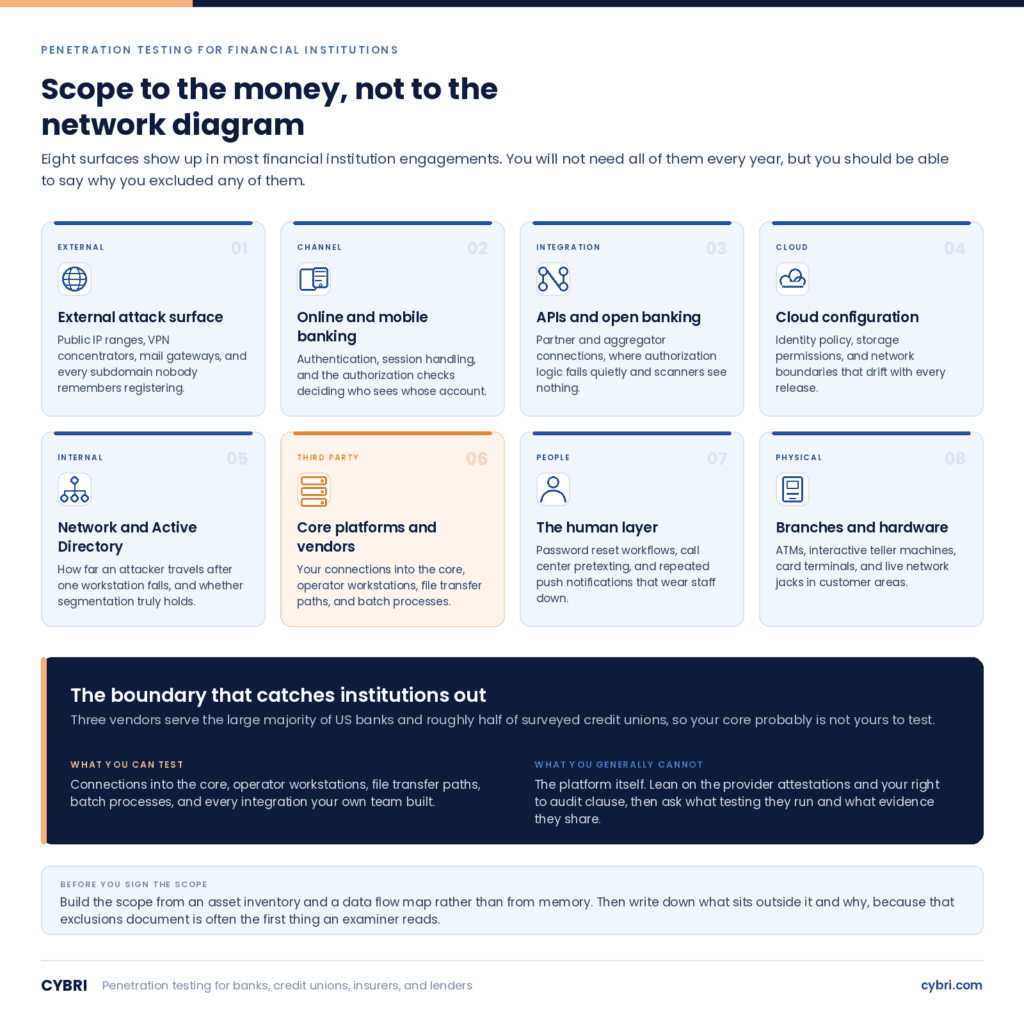
Below, we go over the eight most common attack surfaces that show up for financial institutions, and what you should scope for.
Internet facing infrastructure and the external attack surface
Internet facing infrastructure includes your public IP ranges, VPN concentrator, mail gateway, remote access appliances etc. These are the assets a stranger can reach and should be tested first. Here an external pentest will surface findings fastest.
Web and mobile applications banking channels
Your applications carry the authentication logic, the session handling, and the authorization checks that decide who sees whose account. Mobile apps add client side storage and certificate handling to that list. Both should be tested individually.
APIs, open banking, and partner integrations
Every partner integration, aggregator connection, and data sharing agreement widens the attack surface. When it comes to APIs, most flaws are hidden in authorization logic rather than the infrastructure itself. For example, an endpoint that returns the right data to the wrong customers won’t register on a network scan.
Cloud environments and security configuration
Identity policy, storage permissions, and network boundaries do most of the security work in a cloud tenancy, and all three drift as engineers ship changes. Institutions running workloads spread across more than one cloud provider carry the added problem of controls that behave differently on each platform.
Internal network, Active Directory, and segmentation
Assume one workstation falls. How far does the attacker travel? That question drives internal testing, and the answer routinely disappoints. Legacy Active Directory configurations, cached credentials, and flat network design turn a single phishing click into access to the payment environment.
Core banking platforms and third party providers
Three vendors serve the large majority of US banks and roughly half of surveyed credit unions, which means your core probably isn’t yours to test. You generally can’t point testers at a platform you don’t own, and your contract may forbid it outright.
What you can test is everything on your side of the boundary. The connections into the core, the operator workstations, the file transfer paths, the batch processes, and the integrations your own team built all belong in scope. For the platform itself, lean on the provider’s attestations and your right to audit clause. Ask what testing they perform, how often, and what evidence they’ll share with you.
The human layer
Staff and help desk workflows fail in ways technology doesn’t. Pretexting a password reset, walking a call center agent through a bypass, or wearing an employee down with repeated push notifications all work often enough to keep attackers using them. Deciding whether social engineering belongs inside the engagement really comes down to whether you’re prepared to act on an uncomfortable result.
Physical and hardware surfaces
Branches, ATMs, and interactive teller machines occupy physical space that anyone can walk up to. Card terminals and live network jacks in customer areas create paths that no amount of perimeter hardening addresses. Institutions with a branch footprint should test at least a sample.
Build the scope from an asset inventory and a data flow map. Then, write down what sits outside the scope and why. That exclusion document often becomes the first thing an examiner reads, and a thin justification invites exactly the questions you’d rather avoid.
Choosing the Right Type of Engagement
Once the scope is clear, you have to decide what kind of engagement covers it. The options overlap enough to muddy any vendor conversation, so the table below separates them by what each one actually proves rather than by what it covers.
Engagement types compared
| Engagement type | What it actually validates | Typical trigger | Best fit institution |
|---|---|---|---|
| External network pen- test | Whether the perimeter can be crossed from the open internet without credentials | Annual cycle, new internet facing service | Every institution, without exception |
| Internal network pen- test | How far an attacker travels after one workstation falls | Annual cycle, post core conversion | Institutions with branch networks and legacy Active Directory |
| Web application pen-test | Authentication, authorization, and session handling in the digital banking channel | Major release, new platform | Anyone running online banking or a customer portal |
| Mobile application pen-test | Client side storage, certificate handling, and the API calls behind the app | App rewrite, new mobile vendor | Retail banks, credit unions, consumer lenders |
| API and open banking pen-test | Object level authorization and rate limiting across partner integrations | New fintech partner, new data sharing agreement | Institutions exposing APIs to partners or aggregators |
| Cloud configuration review | Identity policy, storage exposure, and network boundaries in the tenancy | Cloud migration, new workload | Institutions running workloads in AWS, Azure, or GCP |
| Segmentation test (PCI) | Whether the card data environment is genuinely isolated | Every 12 months, or every 6 for service providers | Anyone in scope for PCI DSS |
| Social engineering | Whether staff and help desk workflows resist pretexting and phishing | Annual, after awareness training changes | Institutions with call centers and branch staff |
| Red team exercise | Whether detection and response fire before objectives are reached | After the basics are already covered | Regionals and larger, with a functioning security operations team |
| Threat led penetration testing | Resilience against intelligence modeled adversaries, under regulator supervision | Designation by a competent authority | EU designated significant entities |
| Continuous testing | Whether exposure stays closed between annual engagements | Frequent releases, changing attack surface | Institutions shipping continuously or pursuing the monitoring path under the Safeguards Rule |
Few institutions will need every test type above. Cover the fundamentals first and sequence your tests over a time period instead of conducting them all at once. That way, you won’t burn your security budget immediately.
How Often Financial Institutions Should Test
There’s two questions you should answer, being: What does regulatory compliance require? And, what sort of cadence does your own risk profile call for?
The answer usually results in an at least annual pentesting. Specific segments like card service providers add testing every six months. Institutions relying on the Safeguards Rule without continuous monitoring add vulnerability assessments every six months on top of the annual test.
Certain events should pull a test forward regardless of where you sit in the calendar:
- A core conversion or a major upgrade to the digital banking platform
- A merger, an acquisition, or the integration of an acquired institution
- Joining a new payment rail such as FedNow or RTP
- Adding new features and functionalities to your existing web and mobile applications
- A cloud migration, or moving a significant workload between providers
- Onboarding a fintech partner or opening a new API integration
- Any material change to segmentation controls
Each of those changes the environment enough that last year’s report no longer describes it. When you’re settling on a defensible testing frequency, tie it to your risk assessment rather.
Worth noting, the Safeguards Rule treats effective continuous monitoring as an alternative to the annual test. Institutions shipping code frequently often find that continuous testing keeps pace with a changing environment in a way a point in time engagement never manages.
In any case, write down the reasoning for your testing cadence whichever cadence you land on. Examiners will rarely argue with a frequency you can justify against your own risk assessment.
How a Financial Institution Penetration Test Actually Runs
The mechanics behind a pentest will look fairly similar across different industries. In the financial services section, it’s the amount of care required around production systems, payment windows, and customer data that changes.
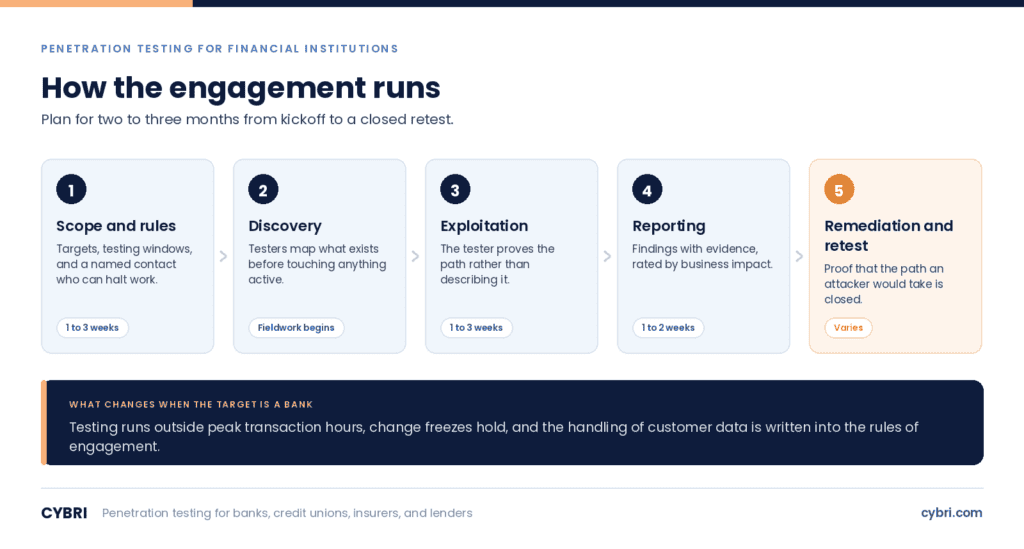
For financial institutions running a pentest of their assets, there are 5 main phases that cover an engagement.
Scoping and rules of engagement
Here you’ll determine testing targets, windows, permitted techniques, escalation thresholds, whether your security team will be aware of the engagement, and a named contact who will own the engagement. This all happens before anyone touches your systems.
Reconnaissance and discovery
When the testing actually begins, testers map what exists before attacking anything. That includes domain records, exposed services, employee information, and technology fingerprints. This is also a good way of reminding your institution of all the assets you own.
Exploitation and lateral movement
Next, active work gets scheduled outside peak transaction hours, and change freeze windows get respected without exception. The phases a tester works through follow a documented sequence for good reason, because uncontrolled testing against a production core creates a risk nobody needs to take.
Reporting and risk rating
Findings should arrive with reproduction steps, supporting evidence, and a rating tied to business impact rather than raw scanner severity. Any nonpublic personal information encountered along the way has to be handled, stored, and destroyed under terms written into the engagement agreement, not agreed on a call.
Remediation and retest
Fixing the finding covers half the job, and proving the fix worked covers the other half. That’s where retestnig comes in. An unresolved critical finding reads as an open finding in the reports, and retesting without paying for a second full engagement usually comes down to including it into the original scope rather than rescoping it later.
What Examiners and Auditors Expect From the Report
Examiners rarely dispute the findings themselves. Instead, they’ll dispute whether anything happened afterward (like remediation and retesting).
A complete evidence package holds the approved scope with signed rules of engagement, tester qualifications and evidence of independence, the methodology named explicitly, findings with risk ratings and reproduction detail, remediation results, and documented exceptions and risk acceptances.
It’s good to know what a complete report actually contains, as it’ll help you judge a provider’s sample report before you sign anything.
Findings That Recur in Financial Institution Environments
Certain problems appear so consistently that experienced testers half expect them before the kickoff call ends. They include:
- Segmentation that exists in the diagram but not in practice. A firewall rule added during a project three years ago quietly bridges two zones your documentation swears are isolated.
- Flat internal networks. One compromised workstation reaches the payment environment because nothing meaningful sits between them.
- Active Directory misconfiguration. Service accounts with excessive rights, stale delegation, and cached credentials shorten the path to domain privilege to a handful of steps.
- Help desk workflows that route around multi factor authentication. A convincing caller resets a password over the phone and the strongest authentication in the building stops mattering.
- Broken object level authorization. Change an account number in an API request and the response hands back somebody else’s statement.
- Third party remote access carrying more privilege than the contract implies. Vendor accounts accumulate rights over years and nobody reviews them until a tester does.
- Administrative interfaces on internet facing appliances. Management consoles that were never meant to face the public internet regularly do.
In addition, we should mention business logic problems like transfer limits, beneficiary changes and scheduled payments. The reason being, business logic flaws slip straight past scanners as nothing about them resembles a vulnerability signature.
What Penetration Testing Costs and How to Budget
We’ve written extensively on pentesting pricing, so we won’t repeat everything here (read out full guide). But here’s the short end of it.
Cost will vary depending on:
- The number of external IP ranges
- The count and complexity of your applications
- Whether internal testing requires someone onsite
- How much of the work is genuinely manual versus tool driven
- Whether a retest is included or billed separately
- Whether the report maps to the frameworks you report against
- Whether you’re buying a standard test or an intelligence led exercise
Four questions separate serious providers from resellers on a scoping call. How many days of testing does this include? Is the retest in scope? Who writes the report, and can I see a redacted sample? What happens if you find something critical on day two?
Now that we’ve covered pricing briefly, let’s discuss choosing a pentesting partner.
How to Evaluate a Penetration Testing Partner
Most providers describe themselves in nearly identical language, which makes building a shortlist harder than it should be. A handful of criteria separate them quickly once you know what to ask for.
Start with sector experience. Ask what they’ve tested in financial services specifically, and whether they’ve worked inside environments resembling yours. A team that has never scoped around a core provider will learn on your engagement.
Then look at who performs the work. Certifications, tenure, and demonstrable independence from your institution all matter, and NYDFS uses the phrase ’qualified internal or external party’ in a way examiners read seriously. Ask whether the people on the sales call will be the people doing the testing.
Methodology transparency comes next. A provider should walk you through their approach before you sign. Also, ask what percentage of the engagement involves hands-on work versus automated tooling.
Request a redacted sample report and read it the way your auditor will. Does it map findings to the frameworks you report against? Does it explain business impact? Get the retest policy in writing, and establish how critical findings reach you during the engagement. Anything serious should surface the day it’s discovered rather than in a PDF six weeks later. Confirm insurance and liability terms while you’re at it.
If you want a shortlist instead of a framework, read our guide on providers with a track record in financial technology.
Frequently Asked Questions
A few questions come up in almost every scoping conversation. Short answers below, with the caveats that matter.
Is penetration testing legally required for banks and credit unions?
Not by a single statute that uses the word. GLBA safeguards reach chartered institutions through interagency guidelines, and examiners expect independent testing proportional to your risk. Annual testing has become the accepted baseline for depository institutions as a result.
Does a vulnerability scan satisfy the GLBA testing requirement?
No. The Safeguards Rule lists penetration testing and vulnerability assessment as separate obligations with separate cadences. Unless you run effective continuous monitoring, you owe an annual penetration test plus vulnerability assessments at least every six months.
How often does a credit union need a penetration test?
NCUA Part 748 doesn’t set a frequency. It requires an information security program appropriate to your size and risk. Most credit unions test annually and add targeted testing after core conversions or major system changes.
Can our internal team perform the test, or does it have to be a third party?
NYDFS permits a qualified internal or external party. The practical constraint is independence. If the same team that built and maintains the environment also tests it, expect questions about objectivity during your exam.
Will penetration testing disrupt online banking or payment processing?
It shouldn’t, provided the rules of engagement set testing windows, respect change freezes, and name someone who can halt work immediately. Settle production safety during scoping rather than after the first alert fires.
What is the difference between a penetration test and a threat led penetration test?
A penetration test finds and proves exploitable weaknesses inside a defined scope. Threat led testing under DORA models a specific adversary using external intelligence, runs for months under regulator supervision, and tests detection and response as much as the controls.
How long does a financial institution penetration test take end to end?
Selecting a vendor, signing the agreements, taking care of payment and setting up access typically takes one to three weeks. Penetration testing runs one to four weeks depending on scope, reporting adds another one to two, and remediation with retests extend timeline further. Plan for two to three months from kickoff to a closed retest.
Do we need to test our core banking provider${APOS}s systems?
Generally you can’t, and your contract may prohibit it. Test everything on your side of the boundary, then use your right to audit clause to obtain the provider’s own testing evidence and attestations.
Anything not covered above usually turns on a detail specific to your environment, which is exactly what a scoping call exists to work out.
Where to Go From Here
You now have the frameworks, the scope, the cadence, and the evidence package. That leaves one narrower and less comfortable question: does your current testing arrangement produce evidence that survives an examination?
If you can point to a documented methodology, findings with named owners, a completed retest, and a board packet showing escalation, you’re in reasonable shape. If the honest answer involves a scan report and a hopeful email to your managed provider, you have work ahead of the next exam cycle.
Start with the scope, since everything else follows from it and getting it wrong costs more than the test. When you’re ready to talk through what your scope should look like, bring your asset inventory and your last set of exam findings.