ISO 27001 Penetration Testing Services
Strengthen Your Security. Prove Your Compliance.
Meet ISO 27001 requirements and auditor expectations with manual-first penetration testing from CYBRI’s OSCP and OSWE certified experts.
9 Years Dedicated To Penetration Testing
Since 2017, CYBRI has been dedicated to penetration testing, helping businesses of all sizes, from startups to multinational enterprises, identify and eliminate security vulnerabilities. Our sole focus is pentesting and vulnerability scanning, ensuring deep expertise and rigorous assessments without distractions.
ISO 27001 Controls That Support Security Testing
ISO 27001’s risk-based approach to information security is reinforced through continual testing and verification. Two controls, in particular, make penetration testing essential:
- A.12.6.1 - Technical Vulnerability Management: Requires identification and timely remediation of technical vulnerabilities.
- A.14.2.8 - System Security Testing: Calls for verification that implemented security controls function as intended.
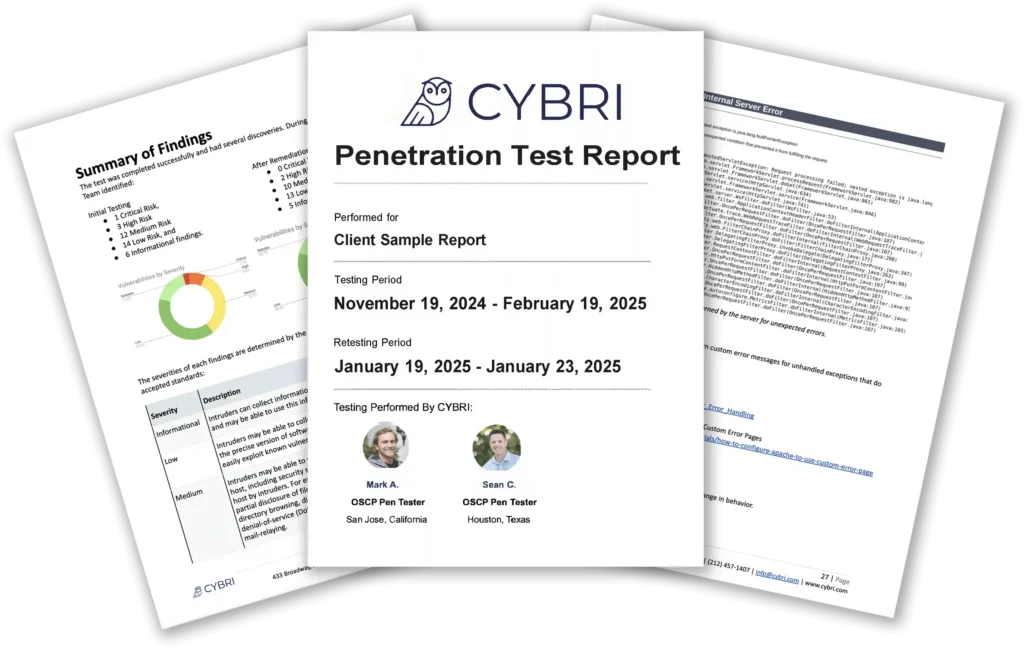
Our ISO 27001 penetration tests connect your risk assessment, implemented controls, and auditor evidence requirements. Each finding is severity-rated, mapped to relevant ISO controls, and supported by actionable remediation guidance.
Our ISO 27001 Penetration Testing Approach
CYBRI combines a manual-first penetration testing methodology with OWASP Top 10 and ISO 27001 alignment to identify technical vulnerabilities and map findings to your ISMS, risk register, and applicable controls.
Our process includes:
1. Scoping & Alignment
We define the testing scope based on your assets, and compliance objectives.
2. Manual & Tool-Assisted Testing
OSCP and OSWE-certified pentesters conduct in-depth testing across applications, APIs, networks, and cloud assets.
3. Reporting & Mapping
We deliver detailed findings mapped to ISO 27001 Annex A controls with severity ratings and clear remediation actions.
4. Remediation Support
You receive clear remediation guidance and optional consultation to help your team resolve identified vulnerabilities.
5. Retesting & Validation
We verify fixes and issue an updated report for audit evidence.
Compliance Testing
Remediation Testing and Support
ISO 27001 Penetration Testing Coverage
|
Rationale |
ISO/IEC 27001:2022 Annex A Controls |
|
Broken Access Control – A01:2021: Access controls may fail to properly enforce what an authenticated or unauthenticated user is permitted to access. This can allow users to access restricted information or functionality, perform unauthorized actions, or escalate their privileges. |
A.5.15, A.5.16, A.5.18, A.8.2, A.8.3 |
|
Cryptographic Failures – A02:2021: Sensitive information may not be adequately protected when stored or transmitted. This can include the use of weak protocols or cipher suites, improper cryptographic implementations, or the ability to bypass otherwise secure communication channels. |
A.5.14, A.8.12, A.8.24 |
|
Injection – A03:2021: Applications may improperly process untrusted input, allowing supplied data to be interpreted as commands, queries, or executable content. This category includes vulnerabilities such as SQL injection and other forms of code or command injection. |
A.8.25, A.8.26, A.8.28, A.8.29 |
|
Insecure Design – A04:2021: Security weaknesses may originate from the application’s underlying design rather than a single implementation mistake. These issues often require architectural or workflow changes instead of a simple software patch and therefore may require more extensive remediation. |
A.8.25, A.8.26, A.8.27 |
|
Security Misconfiguration – A05:2021: Applications, servers, and supporting infrastructure may be deployed with insecure settings. Examples include default credentials, unnecessary functionality, overly detailed error messages, exposed services, or missing security controls. |
A.8.8, A.8.9, A.8.20, A.8.22, A.8.27 |
|
Vulnerable and Outdated Components – A06:2021: Applications may rely on outdated or vulnerable third-party software, libraries, packages, frameworks, or other components. Testing helps determine whether identified components are actually vulnerable and whether they create a meaningful security risk within the application. |
A.8.8, A.8.9, A.8.25 |
|
Identification and Authentication Failures – A07:2021: Weaknesses in authentication or session management can allow attackers to compromise user accounts or assume another user’s identity. Examples include weak password requirements, inadequate protection against brute-force attacks, insecure password-change functionality, or exposure of session tokens and authentication data. |
A.5.16, A.5.17, A.5.18, A.8.2, A.8.5 |
|
Software and Data Integrity Failures – A08:2021: Software and data may lack sufficient protection against unauthorized modification. This can include untrusted software updates, insecure CI/CD pipelines, insufficient integrity verification, and software supply-chain compromises that allow malicious code or data to enter trusted systems. |
A.5.21, A.8.4, A.8.19, A.8.25, A.8.28, A.8.29, A.8.32 |
|
Security Logging and Monitoring Failures – A09:2021: Insufficient logging and monitoring can prevent an organization from identifying suspicious activity or understanding what occurred during a security incident. These weaknesses are commonly assessed alongside secure configuration and help determine whether attacks can be detected and investigated effectively. |
A.5.24, A.5.25, A.5.26, A.8.15, A.8.16, A.8.17 |
|
Server-Side Request Forgery (SSRF) – A10:2021: Applications that retrieve remote resources without adequately validating their destination may allow attackers to make unintended requests through the server. This can expose internal services or allow requests to bypass network controls such as firewalls or other perimeter protections. |
A.8.20, A.8.21, A.8.22, A.8.26, A.8.27, A.8.28 |

Why Choose Cybri for ISO 27001 Penetration Testing
Specialized in Compliance-Driven Testing
Our team focuses on application penetration testing for compliance frameworks including ISO 27001, SOC 2, HIPAA, and others.
Certified Penetration Testers
Every engagement is led by experienced and OSCP-certified penetration testers.
Actionable, Auditor-Ready Reports
Each report includes executive summaries, ISO mapping, and step-by-step remediation guidance, designed for both engineers and auditors.

Transparent, Collaborative Process
We maintain open communication throughout the engagement to ensure clarity, confidence, and readiness for your next audit.

Trusted by SaaS Teams Worldwide
We help technology-driven organizations strengthen security and maintain compliance.
Maximizing Value of ISO 27001 Penetration Testing
User Role/ Authenticated Testing
We perform a thorough penetration test of your web application across its functionality and user roles using OWASP ASVS and OWASP Top 10. For applications with AI or agentic functionality, we assess relevant AI security risks and attack paths.
Mobile
If your web app has a mobile side, it may be valuable to test the interaction between them. Our testing evaluates communication security using our methodology based on OWASP ASVS, OSSTMM, and PTES.
API
API testing is often done in conjunction with web penetration tests. APIs can be a weak vector into any organization that doesn’t check its security. We leverage OWASP’s research to find the most common attack vectors.
Cloud
Your web application sits on top of infrastructure, and even it is in the cloud, it is important to test. Our experts have deep experience in all major cloud providers and follow their terms of service to ensure no interruption: AWS, GCP, Azure, and Oracle. This gives you the opportunity to dive deep into your application’s infrastructure.
Code Review
A code review is the best way to check for vulnerabilities before they are seen by the public. It can also catch business logic flaws and other problems that are not readily apparent in the compiled application. We utilize OWASP’s Code Review Guide and Google’s Standard of Code Review
Internal & External Network Testing
We assess both internal and external network environments to identify weaknesses that could expose critical systems and sensitive data. External testing evaluates your internet-facing attack surface, while internal testing simulates threats from within the network or from an attacker who has gained an initial foothold. Testing covers network services, systems, segmentation, access controls, misconfigurations, and potential paths to privilege escalation or lateral movement.
Schedule an ISO 27001 Penetration Testing Call