SOC 2 Penetration Testing
Strengthen Your Security. Support Your Compliance.
Manual-first, SOC 2 penetration tests trusted by technology companies to deliver auditor-ready reports and remediation tesitng.
CYBRI SOC 2-Aligned Penetration Testing
Since 2017, CYBRI has used OWASP and NIST methodologies to help companies prepare for SOC 2.
- Manual, real-world attack simulation
- Clear, auditor-ready documentation
- Security testing aligned to SOC 2 criteria
- Fast turnaround (7–14 days average)
- Expertise across SaaS stacks (AWS, GCP, Node.js, React, GraphQL, etc.)
CYBRI’s penetration testing goes beyond automated scanning to simulate real-world attacks and provide clear evidence that your security controls are working as intended for SOC 2.
Our Process
1. Scoping Call
We define your scope, goals, and timelines.

2. Manual Pentest Execution
We simulate real-world attacks.

3. SOC 2-Ready Report + Debrief
Receive a clear report, live findings walkthrough, and remediation testing.

9 Years Dedicated To Penetration Testing
Since 2017, CYBRI has been dedicated to penetration testing, helping businesses of all sizes, from startups to multinational enterprises, identify and eliminate security vulnerabilities. Our sole focus is pentesting and vulnerability scanning, ensuring deep expertise and rigorous assessments without distractions.
What’s included with your SOC 2 Pen Test
-
Pentest Scope
Web and mobile apps, APIs, infrastructure, cloud configuration reviews, and internal/external assets—mapped to your in-scope systems and SOC 2 Trust Services Criteria. -
Methodology
Tailored to your SOC 2 objectives and Trust Services Criteria, combining manual testing, OWASP Top 10 coverage, and business logic testing to address both technical risk and compliance expectations. -
Reporting
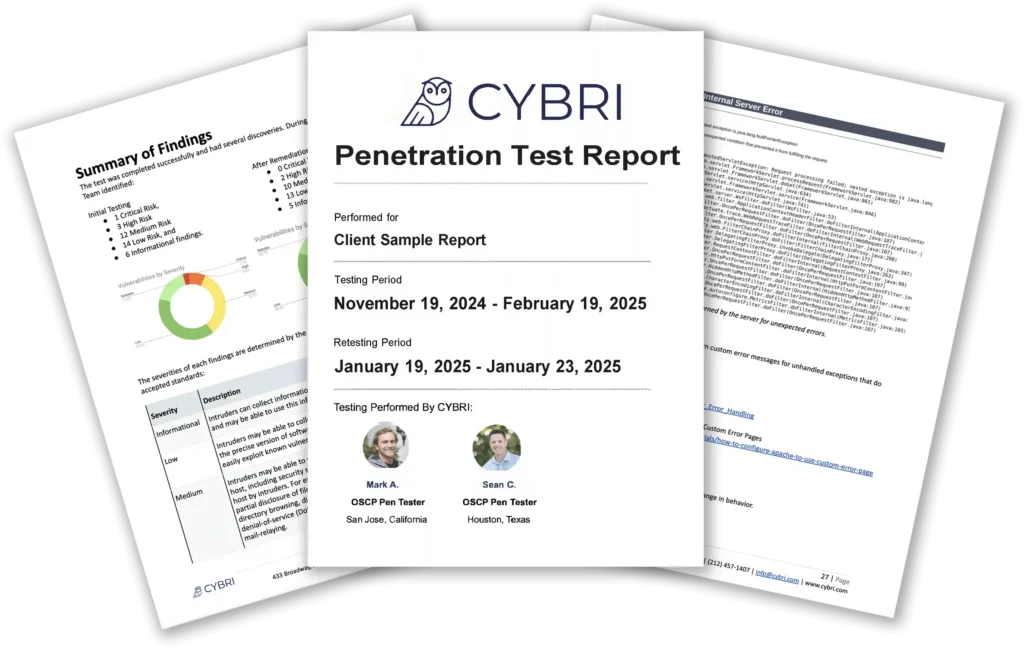
SOC 2-aligned reporting with an executive summary with risk scores, mapped controls, detailed technical findings, and clear remediation guidance. -
Support
Debrief call, remediation guidance, and engagement support, plus optional guidance on presenting results to your auditor or GRC team.
Compliance Testing
CYBRI SOC 2 Pen-Testing Coverage
| SOC 2 Vulnerability Matrix | SOC 2 Trust Services Criteria |
| Broken Access Control: Access controls may fail to properly enforce what an authenticated or unauthenticated user is permitted to access. This can allow users to access restricted information or functionality, perform unauthorized actions, or escalate their privileges. | CC6.1, CC6.2, CC6.3, CC6.6 |
| Cryptographic Failures: Sensitive information may not be adequately protected when stored or transmitted. This can include weak encryption, insecure communication protocols, poor cryptographic configuration, or inadequate protection of confidential information. | CC6.1, CC6.6, CC6.7 |
| Injection: Applications may improperly process untrusted input, allowing supplied data to be interpreted as commands, queries, or executable content. Successful exploitation can result in unauthorized access, modification of information, or compromise of underlying systems. | CC6.1, CC6.6, CC7.1, CC8.1 |
| Insecure Design: Security weaknesses may originate from the application’s underlying architecture or business logic rather than a single implementation error. Addressing these weaknesses may require changes to application design, development practices, or security controls. | CC3.2, CC5.2, CC7.1, CC8.1 |
| Security Misconfiguration: Applications, servers, and supporting infrastructure may be deployed with insecure settings. Examples include default credentials, unnecessary functionality, exposed services, excessive permissions, verbose error messages, or missing security controls. | CC6.1, CC6.6, CC7.1, CC8.1 |
| Vulnerable and Outdated Components: Applications may rely on outdated or vulnerable third-party software, libraries, packages, frameworks, or other components. Organizations should identify these weaknesses and manage the risks introduced by vulnerable technology. | CC7.1, CC7.2, CC8.1, CC9.2 |
| Identification and Authentication Failures: Weaknesses in authentication or session management can allow attackers to compromise accounts or assume another user’s identity. Examples include weak password controls, inadequate brute-force protection, insecure password changes, and exposure or improper handling of session tokens. | CC6.1, CC6.2, CC6.3, CC6.6 |
| Software and Data Integrity Failures: Software and data may lack adequate protection against unauthorized modification. This can include insecure software updates, CI/CD pipelines, dependencies, deployment processes, or third-party components that allow untrusted changes to enter production systems. | CC7.1, CC8.1, CC9.2 |
| Security Logging and Monitoring Failures: Insufficient logging and monitoring can prevent an organization from identifying suspicious activity or understanding what occurred during an incident. Appropriate monitoring helps organizations detect, investigate, and respond to security events. | CC4.1, CC7.2, CC7.3, CC7.4, CC7.5 |
| Server-Side Request Forgery (SSRF): Applications that retrieve remote resources without adequately validating their destination may allow attackers to make unintended requests through the server. This can expose internal resources, cross security boundaries, or bypass network protections. | CC6.1, CC6.6, CC7.1 |
Maximizing Value of SOC 2 Penetration Testing
User Role/ Authenticated Testing
We perform a thorough penetration test of your web application across its functionality and user roles using OWASP ASVS and OWASP Top 10. For applications with AI or agentic functionality, we assess relevant AI security risks and attack paths.
Mobile
If your web app has a mobile side, it may be valuable to test the interaction between them. Our testing evaluates communication security using our methodology based on OWASP ASVS, OSSTMM, and PTES.
API
API testing is often done in conjunction with web penetration tests. APIs can be a weak vector into any organization that doesn’t check its security. We leverage OWASP’s research to find the most common attack vectors.
Cloud
Your web application sits on top of infrastructure, and even it is in the cloud, it is important to test. Our experts have deep experience in all major cloud providers and follow their terms of service to ensure no interruption: AWS, GCP, Azure, and Oracle. This gives you the opportunity to dive deep into your application’s infrastructure.
Code Review
A code review is the best way to check for vulnerabilities before they are seen by the public. It can also catch business logic flaws and other problems that are not readily apparent in the compiled application. We utilize OWASP’s Code Review Guide and Google’s Standard of Code Review
Internal & External Network Testing
We assess both internal and external network environments to identify weaknesses that could expose critical systems and sensitive data. External testing evaluates your internet-facing attack surface, while internal testing simulates threats from within the network or from an attacker who has gained an initial foothold.
Remediation Testing and Support
Who We Serve
Technology Companies
ISO/IEC 27001, SOC 2 (Type I & II)

SaaS
SOC 2 (Type I & II), ISO 27017/27018
Fintech
PCI DSS, SOC 1, SOC 2, ISO/IEC 27001

Healthtech
HIPAA, HITRUST CSF, SOC 2

Mid-Market & Enterprise
NIST 800-53, ISO 27001, SOC 2, GDPR

CYBRI SOC 2 Penetration Testing Services
Web & Mobile Apps
API
Cloud (AWS, Azure, GCP)
External & Internal Networks
Legacy Systems
9 Years Dedicated To Penetration Testing
Since 2017, CYBRI has been dedicated to penetration testing, helping businesses of all sizes, from startups to multinational enterprises, identify and eliminate security vulnerabilities. Our sole focus is pentesting and vulnerability scanning, ensuring deep expertise and rigorous assessments without distractions.
Get a SOC 2 Pentest Quote