Penetration testing matters more than ever in 2025. Enterprises face rising buyer expectations, tighter frameworks such as SOC 2, HIPAA, and ISO 27001, and growing pressure to prove security maturity.
Cloud-native systems, SaaS architectures, and AI-driven applications continue to expand the attack surface, increasing the need for expert validation. Recent research shows that “the average global cost of a data breach reached 4.4 million dollars in 2024” [1], reinforcing why proactive testing is essential for reducing financial and reputational risk.
The market is crowded. Vendors vary significantly in depth, price, and methodology, making it difficult to distinguish credible providers from shallow offerings. This guide helps readers evaluate and shortlist reliable, high-quality penetration testing partners.
TL;DR: The top penetration testing vendors are:
- Cybri: Best for SaaS brands seeking manual-first penetration testing delivered via a PTaaS platform.
- Bishop Fox: Best for continuous attack surface management and deep manual research.
- NetSPI: Best for enterprise-scale PTaaS with broad asset coverage.
- Cobalt: Best for on-demand pentesting integrated with DevSecOps workflows.
- CrowdStrike: Best for threat-informed adversary simulation.
- Rapid7: Best for PTaaS with unified vulnerability and detection tooling.
- Secureworks: Best for intelligence-driven testing backed by CTU research.
- Offensive Security Services: Best for advanced, long-form boutique engagements.
- Rhino Security Labs: Best for cloud-first manual testing and AWS expertise.
- NCC Group: Best for global, regulated, and highly specialized environments.
What Makes a Great Pentest Vendor
A strong penetration testing vendor combines technical depth, industry experience, and reporting that supports fast remediation. Verizon notes that “external actors remain responsible for most confirmed breaches” [2], which shows why vendor quality directly affects risk.
Technical Capabilities
Strong vendors provide broad coverage across applications, APIs, cloud services, and internal networks. They pair automated discovery with senior manual testing to uncover logic flaws and chained attack paths. NIST explains that “skilled human analysis is required to identify complex weaknesses”[3], which highlights the importance of experience and structured methodology.
Industry Experience
Industry familiarity improves relevance. SaaS teams need coverage of multi-tenant issues and API logic, while FinTech and HealthTech organizations depend on SOC 2, PCI DSS, and HIPAA alignment. IBM notes that “regulated sectors experience higher breach costs due to data sensitivity” [1], which underscores why sector-specific knowledge matters.
Reporting Quality
Actionable reporting drives real security improvement. Effective reports provide clear impact descriptions, reproducible evidence, and prioritized guidance engineers can implement quickly. Vendors offering retesting help organizations confirm fixes and maintain audit readiness.
Service Delivery Model
Testing must fit development cycles. PTaaS or continuous testing helps teams address vulnerabilities as systems change. The model should offer real-time visibility, direct tester communication, and structured retesting. Flexibility is crucial for fast-moving engineering teams.
Tools & Technology
Good tooling supports, not replaces, manual testing. Cloud-aware tools, API testing utilities, and Jira or GitHub integrations reduce noise and accelerate remediation. The goal is to enhance analyst efficiency, not automate insight.
Pricing Transparency
Transparent pricing prevents scope confusion. Vendors should clarify how app size, cloud complexity, and API volume affect cost. Predictable models help security teams plan annual testing cycles with consistent budget expectations.
Cybri pairs senior testers with deep SaaS and cloud expertise, delivering clear, audit-ready findings. The BlueBox platform provides real-time visibility and efficient remediation support for fast engineering teams.
The Top 10 Penetration Testing Vendors in 2025
1. Cybri
Cybri specializes in securing SaaS and cloud systems. Their model combines senior manual testers with the BlueBox PTaaS platform, offering real-time visibility, structured remediation, and direct communication with testers. Cybri focuses on complex SaaS architectures, multi-tenant logic, API-heavy backends, and cloud configurations across AWS, GCP, and Azure. Reports include clear impact explanations and remediation steps aligned with SOC 2, HIPAA, and ISO 27001 requirements. Cybri is known for predictable fixed-fee pricing, fast test initiation, and strong developer support.
Strengths:
- Senior testers with SaaS and cloud specialization
- PTaaS delivery with real-time updates and integrated remediation tracking
- Auditor-ready reporting for SOC 2, HIPAA, and ISO 27001
- Fast turnaround and predictable scope-based pricing
Cybri delivers a modern, developer-focused, compliance-aligned pentesting experience designed for teams that need speed, depth, and high-quality manual testing.
2. Bishop Fox
Bishop Fox is a long-established offensive security firm known for research-driven testing and its continuous security platform, Cosmos. Their consultants handle complex environments, including cloud infrastructures and wide external attack surfaces. They excel in adversary simulation and long-term security engagements. Cosmos gives clients ongoing visibility into confirmed exposures, reducing the gap between discovery and remediation.
Strengths:
- Deep manual testing and research-backed methodology
- Cosmos platform for continuous attack surface monitoring
- Strong fit for large and regulated environments
Bishop Fox blends high-end consulting with continuous monitoring for organizations that need sustained, expert-led security validation.
3. NetSPI
NetSPI operates one of the industry’s largest offensive security teams and delivers testing through a mature PTaaS platform. Their model supports broad testing needs across applications, networks, and cloud environments, with centralized findings and workflow integration. NetSPI excels at managing large, multi-application testing programs and coordinating parallel engagements for organizations with high-volume testing requirements.
Strengths:
- Large in-house testing team with broad specialization
- PTaaS platform supporting real-time visibility and retesting
- Strong alignment with enterprise workflows and tooling
- Ability to handle large, multi-application testing programs
NetSPI’s platform scale and enterprise-focused delivery make them a strong choice for teams needing continuous, program-level penetration testing.
4. Cobalt
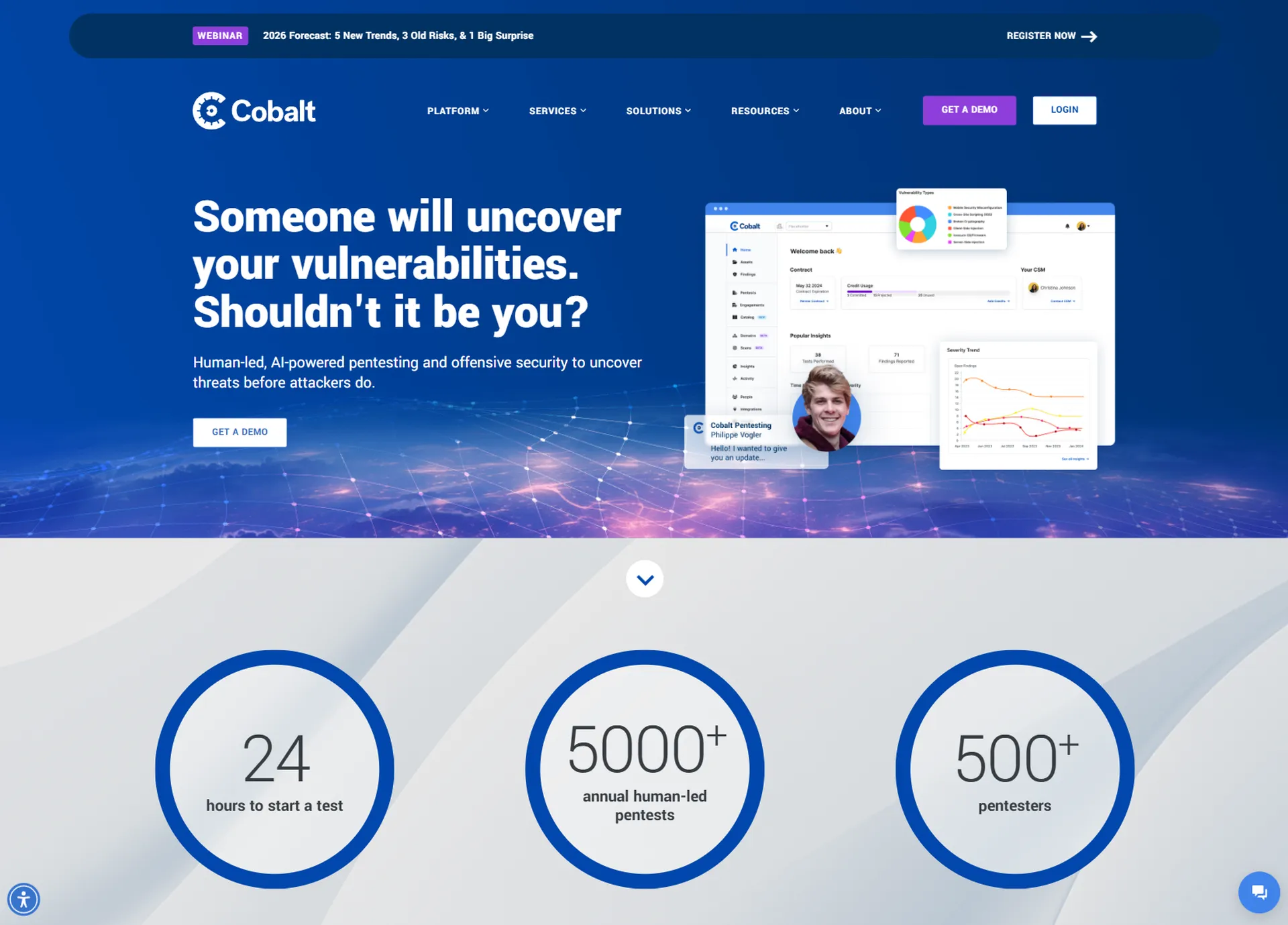
Cobalt is a pioneer of the PTaaS model, providing rapid access to experienced pentesters and real-time collaboration through their platform. Their credit-based system allows teams to schedule tests quickly, adjust scope as needed, and maintain a steady testing cadence. Cobalt is especially effective for web apps, APIs, and mobile testing, with integrations that feed results directly into engineering workflows for faster remediation.
Strengths:
- Rapid test launch and flexible credit-based model
- Strong for web app, mobile, and API pentesting
- Useful integrations for DevSecOps alignment
Cobalt stands out for speed, flexibility, and developer-friendly delivery, ideal for teams needing reliable testing on short notice.
5. CrowdStrike

CrowdStrike provides penetration testing informed by its extensive global threat intelligence. Their offensive security team simulates realistic attacker tactics, focusing on lateral movement, privilege escalation, and how defenders respond. They excel in internal network testing, adversary emulation, and resilience assessments for organizations that want to measure detection and response capabilities against real-world attack patterns.
Strengths:
- Testing informed by global threat intelligence
- Strong internal, external, and adversary simulation services
- Deep expertise in detection and response validation
CrowdStrike excels at realistic, intelligence-driven testing that helps organizations measure true resilience against active threat actors.
6. Rapid7
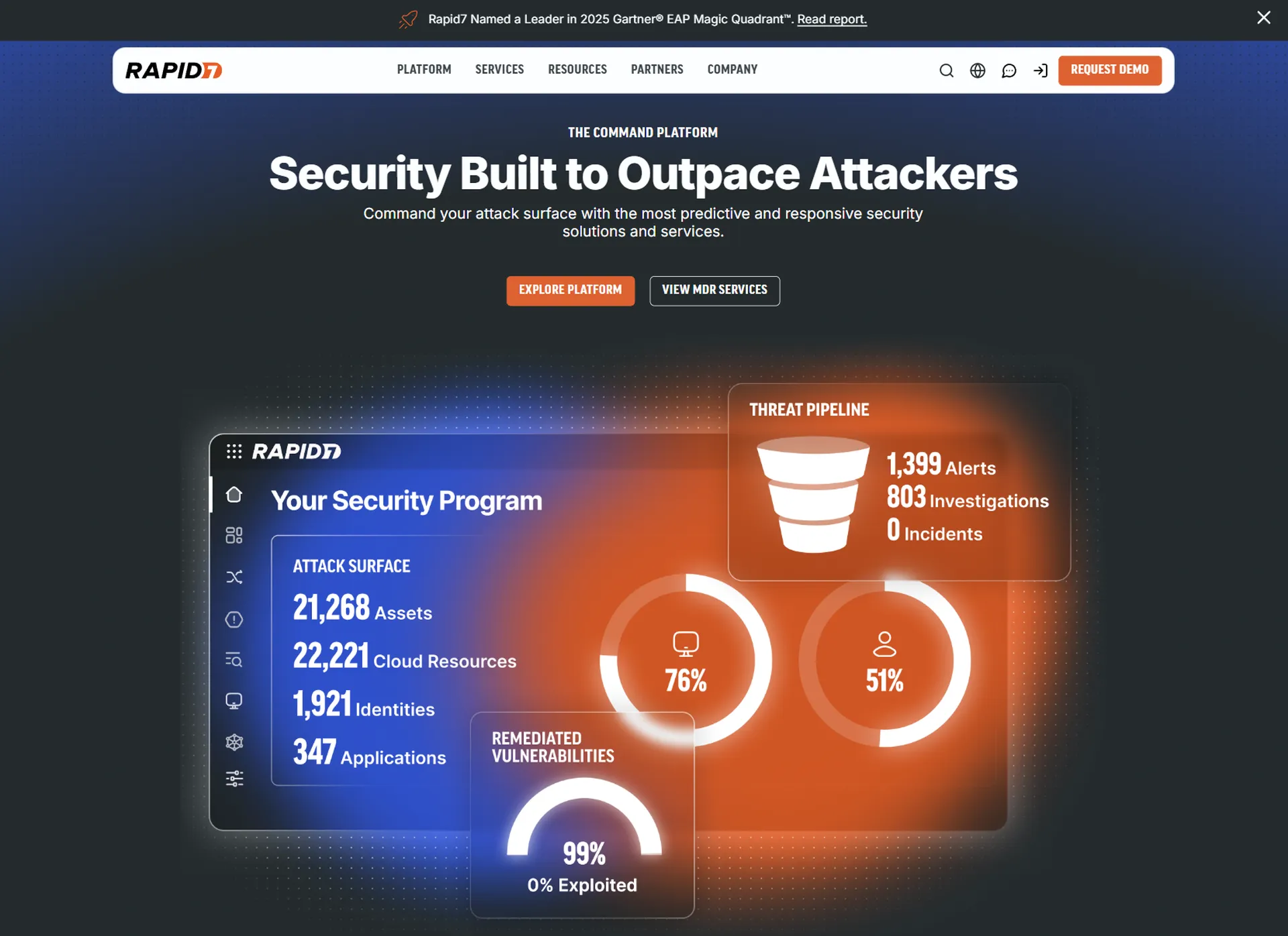
Rapid7 delivers network, application, and cloud testing backed by a strong research history and long-standing contributions to security tooling. Their consultants focus on high-impact vulnerabilities and provide practical remediation advice that fits into existing risk management programs. Rapid7 is a strong match for companies wanting unified visibility across testing and vulnerability management.
Strengths:
- Experienced consultants with strong research background
- Wide coverage across cloud, network, and application environments
- Useful integration with vulnerability management tooling
Rapid7 pairs deep practitioner expertise with strong research history, making them a reliable choice for organizations that want consistent, well-documented assessments.
7. Secureworks

Secureworks provides penetration testing backed by a dedicated threat intelligence unit that tracks global attacker activity. Their services focus on uncovering weaknesses that align with known attack patterns, making them suitable for organizations with strict risk and compliance requirements. Secureworks testers evaluate applications, networks, and cloud environments with an emphasis on real-world exploitation potential.
Strengths:
- Threat intelligence-driven testing
- Strong fit for regulated industries
- Consistent methodology and reporting
Secureworks provides intelligence-informed, enterprise-scale testing suitable for organizations with strict compliance and risk requirements.
8. Offensive Security Services

Offensive Security Services focuses on advanced, highly manual penetration testing and attack simulation. Engagements are typically longer and more detailed than standard pentests, allowing testers to perform deep reconnaissance, exploit chaining, and full attack lifecycle modeling. Their background in building widely used security tools and training materials demonstrates strong technical capability. This vendor is best suited for teams that already perform regular testing and now need a higher level of adversarial pressure.
Strengths:
- Highly specialized manual testing
- Strong background in offensive research and training
- Deep, long-form engagement style
- High effectiveness for mature security programs
Offensive Security excels at advanced, boutique testing that uncovers sophisticated exploit paths beyond typical assessments.
9. Rhino Security Labs
Rhino Security Labs is known for deep cloud expertise and focused assessments across cloud environments. Their consultants evaluate IAM configurations, cloud networking, storage policies, serverless components, and workload protections. Rhino also performs detailed application and API testing, but their strongest area is cloud configuration and privileges. They are a strong choice for companies that want targeted, high-impact cloud testing grounded in realistic adversary techniques.
Strengths:
- Leading cloud security specialization
- Strong AWS, Azure, and GCP expertise
- Thorough exploitation and misconfiguration testing
Rhino stands out for cloud-focused penetration testing depth, ideal for teams relying heavily on cloud services.
10. NCC Group
NCC Group is a global security consultancy offering a broad portfolio of penetration testing services across infrastructure, applications, mobile, hardware, and cloud. Their global presence and standardized methodologies make them well suited for multinational companies with complex risk and compliance requirements. NCC Group testers have extensive experience across regulated sectors and provide structured reporting that supports internal audit and certification needs. Their scale allows them to support large testing programs across distributed environments.
Strengths:
- Global presence and large consultant team
- Wide technical coverage across many asset types
- Suitable for multinational and enterprise environments
NCC Group provides consistent, regulation-ready testing at global scale, making them a dependable choice for organizations with distributed environments.
Comparison Table: Top Vendors at a Glance
| Vendor | Best for | Type of Testing | Delivery Model | Compliance Experience |
|---|---|---|---|---|
| Cybri | SaaS brands | Web app, API, cloud, network | PTaaS, fixed scope | SOC 2, HIPAA, ISO 27001, GDPR and more |
| Bishop Fox | Enterprises with large attack surfaces | Application, cloud, attack surface | Continuous plus manual testing | Enterprise, regulated sectors |
| NETSPI | Large organizations with many assets | Application, network, cloud, broad testing | PTaaS at scale | SOC 2, PCI, ISO frameworks |
| Cobalt | SaaS and mid-market with rapid test needs | Application, mobile, API | PTaaS on-demand | SOC 2, ISO 27001 |
| Crowdstrike | Threat-driven simulation and resilience validation | Adversary simulation, internal, external | Intelligence-led engagements | Financial, enterprise, regulated sectors |
| Rapid7 | Companies needing testing integrated with VM programs | Network, application, cloud | Manual plus platform hybrid | General compliance support |
| Secureworks | Regulated industries with intelligence needs | Network, cloud, application | Threat-informed manual testing | FFIEC, healthcare, financial services |
| Offensive Security | Mature programs needing advanced red-team exercises | Advanced manual, attack simulation | Boutique long-form testing | High-security and government environments |
| Rhino Security | Cloud-heavy organizations | AWS, Azure, GCP, app, API | Specialized engagements | Cloud security compliance and policy |
| NCC Group | Global enterprises needing standardized testing | Full-spectrum testing across all asset types | Traditional and hybrid models | GDPR, ISO 27001, PCI DSS |
How to Choose the Right Penetration Testing Partner
Step 1. Match Vendor to Your Technical Environment
- Cloud workload and identity expertise
- API, container, and modern framework experience
Step 2. Match Vendor to Your Compliance Requirements
Step 3. Evaluate the Report Quality Before Signing
Step 4. Confirm Tester Seniority and Delivery Model
Step 5. Understand Pricing Models
Vendors usually offer fixed-fee, hourly, or subscription testing:
- Fixed-fee works when the scope is clear.
- Hourly suits complex or evolving environments.
- PTaaS or subscription supports continuous testing across the year.
Choose the model that aligns with release tempo and compliance deadlines.
Cybri offers compliance-aligned testing with senior assessors and developer-friendly reports. Their PTaaS model keeps pricing predictable for both recurring and one-time engagements.
Final Thoughts & Next Steps
Choosing the right vendor is about aligning capabilities with your environment, compliance expectations, and risk profile. Teams that evaluate vendors based on testing depth, reporting clarity, and delivery model are better positioned to strengthen security outcomes and maintain audit readiness.
Cybri enables quick test launches, direct access to senior testers, and a PTaaS workflow that accelerates remediation and strengthens security posture. Teams that want faster, clearer penetration testing outcomes can start with Cybri to improve security confidence.