For mid-market and enterprise B2B organizations, penetration testing has become a critical operational gatekeeper. Procurement departments, cyber insurance underwriters, and compliance frameworks (HIPAA, SOC 2, PCI-DSS, ISO 27001, NYDFS) increasingly require independent, third-party manual penetration testing before contracts are signed.
Modern engineering teams deploy code continuously. Relying on a single annual penetration test creates massive windows of vulnerability. Selecting the wrong testing model means risking:
- Failed compliance audits
- Wasted security budgets
- Undetected business logic flaws
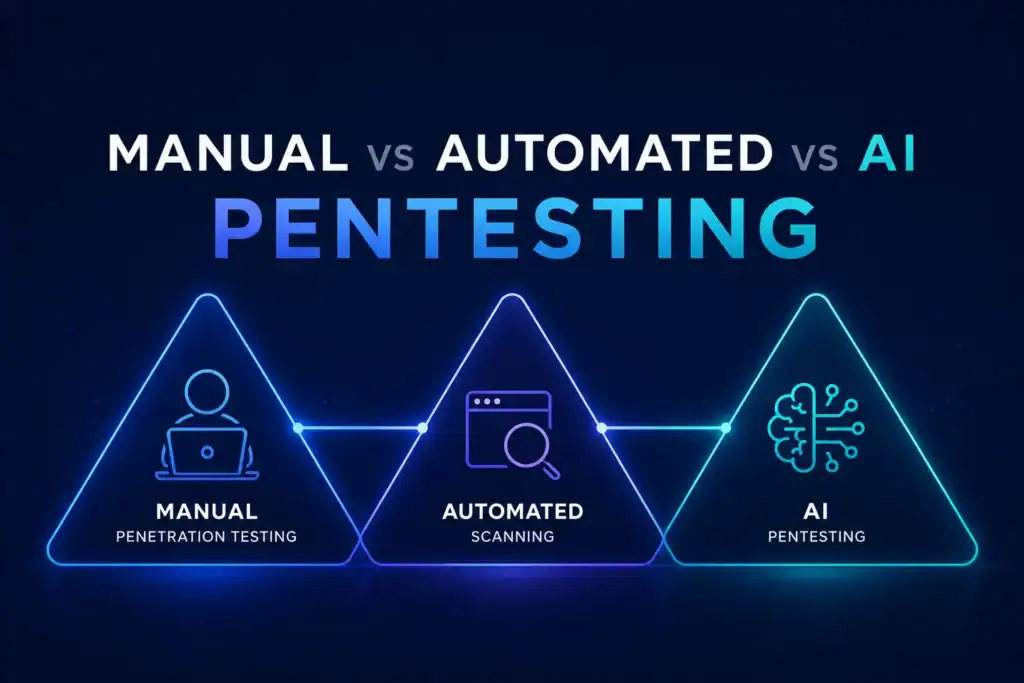
Here is a technical breakdown of manual, automated, AI, and continuous penetration testing models to help you optimize your risk and vulnerability management strategies.
Executive Summary
- Manual penetration testing remains the gold standard for enterprise procurement and compliance requirements.
- Automated scanning provides continuous visibility into known vulnerabilities but cannot identify business logic flaws.
- AI-powered testing tools can improve internal operations but do not replace independent third-party assessments.
- A hybrid approach combining continuous automated testing with periodic manual testing provides the strongest coverage for modern organizations.
Core Security Testing Methodologies
Before deciding on a testing approach, determine how much information and access you want to provide to the penetration testing team. This decision affects the depth of the assessment, the time required, and the overall engagement cost. If your primary goal is to meet a compliance requirement and your infrastructure is relatively small, a basic black-box assessment may be sufficient. However, if identifying and reducing real security risks is a priority, providing greater visibility through a gray-box or white-box approach will result in a more thorough evaluation.
1. White Box Testing: Comprehensive Architecture Audits
White box testing grants penetration testers unrestricted visibility into the target infrastructure.
- Access provided: Source code, architectural diagrams, API documentation, and high-privilege credentials.
- Best for: Meticulous verification of internal application logic and complex development pipelines before code hits production.
- Limitation: Does not simulate the organic path of an external threat actor.
2. Black Box Testing: Simulating the Adversary
Black box testing provides zero prior knowledge of the internal infrastructure.
- Access provided: Only a primary domain name or public IP addresses.
- Best for: Replicating the exact perspective of an external cybercriminal launching a targeted attack.
- Limitation: Significant billable hours are spent on initial reconnaissance rather than deep logic exploitation.
3. Grey Box Testing: Efficient High-ROI Assessments
Grey box testing represents a tactical middle ground, simulating an insider threat or compromised account.
- Access provided: Standard user-level authentication credentials and partial application context.
- Best for: Evaluating B2B SaaS platforms, testing role-based access control (RBAC), and assessing data exfiltration vectors.
- Advantage: Bypasses time-consuming discovery to deliver an excellent return on investment.
Manual Penetration Testing: The Enterprise Gold Standard
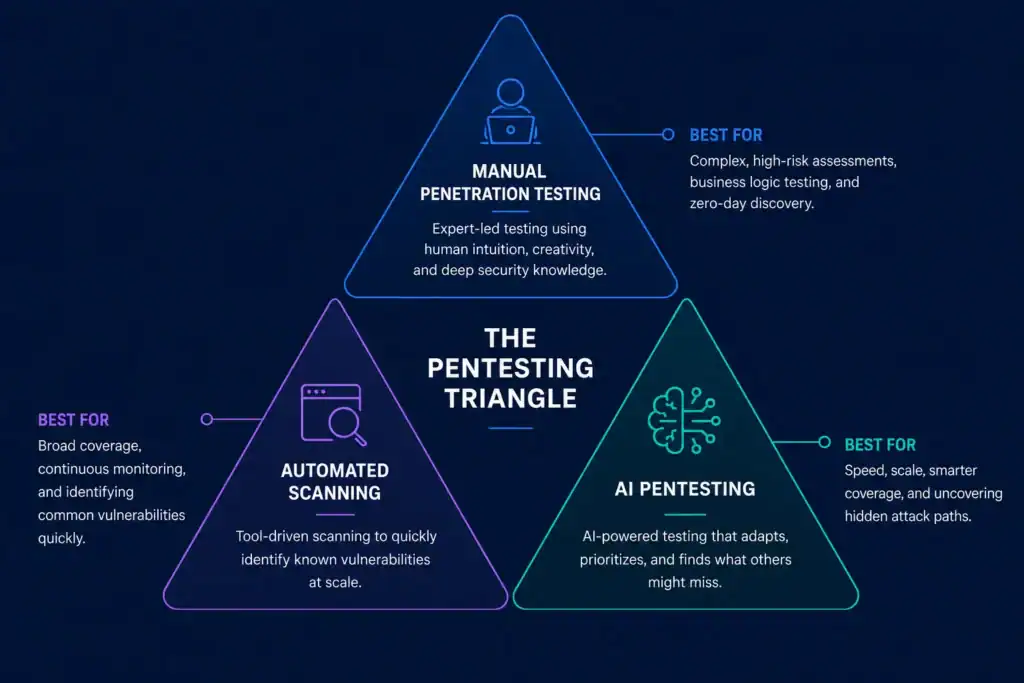
Despite historic advances in automation, manual penetration testing remains the definitive standard required by enterprise procurement teams and regulatory auditors.
Why Automation Isn’t Enough
Software scripts run on static rules. Human security engineers rely on creativity and intuition to chain together disparate system vulnerabilities.
- Identifies Business Logic Flaws: Scanners check if an API requires authentication, but a human validates if logged-in User A can alter a parameter ID to view User B’s private records (Broken Object Level Authorization).
- Finds Complex Exploit Chains: Humans look beyond basic code signatures to expose authorization bypasses and architectural gaps.
- Mandated by Frameworks: A simple PDF export from an automated scanner rarely satisfies enterprise procurement requirements. Fortune 500 companies demand an attestation report signed by a certified, external third party.
Investment Realities
- Cost: Comprehensive manual pentesting engagements typically start at $5,000 for a basic web app penetration test and scale upward based on application complexity and scope. (Review specialized PTaaS pricing models to maximize budget utility).
- Limitation: It is a static, point-in-time assessment. Vulnerabilities introduced in a software update two weeks after the test will remain unpatched until the next annual cycle.
Automated Vulnerability Scanning: Fast But Limited
Automated vulnerability scanning inspects networks for known security flaws by cross-referencing target infrastructure against public CVE databases.
Key Strengths
- Immediate speed and scalability
- Catches low-hanging fruit and missing patches
- Identifies configuration drift
- Provides continuous infrastructure monitoring inside CI/CD pipelines
Operational Limitations
- Lack of Context: Automated tools evaluate vulnerabilities in complete isolation and cannot determine if minor flaws can be chained to achieve system compromise.
- Alert Fatigue: High volumes of false positives place an unnecessary triage burden on internal engineering teams, causing critical issues to be overlooked and, in many cases, demoralizing security and development teams.
The Reality of AI Pentesting Tools
Autonomous AI penetration testing tools claim to execute full-scale security assessments using machine learning models. However, full-scale AI testing remains uncharted territory for enterprise risk management. Large enterprises still require manual penetration testing as the gold standard.
Internal Tools vs. Third-Party Attestation
- Internal Operational Asset: Buying an AI tool means enhancing your internal team. It requires experienced, highly certified penetration testers to manage scope, validate findings, and correct logic models.
- Fails Vendor Risk Assessments: Even with the most advanced AI software, major enterprise clients and regulatory bodies still require an unbiased manual assessment conducted by an external vendor.
- Operational Challenges: For organizations lacking a mature security team, managing an AI tool internally often leads to misconfigured scans and an ongoing vulnerability management battle between development and security teams.
For deeper insights into penetration testing strategies and security best practices, check out our blogs.
The Hybrid Model: CYBRI Continuous Automated Testing
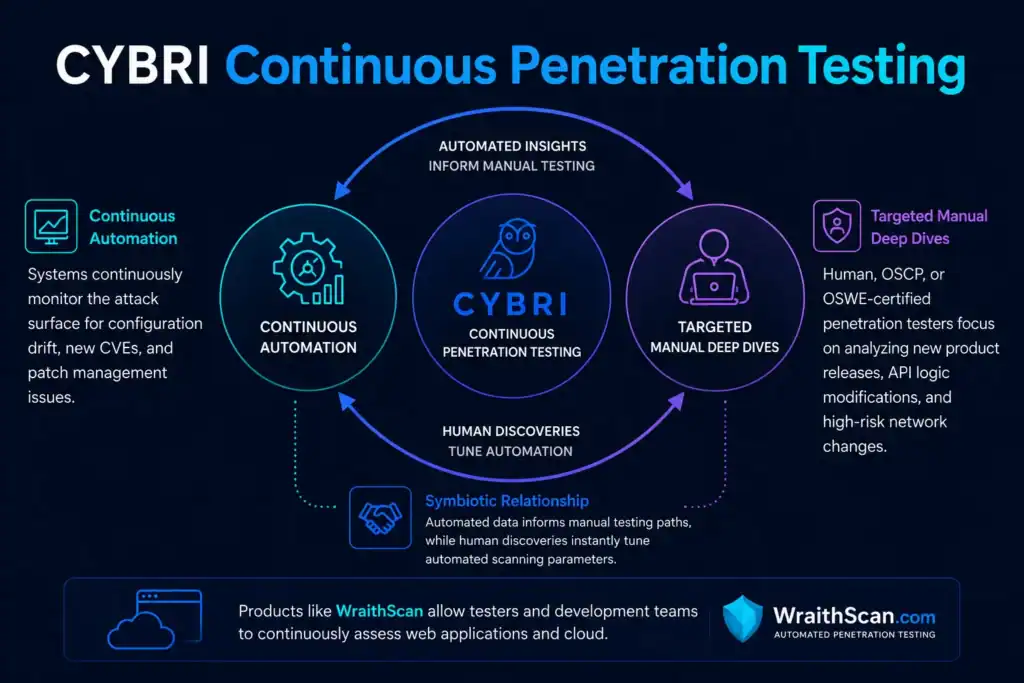
B2B technology companies are moving away from testing multiple times a year. Instead, they are adopting an ongoing hybrid model: continuous automated testing paired with targeted annual or bi-annual manual penetration testing.
How It Works
- Continuous Automation: Systems continuously monitor the attack surface for configuration drift, new CVEs, and patch management issues.
- Targeted Manual Deep Dives: Human, OSCP, OSWE, or OSCE-certified penetration testers focus on analyzing new product releases, API logic modifications, and high-risk network changes.
- Symbiotic Relationship: Automated data informs manual testing paths, while human discoveries instantly tune automated scanning parameters. Products like WraithScan allow testers and development teams to stay on top of the latest vulnerabilities.
Transitioning to this model significantly reduces your mean time to remediation without slowing down engineering release cycles. Read our definitive guide on continuous penetration testing.
Strategic Capability Comparison
| Feature / Metric | Manual Pentesting | Automated Scanning | AI Pentesting Tools | Hybrid PTaaS Model |
| Primary Focus | Business logic, zero-days | Known CVEs, configs | Exploit automation | Total coverage |
| Frequency | Point-in-time | Continuous / Daily | On-demand internal | Continuous + scheduled |
| Compliance | Satisfies SOC 2, HIPAA, NYDFS | Fails standalone audits | Fails third-party mandates | Satisfies all frameworks |
| Internal Overhead | Low (Vendor managed) | High (Triage required) | Extremely High | Low to Moderate |
| Reporting Accuracy | High (Human verified) | Moderate (False positives) | Variable | High (Vetted alerts) |
Conclusion: Build an Enterprise-Ready Pentesting Program
Relying entirely on automated tools leaves your business logic exposed, while traditional manual testing firms can stall release pipelines and often focus more on network assessments than application penetration testing. Independent, third-party manual testing remains the gold standard required by enterprise clients.
Don’t let a compliance audit or a vendor security questionnaire delay your growth. You need a security strategy that moves as fast as your development cycles. At CYBRI, we partner with your team to build a penetration testing program designed around your architecture, data flows, and security needs.
- Explore our Web Application Penetration Testing Services for assessments tailored directly to your production environments.
- Get a tailored project quote from our security architecture team today and close your compliance gaps.
Whether you are looking to integrate continuous hybrid testing or need an immediate manual penetration test for a last-minute client request, our team is ready to help you close vulnerabilities and secure your next contract.
Book a call with us today.
FAQ
Why do large enterprise clients require manual penetration testing over automated scans?
Large companies and compliance auditors require manual penetration testing because automated scans cannot detect complex business logic flaws, authorization bypasses, or chained exploit paths that a human engineer can discover.
Can an internal penetration testing tool replace an external, third party security vendor?
No, an internal tool cannot replace an external vendor because enterprise compliance and vendor risk assessments explicitly mandate an independent, unbiased security evaluation performed by an unrelated third party.
What is the baseline cost of an enterprise manual penetration test?
A professional manual authenticated penetration test typically starts at $5,000, with final costs scaling based on complexity, the number of target applications, API endpoints, user roles, and cloud environment.
How does a hybrid continuous penetration testing model handle false positives?
In a hybrid model, automated scanning tools handle continuous baseline tracking, while specialized human engineers triage the findings to eliminate false positives before delivering verified data to developers.
How often should an organization run penetration tests if they deploy code continuously?
Organizations with rapid deployment cycles should utilize a continuous hybrid model where automated testing runs on every commit, supplemented by targeted manual testing during major feature releases.