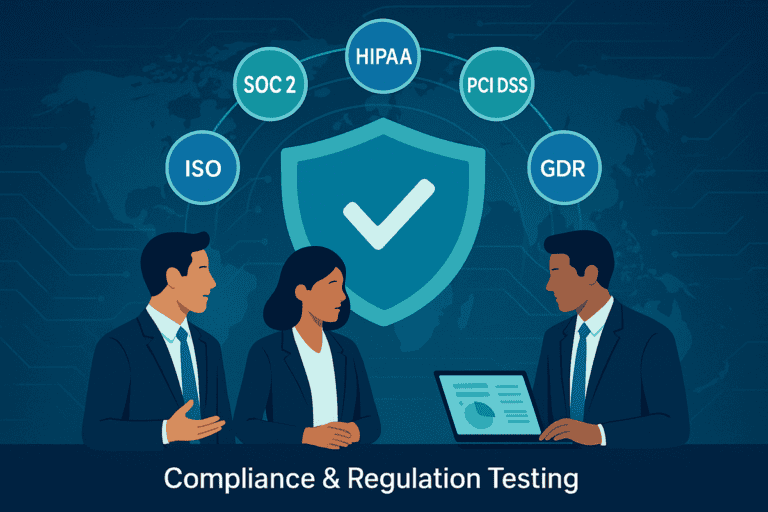
Evaluating various providers for your cloud pentest? You may have found multiple covering AWS, GCP or Azure across manual testing, automated scanning or a posture dashboard. They’ll all label their work as pentesting, but the methodology and result couldn’t be any more different.
The most important part of finding a provider is selecting the one that best fits your needs. In this guide, we’re not just going to name and describe our pick. We’ll provide you with a framework that’ll help you create a finalized shortlist.
So whether you need human-led testing, a quick scan, or perhaps both, we’ll steer you in the direction of the best fit vendor for your business and goals.
The best cloud penetration testing companies are:
- Cybri: for SaaS and cloud-first companies that want manual, exploit-led testing across AWS, Azure, and GCP backed by always-on monitoring between tests.
- Rhino Security Labs: for technology and cloud-native product companies with in-house security teams mature enough to act on research-grade findings.
- Packetlabs: Canadian and North American mid-market and enterprise organizations.
- TrustedSec: for large enterprises with established security programs.
- Redbot Security: for mid-market companies with lean security teams that can’t staff senior offensive expertise internally.
- Evolve Security: for mid-market DevSecOps teams that want continuous testing and findings they can watch land in real time.
- Coalfire: for regulated and public-sector organizations, especially those working toward FedRAMP.
- GuidePoint Security: for federal agencies, government contractors, and cloud service providers pursuing FedRAMP authorization.
- Raxis: for US-based teams that want manual testing plus a platform that plugs into their CI/CD pipeline.
- Schellman: for commercial companies already in multi-framework audit cycles.
Our criteria: how we delivered this shortlist
Each pentesting company we’ve covered here was judged based on the same criteria, being:
- Depth of manual work: Automated scanners flag known issues, but real cloud risk hides in how services connect, how identities inherit permissions, and how one small foothold turns into full account access. So, we looked for firms that validate exploitable attack paths, probe IAM and privilege escalation directly.
- Reporting quality: A strong pentest report will include an executive summary, outline testing methodology, state what the scope of the test was, and provide all technical details, findings and results. A good report should be equally understandable to both your executive team and engineers.
- Remediation and retesting: Finding vulnerabilities is one thing, but providing your team with guidance on how to fix issues, and free retesting to ensure they’re truly gone is what completes a pentesting service.
Finally (and we touched on this earlier) some companies may dress up a scan as a penetration test. Let’s discuss that briefly before getting into detail about each of our recommended vendors.
Actually testing your cloud environment vs an automated scan
Though it’s easy to blame your cloud provider, most breaches start with something your team configured. For example, a public storage bucket, an over-permissioned role, or a forgotten key. And that’s where pentests and scans start to part ways.
Your provider (AWS, GCP, Azure) secures the underlying platform, and a scanner will report known misconfigurations in your setup. It’ll stop there though. It’ll miss everything you place on top (data, identities, configurations), which is where a penetration test picks up.
A pentest dives deep and can chain a loose permission setting into privilege escalation and lateral movement to show what an attacker could truly reach in your setup. That’s the short of it, but we’ve written a full guide covering the difference between a pentest and a scan if you’d like to learn more.
With that out of the way, let’s get into discussing the providers.
The 10 best cloud penetration testing companies in 2026
Before we get into full detail, we break down each of the providers via the table below.
| Company | Headquartered | Founded | Reviews |
|---|---|---|---|
| CYBRI | New York, USA | 2017 | G2, Clutch |
| Rhino Security Labs | Washington, USA | 2013 | |
| Packetlabs | Ontario, Canada | 2011 | G2, Clutch |
| TrustedSec | Ohio, United States | 2012 | G2 |
| Redbot Security | Colorado, USA | 2016 | |
| Evolve Security | Illinois, USA | 2016 | G2 |
| Coalfire | Illinois, USA | 2001 | G2 |
| GuidePoint Security | Virigina, USA | 2011 | G2 |
| Raxis | Atlanta, Geogia | 2011 | Clutch |
| Schellman | Florida, USA | 2002 |
Now let’s get into full detail.
1. CYBRI
Best for: SaaS and cloud-first companies that want hands-on exploit validation backed by a platform for tracking fixes and continuous monitoring.
CYBRI runs deep manual tests paired with automated scans. They show how hackers could exploit your cloud environment while monitoring your attack surface between tests.
Their senior, accredited red team look at IAM privilege escalation, exposed storage, risky serverless functions, container and Kubernetes weaknesses, and gaps in the cloud control plane. Findings are delivered in real time via the Blue Box platform so that your engineers can start fixing issues before the engagement wraps up. After remediation, CYBRI will retest your environment to ensure that your environment is truly secure.
Between tests, CYBRI employs their proprietary tool WraithScan to run automated DAST, watch your external attack surface, analyze AWS and Azure cloud configurations, and run alerts on your CI/CD pipeline when a change opens new exposure between tests. Together, their manual + continuous automated testing ensures your environment is always secure.
On a compliance level, CYBRIs reports map cleanly to SOC 2, ISO 27001, PCI DSS, HIPAA, and GDPR.
2. Rhino Security Labs
Best for: security-conscious organizations that want a boutique, research-driven deep dive into a specific cloud provider.
Rhino Security Labs is a boutique firm known for deep cloud research and the open-source tools its team built, including the Pacu exploitation framework and CloudGoat. Its testers lean on manual, research-backed techniques across AWS, Azure, and GCP, and they also cover network, web, and social engineering. Engagements are consultant-led and their reports are written for both executives and technical teams.
3. Packetlabs
Best for: Teams running cloud-native infrastructure that want a high-effort, in-house manual test.
Packetlabs runs a roughly 95 percent manual methodology and keeps every engagement in-house rather than outsourcing or crowdsourcing. For cloud, their CREST-accredited team simulates breaches across AWS, Azure, and GCP, chaining misconfigurations into privilege pivots and lateral movement. Clients work through the Packetlabs Portal and receive prioritized fixes plus free retests.
4. TrustedSec
Best for: buyers who value a close, consultant-heavy relationship and thorough remediation advice.

TrustedSec built its reputation on hands-on, consultant-led assessments and detailed remediation guidance. Its testers simulate real-world attacks across AWS, Azure, and GCP, then hand back reporting that prioritizes what to fix first. You get a personal, white-glove relationship rather than a self-serve platform.
5. Redbot Security
Best for: teams that want real attack-path validation and remediation-focused reporting over automated output.
Redbot Security positions itself around manual exploit validation instead of checklist-style scanning. Alongside cloud environments, the team tests web and API layers, internal and external networks, and runs red team exercises. Senior testers stay in direct contact with your team and support retesting once fixes land.
6. Evolve Security
Best for: mid-market teams that want testing built into DevSecOps with live visibility.
Evolve Security runs continuous penetration testing and feeds results into its Darwin Attack portal, so you watch findings appear in near real time rather than waiting for a final PDF. Coverage spans cloud and multi-cloud environments, web, mobile, API, network, and social engineering, and the model blends automation with human testers. That setup suits teams that want testing wired into their development cycle.
7. Coalfire
Best for: regulated and compliance-driven organizations, including those pursuing FedRAMP or working in the public sector.

Coalfire carries long roots in cloud and compliance-driven security testing, which shows in how it frames engagements. Its testers assess AWS, Azure, and GCP against regulatory programs and audit evidence, and the work slots into larger governance workflows. Public-sector and heavily regulated buyers tend to find the fit natural, especially around FedRAMP.
8. GuidePoint Security
Best for: enterprises that want cloud testing folded into a broader security advisory relationship.

GuidePoint Security offers cloud penetration testing as a defined service inside a broader advisory practice. The team tests AWS, Azure, and GCP as part of a wider offensive-security and risk portfolio, which helps when several stakeholders shape the buying decision. Enterprises often bring GuidePoint in when compliance, legal, or resilience teams sit at the table.
9. Raxis
Best for: US-based teams that want manual testing plus a platform tied closely to compliance goals.
Raxis, based in Atlanta, pairs deep manual exploitation with its Raxis One platform, offering both point-in-time Raxis Strike tests and continuous Raxis Attack PTaaS. For cloud, US-based engineers probe AWS, Azure, and GCP for lateral movement, privilege escalation, and misconfigurations, alongside network, application, and social engineering work. Findings surface in real time and connect to tools like GitHub, GitLab, and CI/CD webhooks.
10. Schellman
Best for: organizations that want cloud testing from a firm that can also issue their compliance attestations.
Schellman works as an independent assessor and CPA firm, and it runs a dedicated penetration testing practice next to its SOC 2, ISO 27001, PCI DSS, FedRAMP, and HITRUST work. Its cloud testing covers AWS, Azure, GCP, and Oracle Cloud, focusing on IAM privilege escalation, misconfigured serverless components, and lateral movement, with separate cloud configuration assessments available. You typically seed the test with a low-privilege account or API key, and testing usually runs a week or more.
Choosing the right cloud penetration testing partner
Picking a partner comes down to matching a firm’s strengths to your environment.
Overall, picking a partner comes down to how well any given vendor’s strengths complement your security environment and needs.
The first place to start is with the project scope. Count your accounts, subscriptions and projects. Map how complex your IAM model runs and decide whether Kubernetes, containers, serverless functions, and cloud APIs belong in the test. Without this info, a firm won’t be able to plan or provide you with the most accurate quote.
After you’ve scoped your project, you should choose a delivery model that’s aligned with your shipping cadence. For example, a single point-in-time test suits a stable environment. If you have a fast-moving pipeline on the other hand, a PTaaS or continuous testing model will work better for you. If you’re not sure, then learning about how often you should test will help inform you about whether an annual test is enough or you may need to run a model that’s always on.
Next, ask for a sample report and confirm the retesting terms in writing. If you have compliance obligations, then ask whether the vendor’s testing withstands compliance audits like SOC 2, ISO 27001, PCI DSS, HIPAA, or GDPR.
Once you’ve chosen a vendor, prepare your team so access and scope don’t slow things down.
Understanding what you’re getting
Before you compare prices, get clear on what each proposal actually delivers. Two firms can both say “cloud security testing” and mean very different work, so a little scrutiny up front saves you from paying for one thing and expecting another.
Start with the scope of the testing itself. If a proposal describes only automated scanning or a configuration review, with no mention of IAM and privilege-escalation testing, it won’t tell you whether an attacker could truly break into your cloud environment. That doesn’t make the work worthless, though it answers a narrower question than a full penetration test does, so you want to know which one you’re buying.
Next, pin down the commercial promises. If a sales call mentions unlimited testing or free retesting, ask for it in writing on the proposal. Verbal assurances have a way of disappearing once the engagement starts, so treat the written scope as the real agreement.
The strongest signal a firm can give you is clarity. A provider that knows cloud security will tell you plainly whether it’s scoping a configuration review, a penetration test, or both, and they’ll explain what each one covers. If you find yourself guessing, ask the question directly.
Cloud penetration testing vs cloud configuration review
As these two services often get confused, it’s worth going through the differences between both.
A cloud configuration review checks your setup against best practices. A reviewer or a tool works through your AWS, Azure, or GCP settings and flags where they drift from a secure baseline: a public storage bucket, an over-permissive role, logging switched off where it shouldn’t be. A cloud config review is structured and repeatable, and is closer to a vulnerability assessment than a penetration test. It’s useful for catching the most common cloud misconfigurations that pile up as your environment grows. What it won’t do is prove which of those findings an attacker could actually exploit.
That’s where a pentest comes in. A cloud penetration test starts where the review stops. Rather than listing what looks wrong, testers try to break in. They chain a weak permission into privilege escalation, move laterally between services, and trace the real path from a small foothold to sensitive data or full account control. With a pentest, you find out whether a hacker could exploit your security system and what kind of damage they could do.
Now that we’ve cleared up the difference between, it’s worth noting that plenty of mature teams run both a review and a pentest, and so can you.
Costs & pricing considerations
Price ranges for cloud testing swing based on the work involved. So, the more complex your environment the more a thorough test costs.
As a rough anchor, many cloud engagements start in the low five figures and climb from there, with several specialist firms citing minimums in the mid-teens of thousands of dollars. A few factors move that figure: how many accounts and identities fall in scope, whether containers and serverless join the test, how deep the attack-path work goes, and which compliance requirements apply. We’ve written a complete guide on what drives the price of a pentest to help you understand pricing better.
As a general rule of thumb, the cheapest quote often leads to a scan-only engagement. A low number can mean a shallow test, so weigh the price against the depth you actually need.
Choosing your cloud penetration testing partner
The best cloud penetration testing company for you isn’t the loudest brand or the longest feature list. It’s the firm that matches your cloud footprint, tests the way attackers actually operate, and hands back findings your team can act on.
Use the yardstick and the checkpoints above, lean on the red flags to trim the field, and a confident shortlist comes together fast. Each of the ten firms here can run a serious cloud test; your job is to pair the right one to your scope, your release pace, and your compliance goals.
When you’re ready to talk through your cloud scope, our team is happy to help you figure out where testing will make the biggest difference.
Frequently asked questions
Do AWS, Azure, and GCP require permission before a penetration test?
For most standard testing, the big three no longer ask for advance approval, since your own resources stay yours to test. Certain activities and services still carry rules, though, and simulated denial-of-service or testing shared infrastructure can cross a line. A good provider knows each platform’s current policy and handles the rules of engagement for you, so confirm that during scoping.
How long does a cloud penetration test take?
Plan for at least a week of active testing, and more when several accounts, subscriptions, or a tangled IAM model come into play. Remember that fieldwork forms only part of the timeline. You’ll also want room for reporting and a retest once fixes go in, so a full cycle often runs a few weeks end to end.
Can a cloud pentest run without disrupting production?
Yes, when the team scopes it carefully. Mature testers agree on boundaries up front, avoid destructive techniques against live systems, and often seed the test with a low-privilege account rather than pounding the front door. If a provider can’t explain how they’ll protect your uptime, treat that as a warning sign.
Does a cloud penetration test satisfy SOC 2 or ISO 27001?
A manual pentest supplies stronger evidence than a scan for both because it shows your controls hold up against a real attacker rather than a checklist. Even so, the test supports your audit; it won’t replace it. Ask your provider to map findings to the specific criteria your assessor expects.