Plenty of pentests go wrong before testing starts. A company asks for “a pentest,” the firm prices what it can see from the outside, and the final report covers the marketing site while the customer portal, the mobile app, and the API behind both went untested. The reverse happens too: the request lists every server the company owns, and much of the budget goes to systems no auditor or customer will ever ask about. Scope is the written agreement on what the testers will attack, how much they’ll know going in, and what’s off limits. This guide walks through the decisions behind it and what to have ready when you request a quote.
Quick Answers
What does “scope” mean in a pentest?
The agreed list of what gets tested (apps, APIs, cloud accounts, networks), the access the testers get, the dates, and anything off limits. It sets the price, and it decides what the final report can prove to an auditor or customer.
What do you need before requesting a quote?
A reason for the test, a rough list of what you want tested, and a few counts: user roles, API endpoints, IP addresses or cloud accounts. Documentation such as an API collection speeds everything up.
What drives the price?
Size and depth. How many apps and APIs, how many user roles, whether mobile, cloud, or AI features come along, and how much the testers are told up front.
Start With the Reason for the Test
Your trigger decides the scope. An enterprise prospect’s security review needs a recent test of the product that prospect is buying. For a SOC 2 audit, the systems in your SOC 2 system description are what count, while ISO 27001 looks at whatever your certificate covers. PCI DSS, the card-payment security standard, pulls in everything that touches cardholder data, internal network included, at least once every 12 months. A big launch needs the new feature and whatever it connects to.
Write the reason down before the first call with any firm. If an auditor or a customer is driving the test, ask them what scope they expect and get the answer in an email. A short email heads off the most expensive scoping mistake: a report that doesn’t cover what its reader needed.
List What You Want Tested
Most products are several targets sharing one backend. Each type needs different preparation from your team and changes the effort differently.
| What you have | What testers need from you | What changes the effort |
| Web application | URL, test accounts for each user role | Number of roles, screens, and workflows |
| API | Documentation (an OpenAPI file or Postman collection), keys | Number of endpoints |
| Mobile app | Store link or test build, accounts | How the app was built, iOS and Android |
| Cloud | Read-only access to the AWS, Azure, or Google Cloud accounts in scope | Number of accounts and services |
| External network | Public IP addresses and domains | Number of live hosts |
| Internal network | VPN or on-site access, IP ranges | Network size, Active Directory |
| AI features | What the AI can read, what actions it can take, which models it calls | Number of agents, tools, and connectors |
Some rows need more explanation than a table cell allows.
APIs. An API is the interface your apps use to talk to your servers, and it’s often where the worst bugs sit, because attackers call it directly and skip your screens. Testers usually work from documentation you provide: an OpenAPI spec or a Postman collection, both files that list every endpoint with example requests. Send it with the quote request. Without it, testers spend paid days mapping endpoints your engineers could have handed over in a file, and anything they don’t find goes untested. Endpoint count is one of the main things that sizes an API test, so have that number too. Don’t be alarmed if the count runs into the hundreds. Most modern products are built that way, and testers scope large APIs all the time.
Mobile apps. Ask your engineers how the app was built. A wrapper app, which is your website loaded inside a thin app shell, tests a lot like the web app, and most of its risk lives in the same API. A native app, written in Swift for iOS or Kotlin for Android, needs real devices, setup time, and a mobile test of its own. Frameworks like React Native and Flutter fall closer to native. Knowing which kind you have before the call can take a whole line item off the quote.
AI features and MCP servers. If your product has an AI assistant or agent, list what it can read and what it can do on a user’s behalf. MCP servers (Model Context Protocol, a common way of connecting an AI agent to tools and data) count as targets of their own, since each one widens what the agent can reach. CYBRI’s LLM testing page covers what that testing involves.
Internal versus external. An external test attacks what anyone on the internet can reach: your public apps, domains, and IP addresses. Internal testing starts from inside your network, simulating a stolen laptop or a compromised employee account, and checks how far an attacker could move from there. A SaaS company hosted entirely in the cloud usually gets more from the external side plus a cloud configuration review than from a classic internal test. Offices with their own servers, on-premise systems, or PCI obligations call for both.
Decide How Much the Testers Know
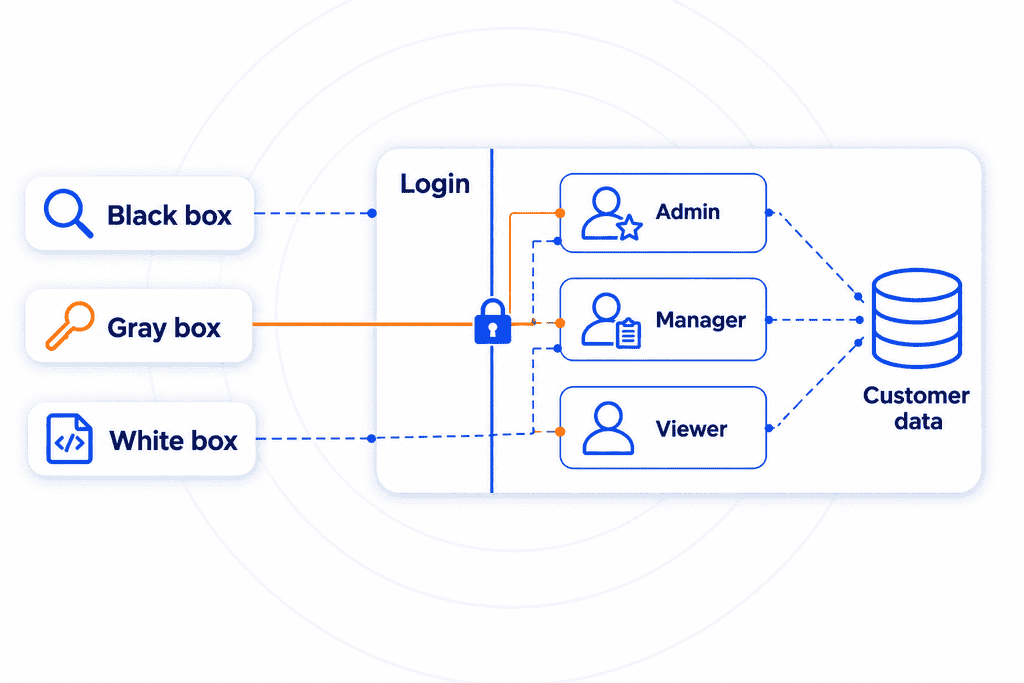
Testers can start with nothing (black box), with logins for each user role (gray box), or with logins plus source code and architecture documents (white box). Buyers often assume black box is the toughest, most valuable option, when for an app with logins it usually buys the least. Testers burn days finding the front door, and the flaws that hurt SaaS companies most, like one customer reading another customer’s data, sit behind the login. Gray box is the right default for most products. White box earns its cost on critical systems or when you want code-level depth. CYBRI’s box types guide compares the three in detail.
Count your user roles either way. A product with admin, manager, and viewer accounts needs testers logged in as each one, because most access-control bugs appear in the gaps between roles. Each added role adds testing time, and the price follows.
Map It to Your Compliance Frameworks Up Front
If the report will serve an audit, name the frameworks during scoping. A single report can map findings to more than one framework, so a company working through SOC 2 and ISO 27001 in the same year can often cover both with one engagement, as long as the scope spans both audit boundaries and the test dates fit both audit periods. Adding HIPAA or ISO 42001 to an existing program works the same way, though an AI standard also needs the AI features in scope.
Ask for the mapping at the start. Requested after the report is written, it usually means a revision; requested up front, it shapes the scope, the method, and the report around what each auditor reads.
One Test or a Program
A single test suits a company with a stable product and one deadline: an audit, a funding round, a first enterprise contract. Companies that ship weekly and field security reviews all year get more from a program, with tests scheduled through the year and retests after each round of fixes. CYBRI’s continuous testing guide covers how often to test. Settle this before the quote. A year of tests is priced differently from one, and the scope of each round can move with the product.
What to Leave Out
Scoping is also deciding what not to pay for. Software you don’t own, such as Salesforce, Stripe, or your email provider, stays out unless that vendor gives written permission; the test covers how your product is configured and connected to it. Cloud providers sit in between. AWS, Microsoft Azure, and Google Cloud let customers test their own resources under published rules, but never the provider’s underlying infrastructure.
Old staging servers, internal tools with no sensitive data, and a marketing site on a hosted page builder can usually wait or get a lighter check. Write every exclusion into the scope so the report states it plainly. Auditors read the exclusions as closely as the inclusions.
What to Send With a Quote Request
Put these in one short document:
- Why you’re testing, and the deadline behind it (audit date, contract date, launch)
- The targets in scope, with rough counts for each
- Your user roles, and whether test accounts already exist
- API documentation, if your team has it
- The frameworks the report should map to
- One-off test or ongoing program
- A technical contact who can set up access and answer questions during testing
Send the same document to every firm you’re comparing. Quotes built from one written scope can be compared line by line, while three quotes built from three different sales calls can’t.
Scoping a Test With CYBRI
A CYBRI engagement starts with a scoping call that turns your list into a fixed-price quote. The call covers the questions most buyers don’t think to answer ahead of time: how the mobile app was built, which roles exist, whether the AI feature can take actions, and which audit or customer the report has to satisfy. Testing is authenticated (gray or white box) by default. The pricing page shows packages by scope, from a single web app with up to two user roles to engagements covering several apps, APIs, and cloud accounts, plus custom projects such as standalone network or mobile tests.
Before testing begins, you get:
- A written scope and rules of engagement, the agreed testing dates, limits, and contacts, signed before anyone touches your systems
- Help with access setup: test accounts, IP allowlisting, and a named contact on each side
- Compliance mapping planned in, for every framework named on the call
During and after testing, senior OSCP-certified testers work manual-first, flag critical issues the same day, and can walk your team through the report on a call. Remediation testing is part of the quote too: a retest of your fixes inside a 90-day window, with an updated report.
To turn your scope into a quote, contact CYBRI.
Frequently Asked Questions
Should the test run against production or a staging copy?
Either works, and so does a mix of both. CYBRI tests in whichever environment you choose. Staging works when it matches production closely: same settings, same login system, realistic data. Production testing runs with agreed limits, such as no destructive actions, no attempts to knock the service offline, and an emergency contact who can pause testing. Many companies go hybrid: the riskier tests run on staging, and a lighter pass on production confirms the live configuration matches.
How long does scoping take?
Usually one call, if the list above is ready. Missing pieces, such as API documentation or test accounts, are what stretch it out, and they also delay the start date, since testing begins once the testers have full access.
Get a Quote That Matches What You Need
A rough list of your apps, APIs, and the audit or deal behind the test is enough to start. The call turns that into a written scope and a fixed-price quote, sized for the reader of the report and nothing more. Book a scoping call with CYBRI.