This article explains:
- What continuous penetration testing is, and how it differs from a scanner subscription or PTaaS
- How manual pentests and automated scanning fit together over a year
- How often to test for a SOC 2 Type 2 or ISO 27001 audit
- The blind spots of automated scanners
Quick answer
- What is continuous penetration testing? Continuous penetration testing (continuous pentesting) is a year-round security testing program that combines one to four manual penetration tests per year with automated vulnerability scanning between tests. Every test includes remediation support and a retest of fixed findings.
- What can a continuous penetration test cover? Any asset in scope: web applications, APIs, mobile apps, cloud environments (AWS, Azure, GCP), and external or internal networks. Each manual test can cover all of them or rotate through them, and the scanner checks in-scope assets for known vulnerabilities between cycles.
- How often does a continuous program test? Most programs run on one of four cycles: once a year, twice a year, every four months, or quarterly. Release frequency, data sensitivity, and audit requirements decide which cycle fits.
- Is continuous pentesting the same as VAPT? Close. VAPT (vulnerability assessment and penetration testing) pairs automated scanning, which finds known weaknesses, with manual testing, which proves what an attacker can exploit. A continuous program runs both halves all year instead of once.
- Who needs continuous penetration testing? Companies that handle sensitive data, such as health records, payment and financial data, or customer personal information, and companies that face recurring audits such as SOC 2 Type 2 and ISO 27001. Most have both.
- Is manual or automated penetration testing better? Neither covers everything alone. Manual testing finds business logic flaws and broken access control between user roles, which scanners miss, while scanners cover known vulnerabilities between tests.
Continuous Pentesting in Practice
A continuous penetration testing program runs on a fixed cycle: one to four manual penetration tests a year, each followed by fixes and a retest. Between cycles, a scanner flags newly announced flaws in widely used software, instead of leaving them for the next test.
Vendors often call this VAPT. The scanner handles the vulnerability assessment (VA), checking for known weaknesses such as outdated libraries, exposed admin panels, and missing patches. Penetration testing (PT) is the human part: a tester logs in as each user role and probes what a scanner can’t reason about, like whether one customer can approve another customer’s payment. Most critical findings come from this manual work.
The scanner stays out of the manual test on purpose. Testers already check for known vulnerabilities as they work, and scanner alerts would only muddy a report meant to hold proven issues. It also waits out the fix window, so it doesn’t re-flag issues the team is already fixing. It starts once each round of fixes is retested and runs until the next test begins.
How the Program Works: One Cycle, Start to Finish
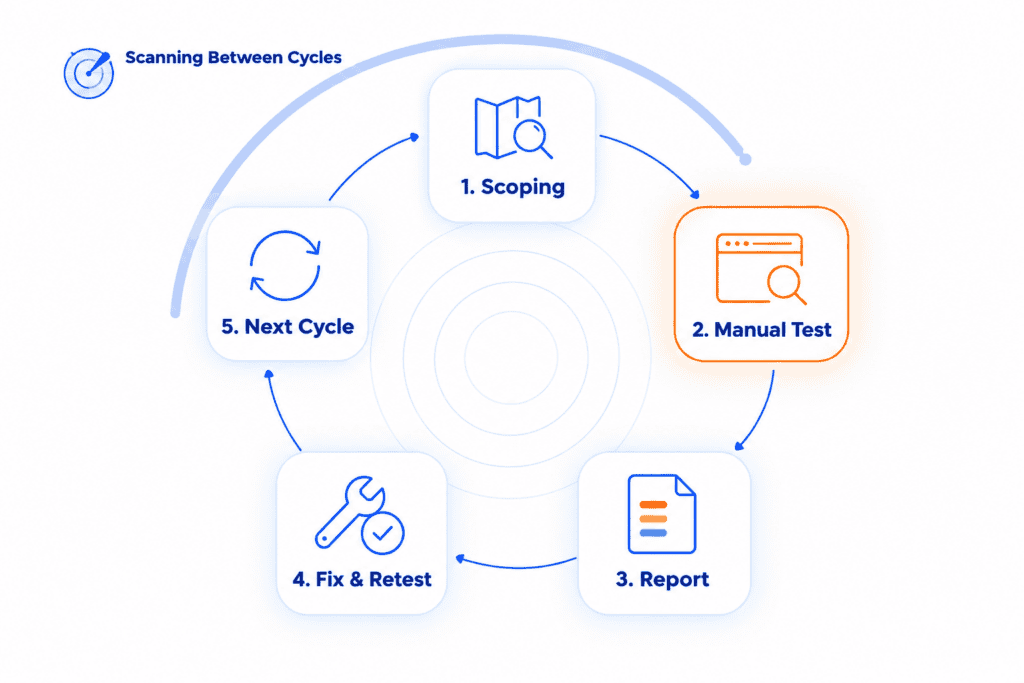
Every cycle follows the same five steps, whether the plan includes one manual test a year or four. The first cycle takes the most setup, and each one after it builds on the last.
- Scoping. The first cycle maps what gets tested: web applications, APIs, mobile apps, cloud environments on AWS, Azure, or GCP, and external or internal networks, plus the user roles inside them. Not every asset needs a full test each cycle: the main application can be covered every time while cloud and network reviews rotate through the year.
- Manual test. Over one to three weeks, depending on scope, testers first map the application: every page, API endpoint, and user role (recon and enumeration). Then they try to break it the way an attacker would. A critical, exploitable finding reaches the team the same day, not weeks later in the final report.
- Report and walkthrough. Findings are ranked by severity, each with steps to fix it, and a call with the testers walks the team through them.
- Fix and retest. Ninety days is the usual window on compliance work, and it covers two things: remediation support, with testers answering questions while engineers fix, and remediation testing, where testers retest each fix to confirm it holds. The cycle closes with an updated report showing what’s been resolved.
- Next cycle. When the next manual test comes around depends on the chosen cadence, from once a year to quarterly. It starts from the updated report and a list of what changed since, so testers build on what they already know about the application.
- Between cycles: scanning. Once the fixes are retested, an automated scanner takes over and checks for known vulnerabilities until the next manual test begins.
Choosing a Testing Cadence: Four Cycles
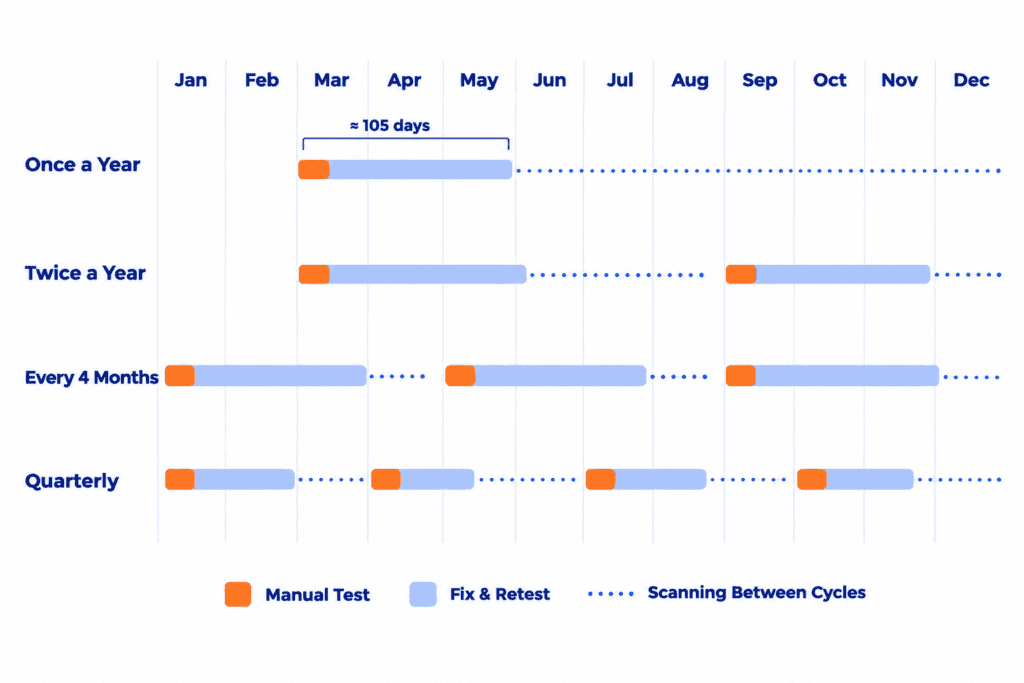
Most continuous programs run on one of the four cadences below. The cadence changes only how often the manual test comes around: every cycle follows the same five steps described above, with scanning running between them.
| Cadence | Manual tests a year | Best for | Audit and compliance angle |
| Once a year | 1 | Product changes slowly, it’s the first SOC 2 or ISO 27001 audit, or money is tight | Meets PCI DSS’s annual pentest requirement, and is usually enough for SOC 2 and ISO 27001 auditors too |
| Twice a year | 2 | Releases go out monthly and the customer base keeps growing | In a SOC 2 Type 2 year, month 3 and month 9 each get a test |
| Every four months | 3 | Frequent releases, sensitive data, several user roles or APIs | Each remediation window closes before the next test starts, so each cycle ends with a current updated report |
| Quarterly | 4 | Weekly releases, health or financial data, enterprise customers with strict security reviews | The fullest evidence trail for SOC 2 Type 2, in step with PCI DSS’s quarterly scans |
More frequent tests make each cycle lighter. An annual test covers a full year of changes, so the report is long and the fix window can pull engineers off planned work for weeks. A test every few months covers only recent changes: a shorter report, code still fresh in the developers’ minds, and fixes that fit into normal sprints.
The schedule can also flex. A big release, a new product, or an architecture change between cycles can trigger an extra targeted test, which PCI DSS and ISO 27001 both expect after significant changes. Timelines and deliverables are covered in more detail in What to Expect From a CYBRI Penetration Test.
Who Needs Continuous Pentesting: Compliance and Sensitive Data
Two situations push a company toward a continuous program: an audit that comes back every year, and data that would do real damage if it leaked. Enterprise buyers and cyber insurers add pressure from outside, asking for penetration test evidence from a third-party human tester.
SOC 2. Continuous pentesting is the best fit for SOC 2 Type 2. A Type 1 report checks controls on one date; Type 2 checks that they worked across an observation period of 3 to 12 months. One pentest report shows a control that ran once, while periodic manual tests, scans, and retests show one that ran all year. Pentests and scans aren’t mandatory for SOC 2, but its criteria list both as ways to check security (CC4.1 and CC7.1). More on SOC 2 Type 2 evidence and SOC 2 penetration testing.
ISO 27001. Certification runs on a three-year cycle with an audit every year, and the standard sets no testing frequency of its own. Controls A.8.8 and A.8.29 expect testing that follows the company’s risk assessment and any major change. A recurring program gives each yearly audit fresh evidence, and it documents the continual improvement the standard asks for. See ISO 27001 penetration testing for additional information.
PCI DSS is explicit. Quarterly external scans. A pentest at least once a year. That is the hybrid model, written into a standard. With HIPAA, GDPR, SEC and ISO 42001 it’s vaguer: they expect security to be checked and documented, without saying how often, and sooner or later an auditor asks to see the records.
SOC 2 and ISO 27001 don’t pick an interval either. The company does. Sensitive data should pull the tests closer together: the more often releases touch patient records (PHI), cardholder data (CHD), or customer personal data (PII), the less time should pass between manual tests.
Why Manual Testing Is the Core of the Program
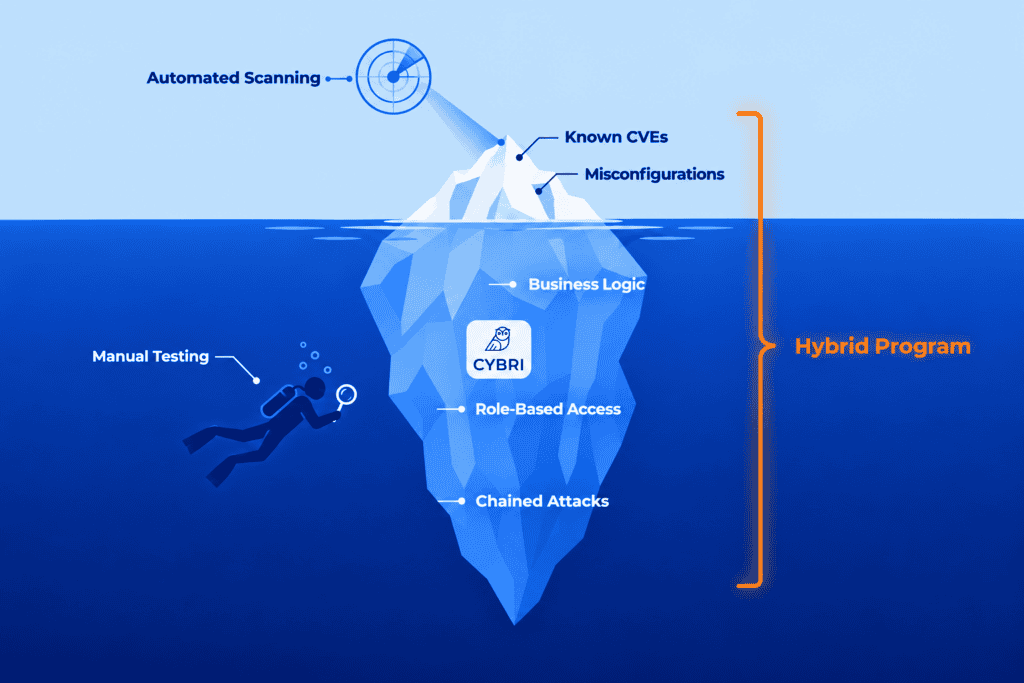
If the goal is to know what an attacker could do with the application, a person has to test it. Scanners compare what they see against patterns of known problems. A tester starts from what the application is for and asks what it should never allow.
Flaws that depend on intent. Some of the costliest bugs look like normal traffic. A coupon that applies twice, or a refund that lands in a different customer’s account, produces a well-formed request and a clean response, so nothing looks broken to a tool. A tester who knows the intended rules spots the break. The guides to business logic flaws and IDOR, BOLA, and privilege escalation cover these in depth.
Chained findings. A tester can combine a few low-severity issues, such as a verbose error message, a predictable ID, and a missing rate limit, into a path to someone else’s account. Rated one by one, none of them would reach the top of a scanner report.
Proven findings. Every finding in a manual report has been confirmed by a tester, with the evidence attached. Engineers spend their time fixing real problems instead of sorting through possible ones.
Evidence buyers accept. Auditors, enterprise security reviewers, and insurers want to know who tested the system and how. A report from senior, OSCP-certified testers, with a stated methodology and scope, answers both questions.
Manual Tests Plus Scanning: Why the Hybrid Pays Off Over Time
Neither half holds up on its own for long. A scanner keeps up with newly announced vulnerabilities but never learns how the application is supposed to work. Manual tests go deep, then leave months where a new flaw in a widely used library sits unnoticed. Together, each covers the other’s blind spot.
| Over a year | Scanner only | Manual tests only | Hybrid program |
| A new flaw announced in a library the app uses | Flagged at the next scan | Waits for the next test | Flagged between cycles |
| Logic and access-control flaws | Missed | Found each test | Found each test |
| What lands on the engineering team | Raw alerts to sort through | Proven findings | Proven findings, plus scanner alerts checked by a tester |
| Audit evidence | Supporting only | One report per test | Reports and scan records across the whole audit window |
| Budget | Low, with no pentest evidence | Set per test | One predictable yearly budget |
The payoff builds over time. Early tests clear out the deep issues, and later ones spend their hours on what changed. Between cycles, the scanner keeps known issues from piling up, so each manual test starts from a cleaner baseline than the last. One gap remains: a logic flaw shipped right after a test waits for the next one, and the cadence decides how long that wait is.
Methodology: The Standards Behind Each Cycle
Auditors ask how a test was run, so each cycle follows the same published standards. That keeps this year’s results comparable with last year’s.
- NIST SP 800-115 sets the order of every test: plan, discover, attack, report.
- OWASP sets what gets checked: the OWASP Top 10 for web apps, the API Security Top 10 for APIs, and ASVS 5.0 for detailed security requirements.
- NIST CSF 2.0 covers the management view. It expects vulnerabilities to be found, confirmed, and recorded (ID.RA-01), and improvements to come from security tests (ID.IM-02). A continuous program delivers both on a schedule.
Testers work in Burp Suite Professional, which captures and replays traffic, plus custom scripts that repeat a request across every user role and ID. Each finding gets a CVSS 4.0 severity score and a tag for the matching SOC 2 criterion or ISO 27001 control, so the auditor doesn’t have to map it by hand.
Frequently Asked Questions
Does SOC 2 need a pentest?
Not strictly. SOC 2 has no pentest mandate. Criterion CC4.1 does name it as one way to evaluate controls, though, and in practice auditors and enterprise customers ask for a recent report anyway. Type 2 audits are where frequency pays off: two or three tests spread across a 12-month observation period show the control working over time, which one report can’t.
Can a vulnerability scanner replace a penetration test?
No. Scanners catch what’s already documented, like a missing patch or an exposed service. They have no sense of how the application is meant to behave. A user reading another role’s data, a checkout that can be gamed, three small bugs chained into an account takeover: those take a human tester. Auditors and enterprise buyers treat a scan report as supporting evidence only.
What is the difference between continuous pentesting and PTaaS?
PTaaS (penetration testing as a service) is a way of buying, scheduling, and tracking tests through an online platform. Continuous pentesting describes how often testing happens: recurring manual tests with automated scanning in between. A PTaaS plan with one test a year is an annual test, while a PTaaS plan with quarterly tests and scanning is a continuous program.
What happens if a major release ships between scheduled tests?
A major release, new product, or architecture change can trigger an extra targeted test of the changed area, without waiting for the next scheduled cycle. PCI DSS and ISO 27001 ask for this after a significant change. Until then, the scanner covers known vulnerabilities between cycles.
How much does continuous penetration testing cost?
Cost depends on how many manual tests run per year, how many applications, APIs, and cloud environments are in scope, and how many user roles need testing. Each manual test is priced by scope, starting at $7,500 for a single web application on CYBRI’s pricing page, with continuous testing available as an add-on subscription.
Plan Your Testing Cycle
A continuous program starts from two facts: when the next audit window opens and how often the product ships. Together they point to a cadence, and a short scoping call turns that into a first cycle with a scope, dates, and a quote. Scoping can start before anything is signed.