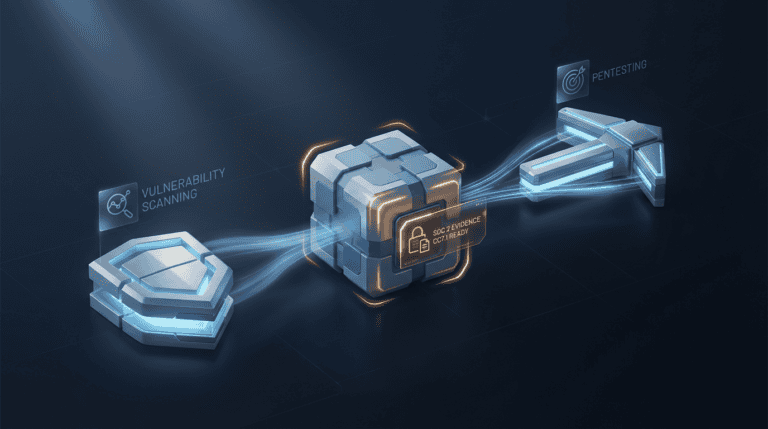
The Promise and Peril of Automated Penetration Testing
Penetration Testing as a Service (PTaaS) has emerged as a modern approach to cybersecurity, offering businesses a way to conduct security tests with more flexibility and speed than traditional, project-based engagements. Many PTaaS platforms are built around the promise of automation, suggesting that continuous, machine-driven scanning can keep organizations secure in a fast-paced development environment. This model promises to integrate security seamlessly into the software development lifecycle, providing constant feedback and rapid results.
However, heavy reliance on automation creates a significant risk. It introduces a blind spot for complex, context-dependent vulnerabilities. Automated tools are not designed to detect these issues. Although automation handles repetitive tasks well, it lacks creativity, intuition, and business understanding. Human experts provide these capabilities. As a result, this gap creates a false sense of security. An organization may believe it is protected because scans return clean results. Meanwhile, critical, high-impact vulnerabilities can remain hidden in plain sight.
The Pros of Automation in PTaaS: Speed, Scale, and Coverage
To understand the trade-offs, it is important to recognize the advantages of automation in a security program. These benefits explain why many organizations choose highly automated PTaaS platforms. Automated tools excel at speed and scale. They quickly scan large infrastructures and identify common, known vulnerabilities across thousands of assets. As a result, they help maintain a baseline level of security hygiene.
In addition, automation works well for routine tasks. It detects outdated software, simple server misconfigurations, and known vulnerability patterns. For example, automated tools often identify certain types of SQL injection. When integrated into a PTaaS platform, these tools enable continuous monitoring. They flag low-hanging issues and obvious configuration errors as they appear. Consequently, human analysts can focus on more complex threats. Overall, automation strengthens security programs. However, it does not replace human expertise.
The Automation Blind Spot: What Scanners Consistently Miss
The main weakness of automated security tools like SAST and DAST is their lack of contextual understanding. They rely on predefined patterns and signatures. As a result, they cannot understand business workflows or an attacker’s creative thinking. These tools detect technical bugs in code. However, they struggle with vulnerabilities that involve abusing legitimate application features in unexpected ways.
Because of this limitation, scanners may find simple technical flaws. At the same time, they often miss complex, multi-step attack chains that define modern cyber threats. This gap creates a dangerous false sense of security. Research shows that development speed is increasing, especially with AI coding tools. As a result, complex vulnerabilities are also becoming more common and harder to detect with automation. Many of the most severe issues require an adversarial mindset and deep business context. Human experts in web application penetration testing are best suited to uncover them.
Deep Dive: Business Logic Vulnerabilities
Business logic vulnerabilities are a class of flaws that allow an attacker to exploit an application’s intended workflow for a malicious outcome. Instead of breaking the code with a technical exploit, the attacker abuses the rules of the application itself. These flaws are unique to each application and depend entirely on its business context, making them invisible to generic scanners.
Common examples of business logic flaws include:
- Workflow Manipulation: An attacker manipulates a multi-step checkout process in an e-commerce application to apply a discount code, remove the qualifying items, and complete the purchase while retaining the unauthorized discount.
- Privilege Escalation: A user performs actions in an unexpected order to bypass a verification step, thereby gaining access to administrative functions or data they are not authorized to see.
- Parameter Tampering: An attacker modifies hidden form fields or API request parameters to change the price of a product or transfer funds from another user’s account.
Automated scanners cannot detect these flaws because they do not understand the business context. A scanner does not know that a user is supposed to pay for an item before accessing it; it only checks for technical errors like cross-site scripting. According to industry data, business logic weaknesses represent a significant portion of critical vulnerabilities, accounting for over 11% of critical findings in some analyses. These high-impact flaws can only be reliably discovered through meticulous, human-led testing.
Deep Dive: Chained Exploits and Contextual Risk
A “chained exploit” is an attack where multiple low-severity vulnerabilities combine to create a high-impact compromise. Real-world attackers often use this technique to bypass layered defenses and reach their goals. It requires creativity, planning, and a deep understanding of system interactions.
Automated scanners analyze vulnerabilities in isolation. For example, a tool may flag an information disclosure issue and an authentication weakness as separate low-risk findings. However, it cannot connect them. For instance, leaked data like a user ID or internal path may unlock an authentication flaw. This combination can lead to unauthorized access. Yet scanners treat these issues independently. As one report explains, “a tester will chain several types of exploits together with the goal of breaking through layers of defenses.”
In contrast, human penetration testers think in attack paths. They use creativity and context to link seemingly minor issues into critical security failures. This ability makes manual testing essential for understanding real-world risk. Without this analysis, organizations see only isolated findings. As a result, they underestimate the true impact of their vulnerabilities.
The Compliance Risk: Why Automation-Only PTaaS Fails Critical Audits
Relying on a purely automated PTaaS solution not only exposes an organization to security risks but can also lead to significant compliance failures. Many regulatory and industry standards require a level of testing depth and methodological rigor that scanners alone cannot provide. Auditors for frameworks like SOC 2, ISO 27001, and HIPAA expect to see evidence of a thorough and comprehensive risk assessment process.
The Payment Card Industry Data Security Standard (PCI-DSS), for instance, explicitly states that penetration testing is a “highly manual process” because it requires understanding and attempting to break a system’s business processes, something automated tools cannot do. A simple scan report often falls short of audit requirements, as it lacks the necessary context, proof of exploitation, and tailored remediation advice. In contrast, a detailed manual penetration test report provides a narrative of the attack, demonstrates the business impact, and offers clear guidance for remediation, which is precisely what auditors need to see to verify compliance. A formal audit checks if controls are adequate, and a manual penetration test proves if they are effective.
Failing to perform adequate manual testing can result in audit failures, loss of certifications, and regulatory fines. For businesses needing to achieve and maintain compliance for SOC 2 or ISO 27001, a manual-first testing approach is not just a best practice, it is a necessity.
The CYBRI Approach: Manual-First PTaaS for True Security
CYBRI’s PTaaS model is designed specifically to address the automation blind spot by prioritizing human expertise. Our approach is manual-first, ensuring that every assessment has the depth, creativity, and contextual awareness needed to find the critical vulnerabilities that automated tools are guaranteed to miss. We believe that technology should empower experts, not attempt to replace them.
Our U.S.-based Red Team of certified experts uses their adversarial mindset to uncover the complex business logic flaws and chained exploits that pose the greatest risk to your organization. These penetration testing services go far beyond a simple scan, simulating the actions of a determined attacker to provide a true measure of your security posture. The CYBRI platform serves as a collaborative hub, providing clients with transparent, real-time visibility into the progress of the manual test and facilitating direct communication with the testing team.
This methodology delivers the deep, rigorous assessments and detailed, compliance-ready reports that technology businesses need to secure their critical infrastructure. It provides the assurance required to achieve and maintain certifications like SOC 2, ISO 27001, and HIPAA, turning security from a liability into a business enabler.
Evaluating PTaaS: Questions to Ask to Avoid the Automation Trap
To avoid the pitfalls of automation-heavy platforms, businesses must ask discerning questions when evaluating PTaaS companies. These questions help differentiate a true penetration test from what is essentially a repackaged scanning service.
- ‘What is the balance between manual and automated testing in your process?’ This question reveals the depth of human expertise involved. A provider that emphasizes a manual-first approach is more likely to find the complex vulnerabilities that matter.
- ‘How do your testers specifically look for business logic vulnerabilities and chained exploits?’ This tests their understanding of context-dependent threats. Their answer should describe a methodical, creative process, not just reliance on a tool.
- ‘What certifications do your penetration testers hold, and will we have direct access to them?’ This assesses the quality and credentials of the experts performing the test. A collaborative platform should allow for direct interaction to resolve questions and speed up remediation.
- ‘Can you provide a sample report to show it meets compliance requirements for standards like SOC 2 or PCI-DSS?’ This verifies that the final deliverable is actionable and audit-ready. The report should provide a clear narrative, evidence of exploitation, and prioritized, practical remediation steps.
Conclusion: Don’t Mistake Scanning for Security
In evaluating the landscape of modern security testing, it is clear that while automation offers speed and scale for basic checks, it creates a dangerous blind spot for the most critical and impactful vulnerabilities. Business logic flaws and chained exploits are where automated tools consistently fail and human expertise excels. Relying on automation alone leaves an organization exposed to significant financial, reputational, and compliance risks.
True security assurance comes from combining the creativity and contextual understanding of expert penetration testers with the efficiency of a modern delivery platform. A manual-first PTaaS approach, which prioritizes deep, human-led analysis, is the most effective way to find and fix the vulnerabilities that matter most. This ensures your organization is not just compliant on paper, but genuinely secure against real-world threats.