Cyber threats directed against the healthcare sector are at unprecedented levels. In fact, healthcare data breaches reached an all time high with 168 million patient records compromised in 2023 [1]. This illustrates that cybersecurity in healthcare is not merely an issue of data protection, but one of continuity of care and patient safety.
Hospital breaches can literally endanger lives, and the average cost of a breach in healthcare is nearly $10 million, which is the highest of any industry [2]. Because of that, healthcare organizations need more than basic IT security – they need specific penetration testing to find risks before attackers find them.
This buyer’s guide will discuss why healthcare requires a distinct approach to penetration testing, profile the best organizations in this space, and lay out what to consider when selecting a partner.
Why Healthcare Requires Specialized Penetration Testing
Legacy Systems Create Unique Security Risks
Healthcare organizations handle highly sensitive patient data and often rely on outdated infrastructure. Around 73% of healthcare providers still use legacy systems [3], largely because upgrading critical devices or software may interrupt patient care.
These systems frequently cannot be patched or taken offline without operational risk. As a result, healthcare environments often contain vulnerabilities that require careful testing methods. Experienced healthcare penetration testers understand how to assess these systems safely without causing downtime or disrupting clinical workflows.
Compliance Requirements Demand Specialized Expertise
Healthcare organizations must comply with regulations such as HIPAA, HITECH, and HITRUST. A general penetration test may identify technical vulnerabilities but overlook compliance-related security gaps.
Specialized healthcare penetration testing providers understand how regulatory requirements apply to healthcare environments. Their assessments help organizations strengthen security while supporting compliance objectives and audit readiness.
Ransomware Threats Continue to Rise
Ransomware attacks targeting hospitals and clinics continue to increase because healthcare providers cannot tolerate prolonged outages. The American Hospital Association described 2023 as the “worst year ever” for healthcare cyberattacks, with 2024 breaches becoming even more severe in scale [3].
Because of this growing threat landscape, healthcare organizations must continuously evaluate the security of networks, applications, EHR systems, and connected medical devices.
Healthcare Environments Require Industry-Specific Knowledge
Healthcare penetration testing requires experience with medical workflows, third-party EHR platforms, legacy infrastructure, and patient safety considerations. Generic penetration testing firms may lack the expertise needed to assess these environments safely and effectively.
Choosing a provider with healthcare-specific expertise helps organizations identify vulnerabilities while minimizing operational risk and improving long-term cyber resilience.
Best Penetration Testing Companies for Healthcare (Vendor List)
1. Cybri
Best for: Healthcare organizations seeking a highly collaborative and transparent penetration testing partner with deep, certified expertise in healthcare compliance and security.
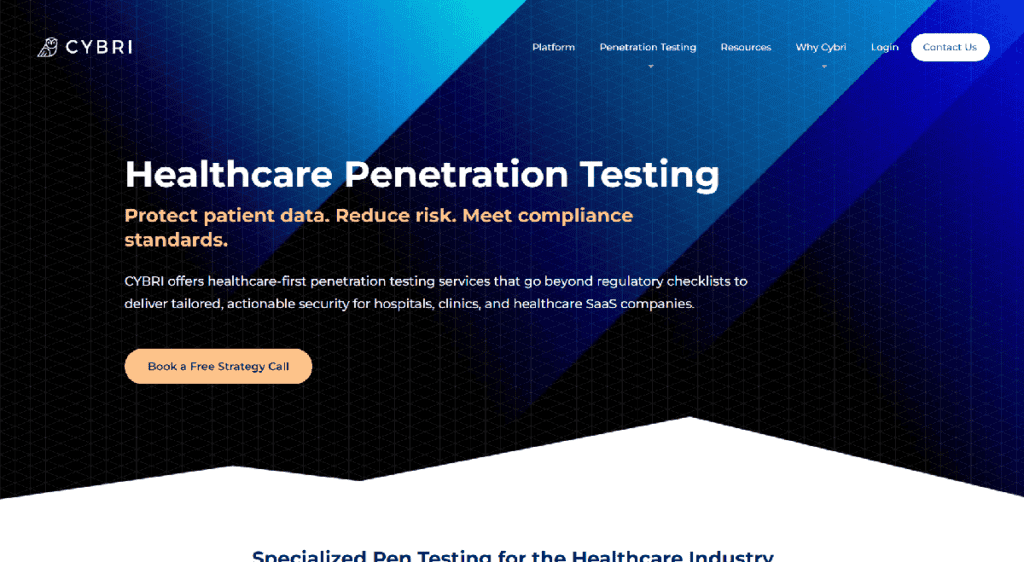
Cybri distinguishes itself as a premier penetration testing firm through its unwavering commitment to the healthcare sector. The company’s industry expertise is proven by its testers’ specialized knowledge in probing EHR systems, medical devices, and cloud-based healthcare applications with precision that avoids operational disruption. Their compliance alignment is exceptional, offering tailored assessments specifically designed for the HIPAA security rule and HITRUST CSF, ensuring that testing protocols directly map to regulatory requirements.
Cybri’s service offerings are enhanced by a highly collaborative model; clients engage directly with their 100% US-based Red Team through the proprietary BlueBox PTaaS platform. This tool provides real-time visibility into Cybri’s testing process, embodying transparency and enabling client IT teams to engage actively. A key strength is their client support & remediation, which includes clear, actionable guidance and complimentary retests to validate that vulnerabilities are resolved effectively.
Finally, Cybri brings detailed reporting to executives without losing track of risk and remediation for the technical teams and executives. The combination of a deep focus on healthcare, certified depth of expertise, and partnership-driven approach positions Cybri as a leading option for providers who prioritize security as a strategic necessity.
2. Drummond Group
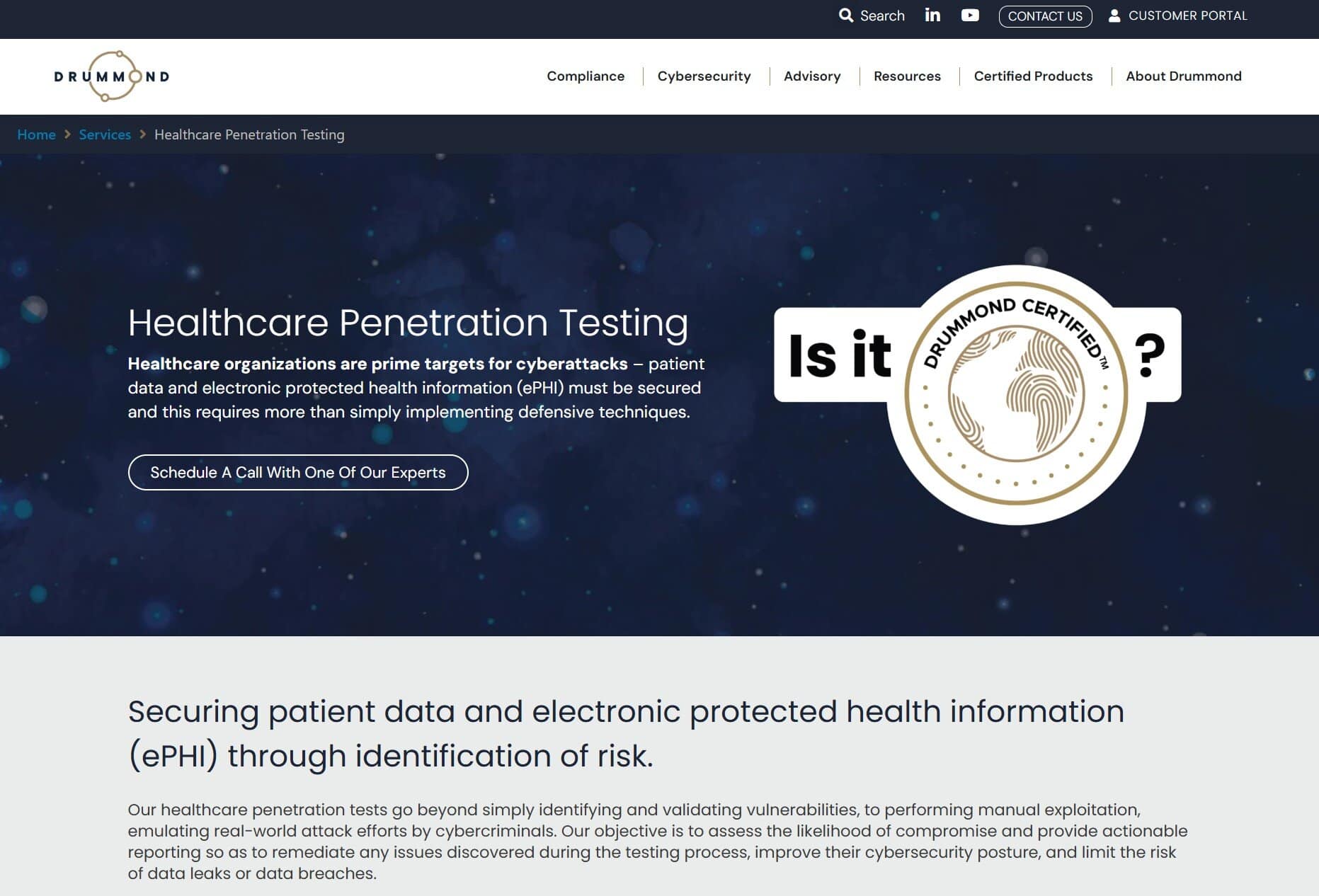
Drummond Group provides healthcare penetration testing services that involve manual exploitation and real-world attack emulation beyond the vulnerability assessments. The purpose of the approach is to understand the likelihood of compromise and reporting with actionable items to remediate the issues, to improve the organization’s cybersecurity posture and reduce the risk of a data breach.
Drummond Group’s Comprehensive Healthcare Risk Assessment (CHRA) can support a variety of regulations. But while their CHRA is valuable for demonstrating compliance, organizations primarily seeking a nimble, adversarial perspective might find the process better suited for audit preparation than for pure, unvarnished security testing.
They offer cloud penetration testing, social engineering, security awareness training, application testing, and IoMT / medical device testing. Drummond emphasizes trust, quality, and integrity, with experts who understand how to create solutions to fit each healthcare environment. They can thus be suited for large health systems that require rigorous, audit-ready compliance reporting. However, their comprehensive, framework-heavy approach might be more process than smaller organizations and startups with a straightforward tech stack actually needs.
3. Depth Security
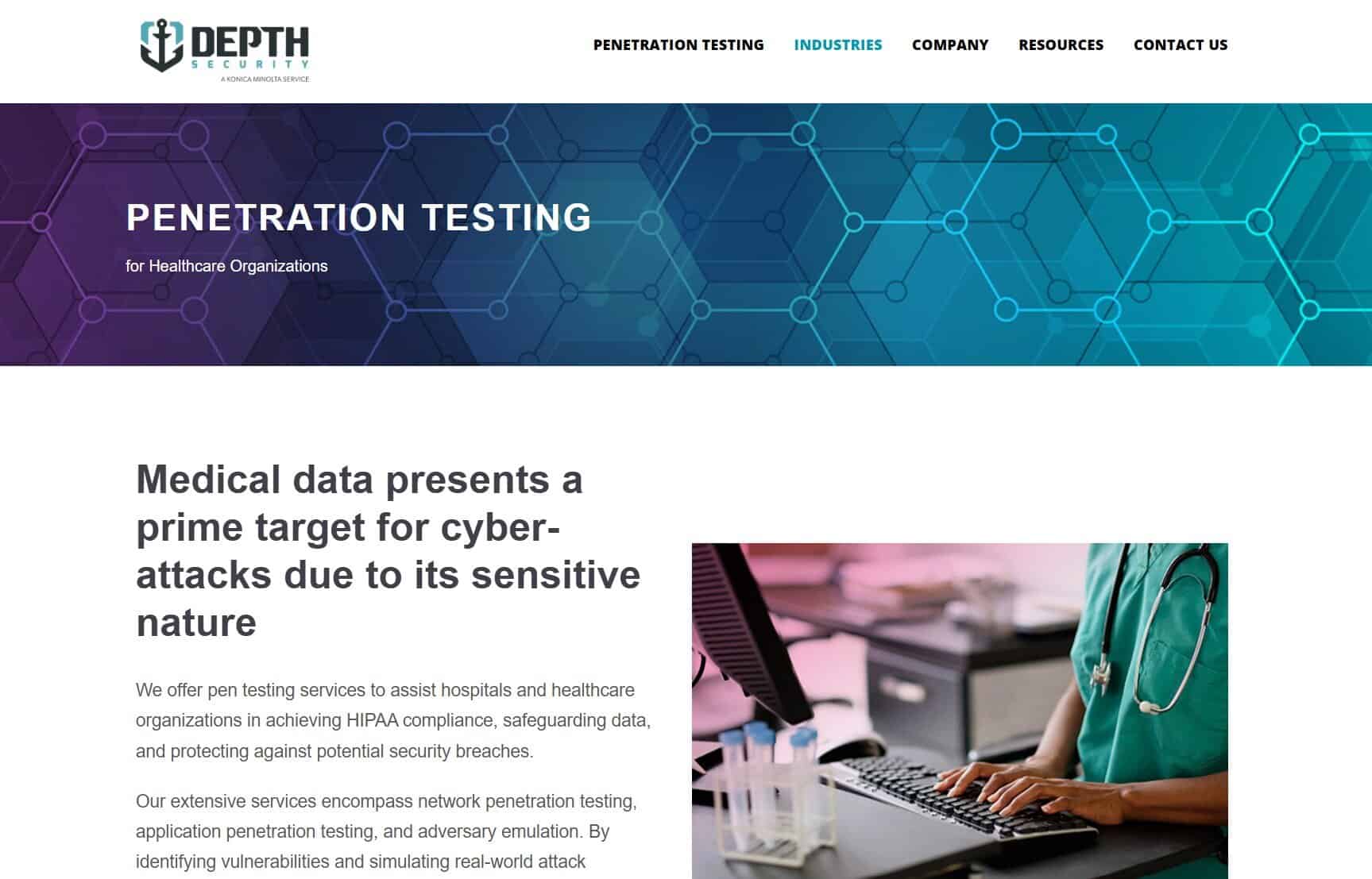
Depth Security offers penetration testing services to provide realistic attacks to identify and exploit vulnerabilities in healthcare networks and applications. Their established methodology, developed through numerous assessments, delivers detailed exploitation paths and concrete proof of concepts. While thorough, this comprehensive approach can sometimes uncover a volume of technical detail that may exceed the immediate needs of organizations seeking a more high-level, strategic overview of their risk posture.
Their services consist of network and application penetration testing, adversary emulation, and customized assessments in healthcare environments. Depth Security’s evidence-based, deep-dive methodology can be great for finding obscure vulnerabilities, but their intense, king-of-the-hill style of testing might be more aggressive than what is required for a routine compliance check.
4. Red Sentry
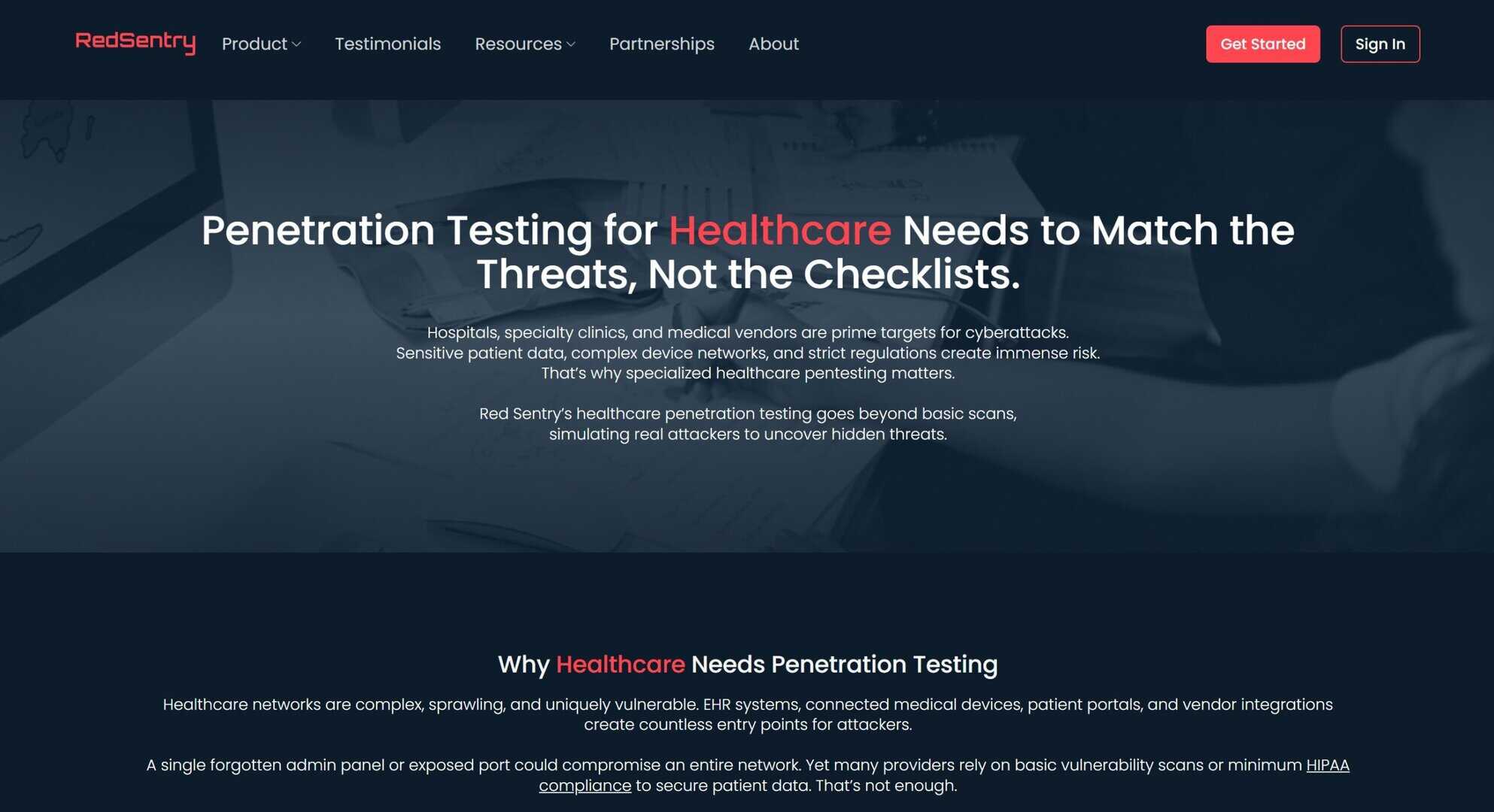
Red Sentry does healthcare penetration testing, simulating attacker methodologies to discover risks in healthcare systems like EHRs, medical devices, patient portals, and vendor integrations. By combining automated scans with man attacks, Red Sentry evaluates for technical vulnerabilities, business logic vulnerabilities, and social engineering weaknesses. Red Sentry also provides documentation to support compliance efforts and suggests steps to address security risks.
Their team is familiar with the challenges of clinical workflows, medical device security, and regulatory requirements. Red Sentry offers penetration testing services across various areas, including infrastructure, Internet of Things (IoT), and compliance-related assessments. Red Sentry can generate detailed reporting in days instead of weeks, but while Red Sentry’s promise of rapid, detailed reporting is attractive for fast-paced environments, organizations seeking a more methodical and thorough testing pace might find their accelerated timeline less conducive to learning.
5. Software Secured
Best for: Healthcare SaaS companies and technology vendors requiring manual penetration testing with robust remediation support and compliance mapping.
Software Secured provides manual penetration testing for healthcare applications handling sensitive PHI. Their methodology maps vulnerabilities to frameworks such as OWASP Top 10, SANS Top 25, and NIST to facilitate HIPAA compliance. They provide detailed reports that include remediation suggestions, stating that they do not provide false positives. For vulnerability triage and tracking, the company provides continuous support via Slack for teams willing to engage in vulnerability management in a dynamic and asynchronous manner.
In terms of service, Software Secured conducts testing for network, web application, mobile and APIs, as standalone engagements or as Penetration Testing as a Service (PTaaS). Software Secured has a reputation for finding high risks (approximately 20% of findings were rated as high severity) and showing transparent pricing. However, their approach to engagement in supporting developers, provided via slack, may not be ideal for more traditional healthcare providers that might prefer formal communications or more standardized project management approaches.
Key Evaluation Criteria: How to Choose the Right Partner
| Criteria | What It Means | Why It Matters for Healthcare |
| Industry Expertise | A provider with proven experience working with healthcare systems like EHRs and medical devices. | They understand critical workflows and are less likely to disrupt patient safety or 24/7 uptime during testing. |
| Compliance Alignment | The firm is knowledgeable about regulations (HIPAA, HITRUST) and incorporates compliance checks into the test. | The pentest must not only find technical holes but also support mandatory regulatory risk assessments. |
| Service Offerings | The vendor can test all layers of your environment, from networks and cloud to medical IoT and social engineering. | Healthcare IT ecosystems are broad; multifaceted testing ensures no critical area is overlooked. |
| Reporting Quality | Clear, actionable reports that rank findings by risk and include detailed remediation instructions are provided. | Good reporting links vulnerabilities to compliance requirements and offers a roadmap for enhancing security. |
| Certifications & Credentials | Both the business and its testers possess the necessary qualifications, such as CISSP, OSCP, and HITRUST Assessor. | Certifications serve as a reminder that the supplier upholds strict standards and stays current with security best practices. |
| Client Support & Remediation | Retesting, remediation assistance, and debriefs are part of the post-test support provided by the vendor. | Having a partner to help plan fixes is essential for implementing significant security improvements with frequently overworked IT staff. |
Final Thoughts & Next Steps
Selecting a pen testing partner is a very important step for any healthcare organization. The costs are high: patient data, trust, and safety can be at risk. As we’ve described, the very best providers mix technical capability with domain knowledge specific to the healthcare space.
Providers not only bring strong hacking skills, they also bring an understanding of the clinical workflows, the nuances of medical devices, and the compliance requirements. By selecting a true specialist in this space, healthcare organizations can identify where vulnerabilities exist, before it is discovered by an attacker, and the organization can continue to provide care to patients.
As a next step, healthcare security leaders should evaluate what testing they currently need and contact one of the approaches outlined in this guide. Talk to them about your environment and challenges; good partners will want to adapt their approach to your reality. For example, Cybri provides free consultations to scope healthcare penetration testing engagements and describes how their BlueBox platform keeps clients engaged during testing.
In the end, your aim should be to establish a permanent relationship with a security firm that will protect your organization from the next attack year after year. Cyber threats are constantly changing, so your company shouldn’t waste any more time. You can guarantee better protection for your patients and their data in the future by enhancing your security today with specialized penetration testing.
Frequently Asked Questions
The cost difference between a test can be significant depending on the scope and complexity of the test. A small clinic may pay a few thousand dollars for a limited engagement and a large health system may pay tens of thousands to a vendor performing comprehensive security assessments, including exploratory engagement.In general, a typical professional penetration test is in the $10,000 to $35,000 range on average [5] and there will be complex projects that go above $50,000.
At least once a year is a common baseline for healthcare organizations, according to a number of industry experts [6]. There are many industry standards that recommend annual testing, and that is typically ample time to identify new vulnerabilities related to a year of IT changes. In some situations (e.g., like after app updates), testing on a more frequent basis may be the best approach.
A HIPAA risk assessment is a wide reaching examination of security risks and controls across the organization, usually administrative,while a penetration test is a narrow and technical test where ethical hackers actively exploit vulnerabilities. Under the HIPAA Security Rule, healthcare organizations must conduct periodic risk analyses of their ePHI security [7].
References
- HIPAA Journal. (July 2025). Healthcare Data Breach Statistics
- HIPAA Journal. (July 2024). Average Cost of a Data Breach Rises to $4.88M; Falls to $9.77M in Healthcare
- Paubox. (June 2025). Modernization of healthcare legacy systems
- S2S Communications. (July 2025). Why Healthcare Needs Specialized Penetration Testing to Protect Patient Data
- Network Assured. (August 2024). How Much Does Red Team Penetration Testing Cost Today?
- Gartner. (2023). How frequently do you perform penetration testing of your web applications?
- Outpost24. (Aug 2025). Does HIPAA require penetration testing?