Almost everything a company gets paid for ends up in a database. Customer records, payment history, support tickets, the files clients upload. It is also the layer that gets tested least, and the reason is mundane: hardly anyone sells a database penetration test on its own.
Look through the service pages of the better-known US testing firms and the word “database” barely shows up. Testing is sold by asset. Web app, API, internal network, cloud. The data layer gets covered as a byproduct of one of those, or it gets missed. Which makes the buying question different from what most people expect. Not who sells a database pentest, but which firm reaches the database during work it does sell, and what its testers do once they are in there.
This guide compares seven US-based companies that reach the data layer, and says plainly which kind of company each one suits. For the mechanics of what gets checked once a tester has database access, CYBRI’s guide to database penetration testing goes through it in detail.
The seven companies on this list:
- CYBRI: best for SaaS companies and smaller teams that want the database tested inside the same engagement as the app, API, and cloud, with the findings explained on a call
- NetSPI: best for large companies running big Microsoft SQL Server estates that want testers with years of published database attack research behind them
- TrustedSec: best for organizations where the database sits inside a large Windows and Active Directory environment
- Raxis: best for teams that want to see in writing how far an attacker gets from one compromised laptop toward the records
- Triaxiom Security: best for mid-size companies with a PCI DSS deadline and a cardholder database in scope
- Rhino Security Labs: best for companies whose data lives in managed cloud databases
- Red Siege: best for lean teams that want to know what one stolen employee password could reach
Why the Data Layer Gets Tested Last
Nobody decides to skip the database. It falls out of scope quietly, during paperwork, and the gap only shows up when an auditor or a customer asks a question the last report cannot answer.
The Scope Form Never Asks
A quote request asks for domains, IP ranges, and the number of user roles. Nothing on that form says “the database.” So unless somebody raises it, the scope gets built around the app and the network, and the data layer rides along as whatever the app happens to expose. One sentence on the scoping call fixes it. Ask whether the test will use a real database login, or only reach the database through the app’s inputs.
An App Test Knocks on the Front Door Only
A web application test looks for ways to make the app misbehave, and good testers do find flaws that pull data out of the database that way. What that test cannot see is the inside. Which accounts exist, what each one is allowed to read, whether the service account the app logs in with has rights far beyond the handful of tables it uses, whether last night’s backup is encrypted. Those answers come from working inside the database with a real account, at the privilege level a regular employee or a compromised app would have.
A Managed Database Is Still Yours to Secure
Teams running Amazon RDS, Cloud SQL, or Azure SQL often assume the provider has this covered. The provider patches the engine, replaces failed hardware, and keeps the service running. Accounts, privileges, network exposure, snapshot permissions, and encryption settings stay with the customer. Most cloud data incidents trace back to one of those, not to a flaw in the provider’s software.
What Auditors Want to See
PCI DSS puts the cardholder database in scope by definition, and asks for encryption of stored data, least privilege, and testing at least every twelve months. HIPAA expects periodic technical evaluation of systems holding health data. GDPR names encryption and regular testing in Article 32. SOC 2 and ISO 27001 do not require a database test by name, and auditors still ask what was tested and what happened to the findings. A report that stops at the app layer leaves that question half answered.
How These Companies Were Chosen
Every company here met the same bar:
- US headquarters, for contracts, data handling, and working hours that match yours
- The data layer is within reach of what they sell, through internal network, application, API, or cloud testing
- Manual exploitation by senior testers, with a person confirming every finding
- Published evidence of data-layer work, on their own pages or in their research, whether that means database accounts, privileged accounts, or cloud data stores
- Reports two audiences can use, a non-technical approver and an auditor
- An established practice with a public track record
Retest terms vary across the list, so retesting appears further down as a question to ask rather than a claim made on anyone’s behalf.
The 7 Best Database Penetration Testing Companies in 2026
1. CYBRI
Best for: SaaS companies and smaller teams that want the database tested inside the same engagement as the app, API, and cloud, with the findings explained on a call
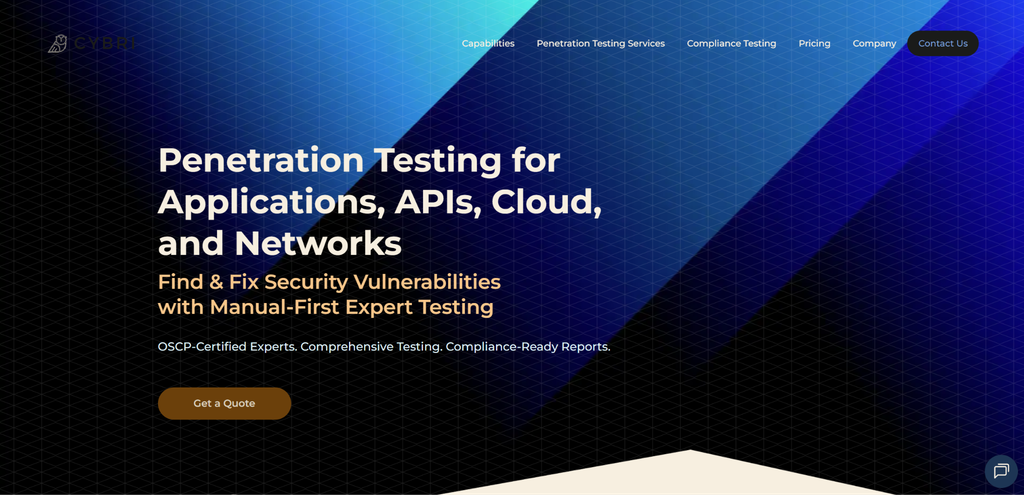
CYBRI is a New York penetration testing company that has worked mostly with SaaS businesses since 2017. Testing is manual-first and run by senior US-based testers who hold the OSCP certificate. Every engagement carries basic database coverage, reached through the app, the API, the network, or the cloud account, depending on what is in scope.
The deeper work goes further, and it gets added to the scope of an engagement rather than sold as a separate product. Testers start from a low-privilege or unprivileged database account, the same position a regular employee or a compromised application sits in, and work from there: what that account can read, how far its rights can be stretched, which paths lead toward administrator access, how the data sits at rest. Scoping includes setting up that account and the connection details, so the first day of testing is spent testing.
Reports come in two parts. A plain-language summary for whoever signs off, and technical findings with severity scores and fix steps for the engineers. Mapping covers PCI DSS, HIPAA, SOC 2, ISO 27001, and GDPR. Anything critical gets flagged the same day it is confirmed, ahead of the report. Remediation support and a retest inside a 90-day window are part of the quote, so fixes get verified rather than assumed.
For a company with a small engineering team and no in-house security staff, the practical difference is access to the testers. Scoping is a short conversation rather than a procurement cycle, the findings get walked through on a video call with both teams on it, and questions during the fix work go straight to the people who found the problem.
2. NetSPI
Best for: large companies running big Microsoft SQL Server estates that want testers with years of published database attack research behind them
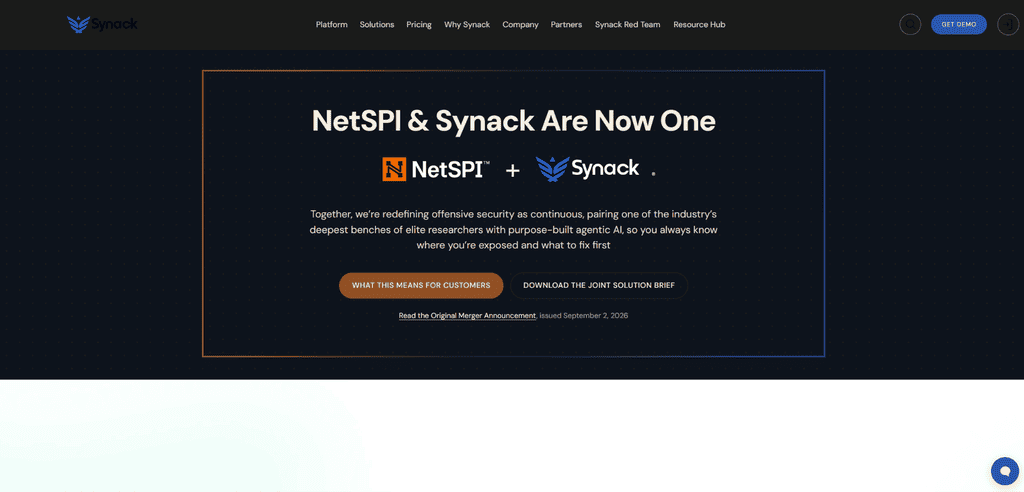
NetSPI, based in Minneapolis, has been testing since 2001 and runs one of the larger service catalogs in the US market. Internal network, external network, host-based, application, API, cloud across all three major providers, mainframe, and secure code review all sit under one roof.
What sets NetSPI apart on a database list is what its team has published. Its researchers built and released PowerUpSQL, an open-source toolkit for attacking SQL Server that finds instances across a Windows domain, audits them for weak configuration, and looks for ways a limited account can climb to full administrator rights. NetSPI has also released DAFT, a database auditing tool that can search SQL Server tables for sensitive data by keyword. Few firms have put that much public work into one database platform.
For an enterprise with hundreds of SQL Server instances, dozens of third-party applications that each brought their own database, and a Windows domain tying it all together, that depth is the reason to call. NetSPI fits companies that need breadth of coverage and testers who already know how a large SQL Server estate falls over.
3. TrustedSec
Best for: organizations where the database sits inside a large Windows and Active Directory environment
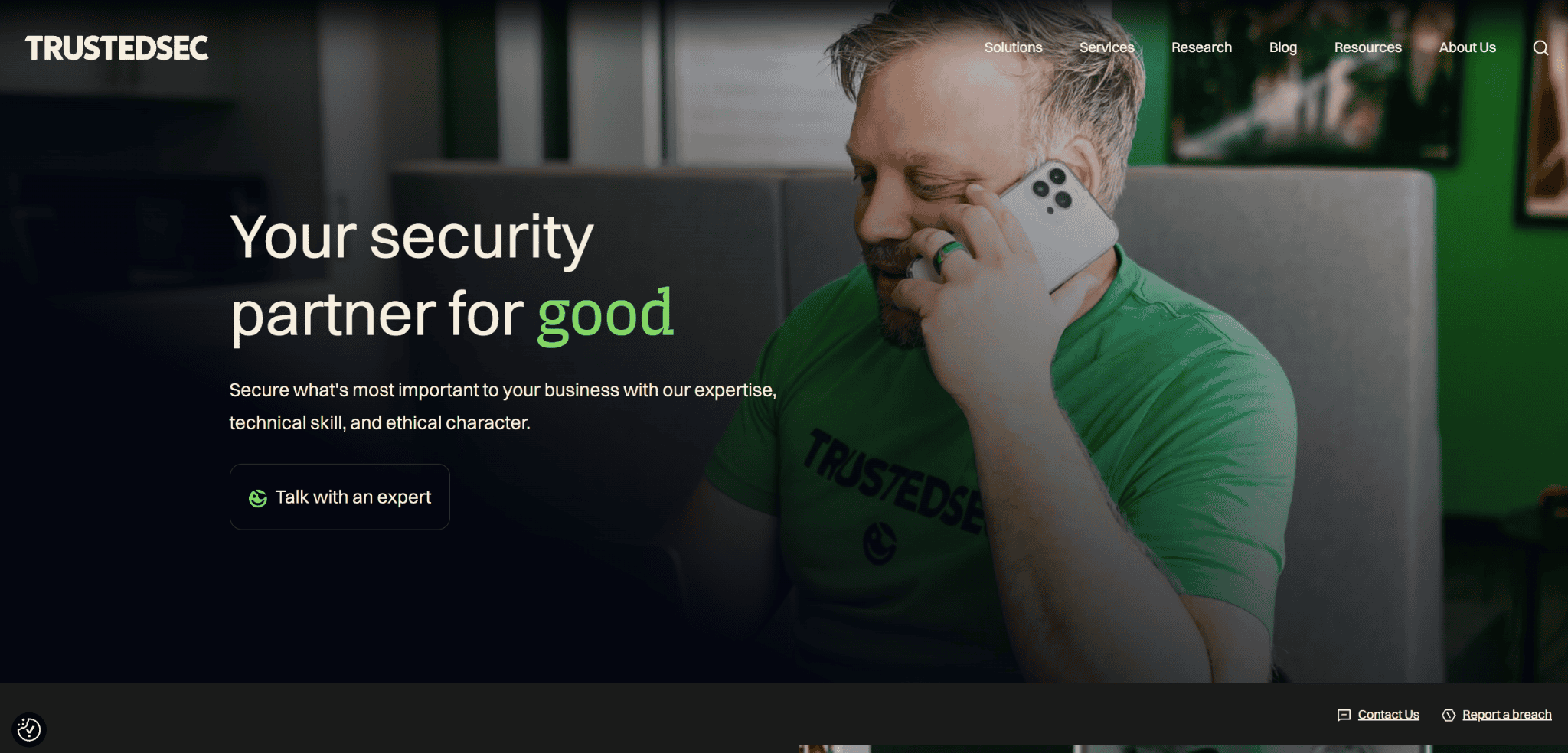
TrustedSec, based in Ohio, was founded in 2012 by David Kennedy. It holds CREST certification for penetration testing, and Forrester named it a Leader in The Forrester Wave: Cybersecurity Consulting Services, Q2 2024, where it received the highest scores in both the current offering and strategy categories among the fifteen providers evaluated.
Its engagements follow a published sequence: scoping, reconnaissance, finding the weaknesses, exploiting them by hand, reporting, then validation testing once fixes are in, where the testers go back and confirm the problem is gone. The firm’s strongest specialty is the Microsoft environment around the data. Its Active Directory assessment covers forests, domains, group policies, privileged accounts, and service accounts, with findings tied to MITRE ATT&CK, the industry catalog of real attacker techniques. The Trimarc team joined TrustedSec in 2025, bringing one of the small number of Microsoft Certified Masters in Active Directory with it.
That matters for the data layer more than it first sounds. In most mid-size and enterprise networks, database logins are domain accounts, and the service account an application uses to reach its database is managed in Active Directory. Fix the domain and you have fixed much of the route to the records. TrustedSec suits organizations with that shape, and with a security team that wants consultants who will also help harden what they found.
4. Raxis
Best for: teams that want to see in writing how far an attacker gets from one compromised laptop toward the records
Raxis is an Atlanta firm that has been testing by hand since 2011. Its internal network work is run by senior US-based engineers holding certificates such as OSCP and OSCE, with no outsourcing and no junior testers practicing on a client’s network.
The internal test starts from a position most companies worry about and few have measured: one machine inside the building, under an attacker’s control. From there the testers move between systems the way a real intruder would, capture and crack credentials, abuse Active Directory misconfigurations that turn an ordinary user into a domain administrator, and map how much ground one compromised host covers. Network segmentation is checked directly, including whether sensitive segments such as PCI cardholder data are actually walled off. The objective is stated in the same terms a non-technical reader thinks in: how close a tester can get to the most sensitive data.
Deliverables suit a board as much as an engineering team. An executive summary, technical findings with reproduction steps, an attack storyboard that lays out the path from first foothold to the data, and an attestation letter. Retesting of fixed findings is included at no extra charge. Findings show up in the Raxis One portal as they are discovered and can sync to Jira or GitHub.
5. Triaxiom Security
Best for: mid-size companies with a PCI DSS deadline and a cardholder database in scope
Triaxiom Security works out of Charlotte, North Carolina, and says more than 650 security teams have chosen it. Its process is the most predictable on this list: scoping, a flat-rate quote within hours, a kickoff call, testing, a quality review, a report presentation, and a retest. Quotes carry no hidden fees, and a one-time retest within 90 days of report delivery is included free of charge. Triaxiom is a CREST-accredited provider, and its engineers hold certifications including OSCP and OSWE.
Payment card work is where Triaxiom’s strength touches the database directly. Its engineers include PCI Qualified Security Assessors, and PCI DSS makes the cardholder data environment the center of the assessment, which is a database question before it is anything else. An internal penetration test sits in the same service line, which is how the question of what an attacker already inside the network can reach gets answered rather than assumed.
Companies with an audit date on the calendar tend to like the speed. A quote lands in hours, testing launches in days, and the retest is already paid for before anyone needs it.

6. Rhino Security Labs
Best for: companies whose data lives in managed cloud databases
Rhino Security Labs is a small specialist firm known for its cloud security research. Engagements are manual and deep rather than broad: the firm puts roughly 95% of a test in a person’s hands, and pitches itself to buyers who want more than a vulnerability scanner gives them.
Cloud is the specialty, with dedicated testing for AWS, Google Cloud, and Azure, alongside web application, network, and secure code review work. For a modern SaaS company that combination is closer to a database test than it sounds. When the records live in a managed service, the way in is rarely a flaw in the database engine. It is an over-permissive role, an instance reachable from more places than anyone intended, or a snapshot that somebody shared and forgot. Rhino’s cloud research has been covered by WIRED and Krebs on Security, which is unusual for a firm this size.
Reports are built for executives and engineers alike, carrying a risk summary and the vulnerability detail together. The firm is also candid about its calendar: its own FAQ says scheduling can be filled two to six weeks out, and most projects run multiple weeks, so this is one to approach early. Retest terms are not published, so raise them during scoping. Rhino fits teams who would rather have a small group of specialists on their cloud accounts than a large firm’s standard checklist.
7. Red Siege
Best for: lean teams that want to know what one stolen employee password could reach
Red Siege, founded in 2017 and led by CEO Tim Medin, builds engagements around a single question: which data would hurt most if someone took it. Every test is scoped around the data and processes a client can least afford to lose, rather than a fixed template.
The service that fits a database conversation best is the Assumed Breach Assessment. Rather than spending days getting in, the testers start where a phishing email or a reused password would put them, as a compromised user inside the network, and move from there toward critical data. A cloud version covers Microsoft 365 and AWS environments. Web application and API testing is available too, done by hand and role by role, which is how the injection flaws that reach a database get found.
Reporting is deliberately short on noise. The firm commits to reporting the issues that pose real risk, which suits a small team that cannot act on a hundred low-severity items. For companies with a handful of IT staff and no appetite for a platform subscription, Red Siege is a sensible call.
How to Choose a Partner for Database Testing
All seven firms reach the data layer. They get there by different routes, which means two quotes can look similar and cover very different ground. Use these points to compare them:
| Criteria | What to look for |
| Database access during the test | Whether testers get a real database login, and at what privilege level. Working from inside with a low-privilege account is the part an app test cannot replace. |
| Engines in scope | SQL Server, Oracle, MySQL and MariaDB, PostgreSQL, MongoDB, and managed cloud databases each fail in their own way. Name yours during scoping. |
| Where the test starts | From the internet, from inside the network, or from a user account an attacker already controls. The third one produces the most useful answers about data. |
| Privileges | Whether anyone reviews which accounts can read which tables, especially the service account the application uses. |
| Data at rest | Encryption, backups, and snapshot permissions. A stolen backup is a breach with no attack required. |
| Segmentation | Whether an ordinary laptop can reach the database at all. Required reading for PCI DSS, useful for everyone else. |
| Retest terms | Included, offered on request, time-limited, or quoted separately. Ask before signing, since terms differ across every firm on this list. |
| What the report gives an auditor | Severity scoring, fix steps, framework mapping, and in some cases an attestation letter. |
Scope follows the data, not the org chart. A company with one application and one small database is well covered by a good application test. A company with a shared database behind several products, a recent migration, or regulated records needs somebody working inside the data layer with an account in hand.
A Database Test and a Database Scan Are Not the Same Purchase
Some providers sell database scanning, which checks configuration and patch levels against a baseline and produces a list. That has value, and compliance programs often ask for it. A scan compares settings to a standard. A test tries to get the data.
The difference shows up in the findings. A scan reports that an account holds broad permissions. A tester logs in with that account, reads a table it should never have been able to touch, and documents the exact steps so an engineer can reproduce it and a manager can see what it would have cost. Both have a place. Just know which one a quote is offering, because the two are priced and scoped very differently.
Final Thoughts
Each firm on this list does strong work at the data layer, and the right pick depends on how your records are hosted and who needs to read the report. Large Microsoft estates point toward NetSPI or TrustedSec. A PCI deadline points toward Triaxiom. Cloud-hosted data suits Rhino Security Labs.
For a SaaS company or a smaller team, CYBRI is the strongest fit. The database goes into the same engagement as the app, the API, and the cloud account, so one report shows the whole path from an internet-facing input through to customer records. Testing starts from a low-privilege database account rather than guessing from the outside, criticals arrive the same day they are confirmed, and the findings get explained on a call instead of landing as a PDF nobody can interpret. A short scoping conversation is enough to size the work, so contact CYBRI to get started.
Frequently Asked Questions
Does a web application pentest already cover my database?
Partly. A web app test finds flaws that pull data out through the application, including SQL injection, and that is real coverage. What it does not examine is the inside of the database: which accounts exist, what each one can read, whether the application’s own login has far more rights than it needs, and whether stored data and backups are encrypted. Those require a tester working with a database account.
Do testers need access to the database?
For the deeper work, yes, and the usual setup is a low-privilege account plus connection details, created during scoping. It sounds counterintuitive to hand out a login, and it mirrors how most real incidents start, with credentials someone already has. Testing without it limits the work to what the app exposes.
Is a managed cloud database the provider’s responsibility?
The provider handles the engine, the patching, and the infrastructure. Everything that decides who can reach the data stays with the customer: accounts and privileges, network exposure, snapshot sharing, and encryption settings. Those are the parts worth testing.
Do PCI DSS, HIPAA, or GDPR require a database test by name?
None of them names one. PCI DSS puts the cardholder database in scope and asks for stored-data encryption, least privilege, and testing at least annually. HIPAA expects periodic technical evaluation. GDPR’s Article 32 names encryption and regular testing. Auditors reviewing SOC 2 or ISO 27001 ask what was tested and what came of the findings, and a report that includes the data layer answers that cleanly.
Ready to Put Your Database in Scope?
CYBRI runs manual, senior-led penetration tests where the data layer is part of the engagement rather than an upsell, with testers working from a low-privilege database account, same-day alerts on critical findings, remediation support and retesting inside a 90-day window, and reports mapped to SOC 2, ISO 27001, PCI DSS, HIPAA, and GDPR. Learn more about network and infrastructure penetration testing or contact CYBRI for a quote.