Every penetration test of an application covers two halves. The frontend is the screens and buttons a user sees. The backend sits behind them: the servers, the APIs (the web addresses an app calls to read and change data), and the logic that stores records and decides who may do what. Testing the frontend shows what a user can do through the interface. Backend penetration testing skips the interface and sends requests to the server directly, which is how attackers work once they stop using the app as intended. This article covers what lives in the backend, the flaws that tend to show up there, and how testing it differs from testing the screens.
Quick Answers
What is a backend penetration test?
A manual, authorized attack on the server side of an application. The tester talks to the APIs directly and checks login and permission rules, input handling, business logic, and the connections to databases and other services.
What does it find that a frontend test or a scanner won’t?
Mostly authorization and logic flaws: one customer opening another customer’s records, a regular account calling an admin function, a refund with a negative amount. Injection and SSRF (tricking the server into making requests on the attacker’s behalf) turn up too. Scanners miss the first group because they can’t tell who is supposed to be allowed to do what.
Is it separate from a regular pentest?
No. Any proper application or API pentest includes the backend. What’s worth checking is that the scope names the server side, not only the screens.
Who needs it most?
Companies that run an API or SaaS product, store many customers’ data in one shared system, handle regulated data, or have only ever had the frontend tested or scanned.
What Is Backend Penetration Testing?
A backend penetration test is a manual, authorized attack on the server side of an application. The tester usually starts with a predetermined user account and looks for anything the server allows that it shouldn’t.
In scope: every endpoint, meaning each address the server exposes; authentication, how the server confirms who a user is; authorization, how it decides what that user may do; input handling; requests the server makes to other systems; business flows such as checkout and refunds; configuration; and the queries the application sends to its database.
Other tests cover the layers around it. A frontend test looks at the screens, and a network or infrastructure test looks at the servers, firewalls, and network underneath. The backend test covers the part in between, the code that receives a request and decides what to do with it.
Why Trust Boundaries Are the Center of Backend Security
The frontend runs on the user’s own device, so anything it enforces can be changed or skipped. A web application firewall blocks known attack patterns but can’t tell whether this customer should see that invoice. Only the backend can.
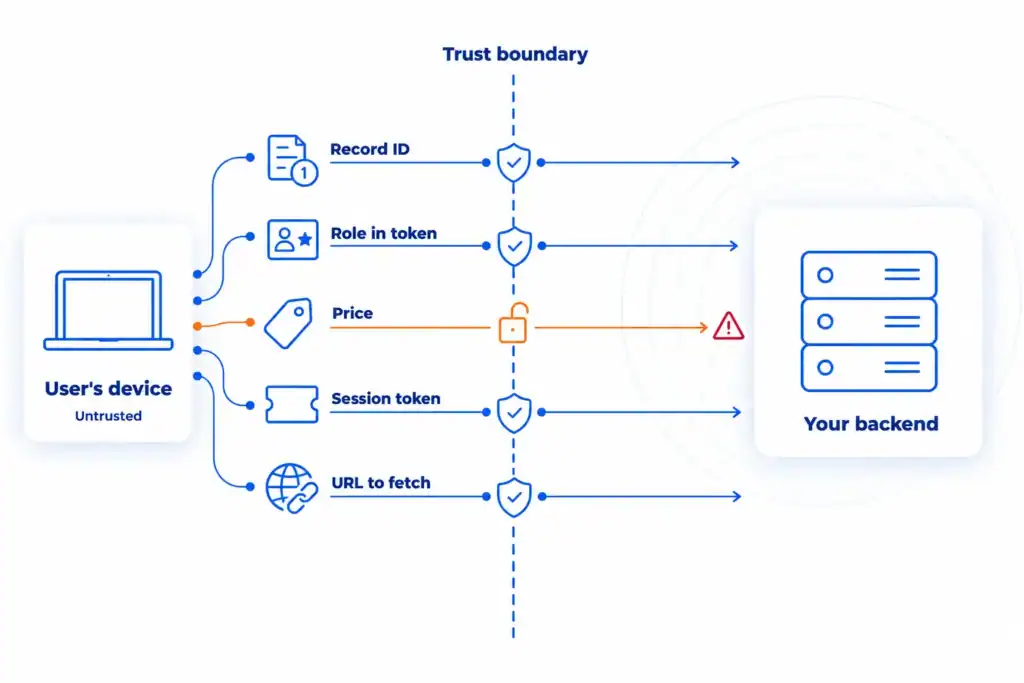
The line between the user’s device and your server is the trust boundary. Everything crossing it is untrusted, from the record number in the URL to the price in a checkout request, and the backend has to check each value itself. Miss one check and the app still works normally while any logged-in user pulls other customers’ records by changing a number. Broken access control, this exact failure, tops the OWASP Top 10 for 2025, the industry’s standard list of web application risks.
Each value a request carries needs its own server-side check:
| The request carries | The server must confirm | If it doesn’t |
| A record ID (order, invoice, user) | This account may access that specific record | Any user reads or edits other customers’ data (BOLA) |
| A role or permission in the login token | The account really holds that permission | A regular user runs admin actions (BFLA) |
| A price or quantity | The value came from the server, not the user | Free orders, fake discounts, fraudulent refunds |
| A session or login token | It is genuine, unexpired, and belongs to this user | The attacker acts as someone else |
| A URL for the server to fetch | The destination is allowed | The server is used to reach internal systems (SSRF) |
Core Vulnerability Classes, Mapped to OWASP and the API Top 10
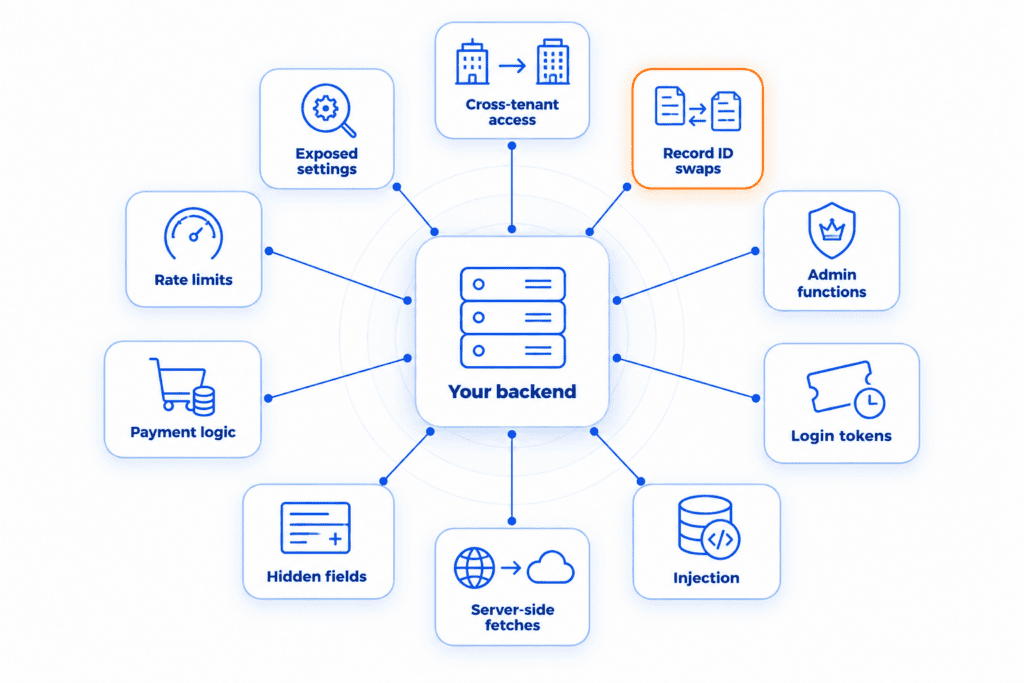
Most backend findings fall into a short list of known categories. Two OWASP lists cover them: the Top 10 for web applications, 2025 edition, and the API Security Top 10, whose 2023 edition is still the current one.
Broken object level authorization (BOLA). The server returns a record without checking that it belongs to the person asking. Change an order number in a request from 1001 to 1002 and someone else’s order comes back. The older web name for the same flaw is IDOR, insecure direct object reference, covered in detail in the frontend article. BOLA is the number one entry on the API list.
Broken function level authorization (BFLA). An admin action, such as deleting users or exporting all data, is hidden from regular users on screen but still works when a regular account calls it directly.
Broken authentication. Login tokens that never expire, sessions that survive logout, password-reset links that can be reused or guessed. Each one gives an attacker a way into someone else’s account.
Mass assignment. The server saves every field a request sends, so adding “role”: “admin” to a profile update can be enough to become an administrator. Its mirror image is a response that carries more than the screen shows, such as other users’ emails. The OWASP API list groups both under broken object property level authorization.
Injection. User input lands inside a database query, a system command, or a template and runs as code. SQL injection is the best-known form, and a successful one can dump whole tables. Injection dropped from third to fifth on the 2025 list, though the damage it does hasn’t changed.
Server-side request forgery (SSRF). A feature that fetches a URL, like an image import or a webhook, gets pointed at internal addresses instead. In the cloud, the usual target is the metadata service, which can return the server’s access keys. The 2025 web list folds SSRF into broken access control, while the API list keeps it separate.
Insecure deserialization. The server rebuilds program objects from request data without checking it first. In the worst case, one crafted request runs the attacker’s code on the server.
Business logic abuse. Every feature works as written, and the rules still allow misuse: a coupon applied a hundred times, a refund for a negative quantity, two withdrawals that both succeed against one balance. Finding these takes someone who knows what the app is meant to do, because nothing in the code is technically broken.
Security misconfiguration. Debug mode left on in production, error messages that expose internal paths, default passwords, API keys sitting in responses. This category climbed to second place in 2025.
| Finding | OWASP Top 10:2025 | OWASP API Security Top 10:2023 |
| BOLA / IDOR | A01 Broken Access Control | API1 Broken Object Level Authorization |
| BFLA | A01 Broken Access Control | API5 Broken Function Level Authorization |
| Broken authentication | A07 Authentication Failures | API2 Broken Authentication |
| Mass assignment, excess data in responses | A08 Software or Data Integrity Failures (mass assignment), A01 Broken Access Control (excess data) | API3 Broken Object Property Level Authorization |
| Injection | A05 Injection | No separate entry since 2023 |
| SSRF | A01 Broken Access Control | API7 Server Side Request Forgery |
| Insecure deserialization | A08 Software or Data Integrity Failures | No separate entry |
| Business logic abuse | A06 Insecure Design | API6 Unrestricted Access to Sensitive Business Flows |
| Security misconfiguration | A02 Security Misconfiguration | API8 Security Misconfiguration |
What the Tester Checks
- Test accounts for every role in at least two separate customer organizations, so the tester can try to reach one from the other.
- Record IDs swapped between accounts on every endpoint that returns or changes data.
- Admin-only functions called directly from a regular account.
- Login tokens altered, reused after logout, and checked for expiry, plus password-reset links tested for reuse.
- Injection attempts on every input that reaches a database query, a system command, or a template.
- Every feature that fetches a URL tested against internal addresses and the cloud metadata service.
- Extra fields such as a role or a price added to requests, and responses checked for data the screen never shows.
- Checkout, refund, coupon, and transfer flows pushed with negative numbers, repeats, and simultaneous requests.
- Rate limits checked on logins, password resets, and expensive operations.
- Error messages, debug settings, exposed admin or monitoring endpoints, and leaked keys reviewed.
How API and Service Complexity Multiplies Risk
Every endpoint has to apply the right rule for every role. An API with 60 endpoints and 4 roles means 240 separate access decisions, and the server has to get all of them right in every release. Testers work through that grid cell by cell, because one wrong cell is enough:
| Endpoint | Customer | Support agent | Admin |
| View own orders | Allowed | Allowed | Allowed |
| View any customer’s orders | Denied | Allowed | Allowed |
| Issue a refund | Denied | Allowed | Allowed |
| Export all customer data | Denied | Allowed (should be denied) | Allowed |
Larger systems add a second problem. When an application is split into many small services, each handling one job, those services often trust each other without any check, on the assumption that a call from inside the network must be safe. One SSRF flaw or one compromised service puts an attacker in that inside position, and every internal endpoint behind it opens up.
The grid also keeps changing. A new endpoint ships without its check, or a new role gets added and older endpoints never learn about it. A backend that passed last year can fail the same test today, which is why it needs retesting after significant changes.
Backend Stacks at a Glance
Most backend flaws come from design decisions, so they show up in every language. A missing ownership check looks the same in Node.js as it does in Java. Each stack does have its own habitual weak spots, though, and a tester adjusts the plan to the one you run.
| Stack | Where teams commonly slip |
| Node.js (Express) | Access checks are added route by route, so a new route can ship without one. Crafted JSON can also alter how the whole app behaves, a flaw called prototype pollution. |
| Python (Django, Flask) | API definitions set to accept every field, which opens the door to mass assignment. Debug mode left on in production, exposing settings and code. |
| Ruby on Rails | The built-in field filter switched off with a single shortcut, bringing mass assignment back. Unsafe loading of stored data formats. |
| Java (Spring Boot) | Built-in monitoring endpoints left public, some of which can leak memory contents with passwords inside. Unsafe deserialization. |
| PHP (Laravel) | Mass-assignment protection disabled on data models. Debug mode exposing environment keys. |
| .NET (ASP.NET Core) | One controller missing its authorization attribute. Older code still relying on an unsafe deserializer. |
| Go | Few framework defaults, so every handler writes its own access and input checks. Code that fetches user-supplied URLs, open to SSRF. |
No stack on this list is safe or unsafe by itself. The table only tells a tester where to look first.
How Automated Tools and Manual Testing Work Together
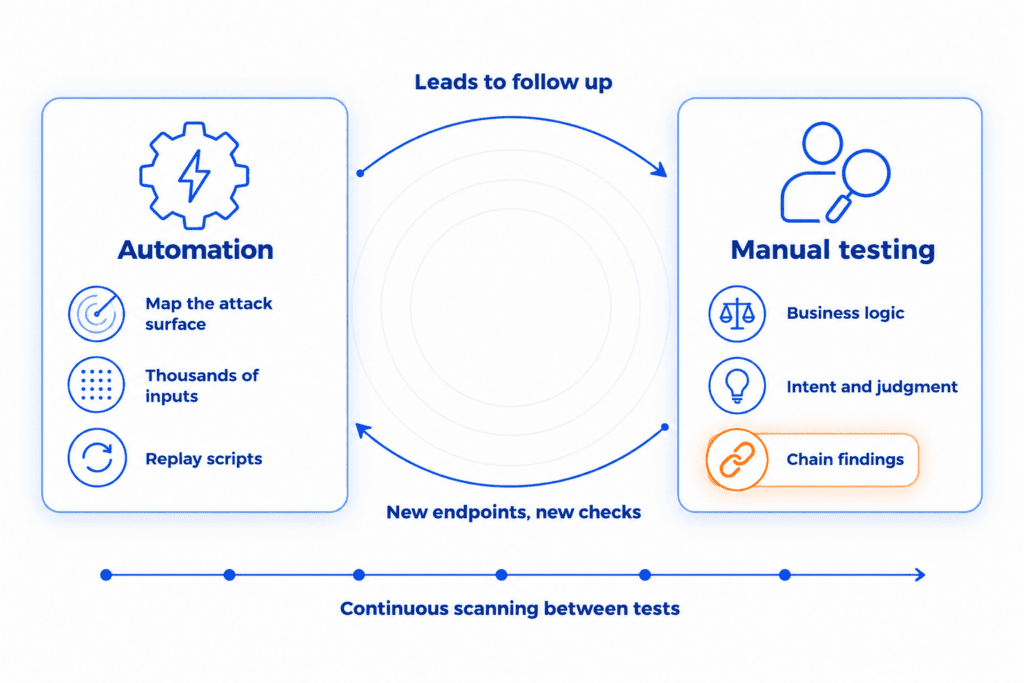
A solid backend test uses automation and human testing together, each for the job it does best.
Automation goes first. Scanners and discovery tools map the attack surface, including old API versions that still answer requests even though the app stopped calling them. They run thousands of inputs against every parameter to look for known injection patterns, flag outdated libraries and weak settings, and finish in hours what would take a person weeks. Scripts handle the repetitive work as well, like replaying one request under every test account or cycling through record numbers.
That frees the tester for the part that needs judgment. A person knows a support agent shouldn’t be able to export the customer list, and that a refund should never come out negative. Those are questions about intent, and answering them means understanding how the business is supposed to work. The tester follows up on what the tools surfaced and chains small findings into the path a real intruder would take.
Each side also feeds the other. An endpoint found by hand goes back into the automated run. A weakness confirmed manually gets scripted, so it can be checked across every endpoint at once. Between full tests, continuous scanning catches regressions as new code ships, and the next manual round concentrates on whatever changed.
How a Backend Pentest With CYBRI Works
- Scoping. A kickoff call settles which applications, APIs, and environments are in scope, usually a staging copy rather than production. The client supplies test accounts for each role, API documentation, and IP allowlisting if needed.
- Reconnaissance. The tester maps every endpoint, parameter, and role, including old or undocumented APIs. More on this stage in the reconnaissance guide.
- Manual testing. The tester works through the checks listed above, account by account and endpoint by endpoint.
- Reporting. Every finding carries a CVSS 4.0 score, the standard 0 to 10 severity scale, along with its business impact and steps to fix it. Anything critical and exploitable reaches your team the same day instead of waiting for the final report.
- Remediation support and testing. While your team works on fixes, the testers answer questions and help with the right approach. Once fixes land, they retest to confirm each one holds and update the report. All of this happens inside a 90-day remediation window.
- Ongoing testing (optional). Recurring tests or continuous coverage catch the access-check drift described above as new code ships.
Testing, reporting, and the delivery call typically take one to two weeks, counted from the day the tester has access to everything in scope. Every engagement includes:
- Senior, OSCP-certified testers working manual-first
- Authenticated gray box testing across multiple user roles by default
- Coverage of the OWASP Top 10, following NIST testing guidance
- A fixed price agreed before work starts
- A technical review with CVSS 4.0 scores and fix steps for every finding, plus a plain-language summary for leadership and auditors
- Same-day alerts for critical, exploitable issues
- Reports mapped to SOC 2, HIPAA, ISO 27001, PCI DSS, and GDPR
- Blue Box dashboard access on continuous and PTaaS plans
To find out what a backend test would cover for your application, contact CYBRI for a scoping call.
Frequently Asked Questions
Does a backend pentest help with SOC 2, PCI DSS, ISO 27001, or HIPAA?
Yes, it produces the evidence those audits look for. PCI DSS requires penetration testing at least every 12 months and after significant changes, with the application layer in scope. SOC 2 does not mandate a pentest, but auditors widely accept one as evidence that access controls work. ISO 27001 doesn’t name penetration testing either, but its controls for technical vulnerability management (A.8.8) and security testing (A.8.29) expect regular, documented testing, and a pentest report is the usual evidence. HIPAA calls for periodic technical evaluations, and a rule proposed in 2025 would make annual pentesting explicit.
What is the difference between a backend pentest and an API pentest?
An API pentest focuses on the endpoints an application exposes: their login checks, access rules, and input handling. A backend pentest covers that and what sits behind the endpoints, such as multi-step business flows, calls between internal services, background jobs, and server configuration. For an API-first product, the API test makes up most of the backend test.
What is the difference between IDOR and BOLA?
They describe the same flaw. IDOR, insecure direct object reference, is the older web term, and BOLA, broken object level authorization, is the name OWASP uses for APIs. Both mean the server hands over a record without checking who owns it. More detail in the IDOR and BOLA guide.
How much does a backend pentest cost, and how long does it take?
At CYBRI, pricing starts at $5,000 and testing runs 5 or more business days, at a fixed price agreed up front. The final figure depends on scope: how many applications and APIs are tested, how many user roles they have, and which environments are included. Current tiers are on the pricing page.
Can a backend test run against production?
It can, though staging is the safer default, since testing changes records and pushes flows like refunds and transfers. CYBRI also runs a hybrid approach: the full test happens on staging, and the key findings are then validated on production with care, which confirms the real system is affected without putting live data at risk.
Find Out What Your Backend Lets Through
A polished app says little about what the server behind it will accept. A short scoping call maps your APIs, user roles, and business flows, and turns them into a fixed-price test plan. Book a scoping call with CYBRI to see where your backend stands.