The Challenge of Scanner Overload: Too Much Noise, Not Enough Signal
Automated vulnerability scanners are a foundational component of any modern security program. They provide essential, broad coverage across networks and applications, identifying known vulnerabilities and misconfigurations at scale. However, this strength in volume is also a significant weakness. Security and development teams are often inundated with thousands of alerts, a phenomenon known as ‘alert fatigue.’ The sheer number of findings makes it impossible to ‘patch everything,’ creating a difficult and often paralyzing challenge.
According to industry analysis, the number of publicly disclosed Common Vulnerabilities and Exposures (CVEs) is staggering, with projections suggesting over 47,000 in 2025 alone. An automated scanner casting a wide net across your environment will inevitably flag a large portion of these. The problem is that many of these alerts lack critical context. A significant number may be false positives—vulnerabilities that are flagged by the tool but are not actually exploitable due to specific configurations, environmental factors, or mitigating controls. Chasing down these non-threats consumes valuable time and resources that could be spent on genuine risks.
This data overload forces teams into a reactive posture, struggling to decide which fires to put out first. The fundamental question that emerges from the flood of scanner data is, ‘How can we validate these findings and prioritize our efforts to focus only on what poses a real risk to our business?’ The answer lies in moving beyond the scanner’s raw output and applying layers of intelligence and expert analysis.
Why Traditional Prioritization Fails: The Limits of CVSS
For many years, the standard approach to prioritizing scanner findings has been to sort them by their Common Vulnerability Scoring System (CVSS) score. This method involves tackling the ‘Critical’ and ‘High’ rated vulnerabilities first and working down the list. While seemingly logical, this approach is fundamentally flawed and inefficient in today’s threat landscape.
The CVSS is designed to measure the theoretical, technical severity of a vulnerability in a worst-case, isolated scenario. As security experts explain, a CVSS score is a measure of severity, not risk. It fails to account for the specific context of your organization. Key factors missing from a static CVSS score include:
- Actual Exploitability: Is the vulnerability being actively and widely exploited by attackers in the wild?
- Asset Criticality: Does the vulnerability exist on a non-critical development server or on the ‘crown jewel’ database that processes all customer payments?
- Environmental Context: Is the affected asset exposed to the internet, or is it isolated deep within an internal network with multiple layers of security?
- Mitigating Controls: Is there a Web Application Firewall (WAF) or other security control already in place that makes exploiting the vulnerability impossible?
Relying solely on CVSS scores often leads to a misallocation of resources. Teams may spend weeks patching a ‘Critical’ vulnerability on a low-impact, internal system that no attacker can reach, while a ‘Medium’ vulnerability on a public-facing application with a known public exploit goes ignored. As detailed in one guide on the topic, this disconnect between theoretical severity and real-world risk is why modern security programs have moved toward a more intelligent, multi-faceted approach to prioritization.
A Smarter Start: Prioritizing with Exploit Intelligence (KEV & EPSS)
Before engaging human experts, security teams can significantly reduce scanner noise by enriching CVSS data with real-time exploit intelligence. This modern approach helps answer the crucial question, ‘Is anyone actually using this vulnerability to attack organizations like mine?’ Two primary resources provide this intelligence: the KEV Catalog and EPSS.
First, the CISA Known Exploited Vulnerabilities (KEV) Catalog is a curated list of vulnerabilities that the U.S. Cybersecurity and Infrastructure Security Agency has confirmed are being actively exploited in real-world attacks. This is not a theoretical list. It is a catalog of proven threats. Any vulnerability from your scanner report that appears on the KEV list should immediately become a top priority for remediation, regardless of its CVSS score. These are the vulnerabilities that represent a clear and present danger.
Second, the Exploit Prediction Scoring System (EPSS), managed by FIRST.org, offers a forward-looking, probabilistic measure. As detailed in a comparison of the two systems, while CVSS tells you how severe a vulnerability could be, EPSS tells you how likely it is to be exploited. It provides a score between 0% and 100% that estimates the probability of a vulnerability being exploited in the next 30 days. A high EPSS score for a given CVE is a strong signal that attackers are preparing to weaponize it, allowing teams to proactively patch it before it becomes a widespread threat.
Using KEV and EPSS to filter scanner results is a powerful first step. It helps teams triage the mountain of alerts and focus on the subset of vulnerabilities that are either already being exploited or are highly likely to be exploited soon. This dramatically cuts down the noise and allows for a more strategic allocation of remediation resources.
The Human Element: Manual Validation to Confirm Real Risk
While exploit intelligence provides a much-needed layer of prioritization, it still operates without full environmental context. A vulnerability may be on the KEV list, but is it exploitable in your specific, unique environment? This is where the human element becomes indispensable. The critical next step is manual validation by a certified security expert.
Manual penetration testing, as performed by a dedicated penetration testing company, moves beyond theoretical analysis and simulates the actions of a real-world attacker. An expert pentester doesn’t just check if a vulnerability exists; they actively attempt to exploit it to determine its true impact. This process definitively confirms whether a flagged vulnerability poses a genuine, demonstrable risk or if it is a false positive. As one analysis of manual vs. automated testing highlights, a vulnerability scan identifies potential weaknesses, whereas a penetration test confirms if they are exploitable and determines the business impact.
This validation process is crucial for operational efficiency. By eliminating false positives, manual testing saves countless developer hours that would otherwise be wasted investigating and attempting to fix issues that pose no real threat. CYBRI’s manual-first approach provides the ground truth your team needs. Our experts confirm which of the thousands of scanner alerts represent a tangible danger to your business operations, allowing you to focus your efforts with precision.
Finding What Scanners Miss: Business Logic Flaws and Chained Exploits
Beyond validating scanner findings, manual penetration testing uncovers entire classes of critical vulnerabilities that automated tools are fundamentally incapable of detecting. Scanners are programmed to find known technical signatures, such as those outlined in the OWASP Top 10. They cannot understand the unique purpose, workflow, and business context of your application.
This is where business logic flaws emerge. These are not bugs in the technical code but flaws in the application’s process or rules. For example, an e-commerce site might allow a user to apply a discount coupon for orders over $100, but fail to re-validate the cart total if the user subsequently removes an item. A manual tester, thinking like an attacker, would test this sequence and could exploit it to purchase goods at an unauthorized discount. As one analysis notes, an automated scanner would never find this because it doesn’t understand the concept of a ‘checkout process.’ This type of vulnerability is especially critical in web application penetration testing.
Furthermore, human experts excel at ‘exploit chaining.’ An automated scanner might flag several ‘Low’ or ‘Medium’ risk vulnerabilities and treat them as isolated, low-priority issues. A skilled pentester, however, can identify how to combine these seemingly minor flaws into a sophisticated, multi-step attack path. For instance, a low-risk information disclosure vulnerability could reveal a server version, which, when combined with a weak default password on an internal service, could lead to a full system compromise. This creative, context-aware analysis uncovers high-impact risks that are completely invisible to automated tools.
The Solution: How CYBRI’s PTaaS Helps You Fix What Matters
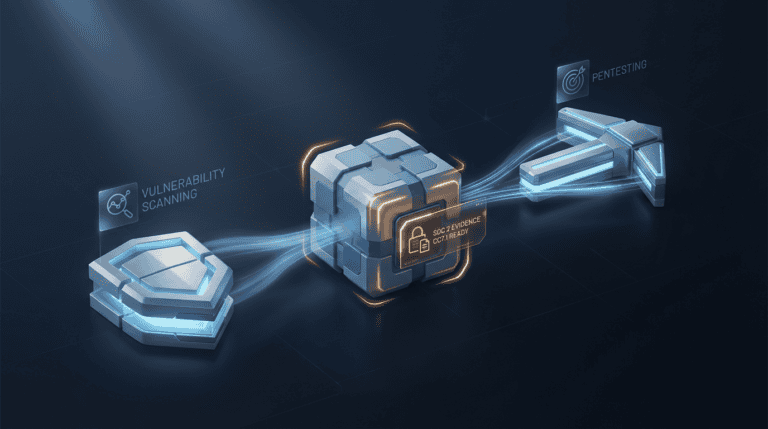
CYBRI’s Penetration Testing as a Service (PTaaS) provides the definitive solution for organizations struggling with scanner overload. Our service is designed to cut through the noise and deliver the actionable intelligence you need to secure your infrastructure and achieve compliance.
Our methodology is manual-first, leveraging a U.S.-based Red Team of certified experts holding credentials like OSCP and OSWE. This focus on deep, rigorous human analysis ensures we not only validate your scanner findings but also uncover the complex vulnerabilities that automated tools miss. We provide on-demand tests at a fixed price, giving you access to expert validation without the unpredictable costs often associated with security consulting.
All findings are delivered through our collaborative cloud platform. This modern approach allows your team to track testing progress in real-time, communicate directly with our pentesters for clarification, and manage the entire remediation lifecycle from a single dashboard. This ensures your development resources are focused exclusively on fixing vulnerabilities that have been proven to pose a genuine threat. The process culminates in a comprehensive, compliance-ready report that provides the documented evidence of due diligence required for standards like SOC 2, ISO 27001, and HIPAA.
By partnering with a specialized penetration testing company like CYBRI, you transform a chaotic list of scanner alerts into a prioritized, validated, and actionable remediation plan.
Key Takeaways: From Scanner Noise to Actionable Intelligence
To effectively manage your organization’s risk, it is essential to move beyond the limitations of automated scanning and adopt a more mature, context-aware security strategy. The path from scanner noise to actionable intelligence involves several key steps.
- Scanner results are a starting point, not a to-do list. They are filled with noise, false positives, and lack the business context needed for effective prioritization.
- Prioritizing with CVSS alone is ineffective. Modern prioritization must incorporate real-time exploit intelligence from sources like CISA’s KEV catalog and the EPSS to understand likelihood.
- Manual validation is the most critical step. A human expert must confirm exploitability within your specific environment to eliminate false positives and accurately assess business impact.
- Manual testing finds what scanners miss. Human creativity is required to uncover complex risks like business logic flaws and chained exploits that are invisible to automated tools.
- CYBRI’s manual-first PTaaS provides the expert analysis needed. Our service helps you cut through the noise, focus your team on fixing the vulnerabilities that truly matter, and achieve your security and compliance goals.
If you are ready to move beyond scanner overload and gain true clarity on your security posture, request a demo to see how CYBRI can help you fix what matters.