The landscape of cyber insurance has fundamentally changed. What was once a straightforward process of filling out a questionnaire has become a rigorous evaluation of your organization’s true security posture. In response to escalating cyber threats, insurers are no longer taking your word for it. They demand tangible, verifiable proof that you have effective security controls in place. This is where penetration testing has shifted from a best practice to a business necessity.
Insurers now see penetration testing as a critical requirement for eligibility. It serves as the objective, third-party validation they need to assess your company’s ability to defend against real-world attacks. A comprehensive test provides underwriters with the hard evidence required to accurately price risk, which directly influences your policy eligibility, premiums, and coverage terms. Without it, many organizations find themselves facing prohibitively high costs or outright denial of coverage.
Why Penetration Testing is Now a Key Factor for Cyber Insurance Eligibility
In the face of rising cybercrime costs, which are projected to reach $10.5 trillion annually by 2025, the cyber insurance market is hardening. Insurers, facing unsustainable losses from claims, have tightened their underwriting criteria significantly. Simple self-reported security checklists are no longer sufficient. Instead, providers demand objective proof that an organization’s security controls are not just present, but effective.
Penetration testing has become the gold standard for providing this proof. According to industry reports, it is now a key factor in qualifying for cyber insurance because it simulates a real-world attack to identify and fix vulnerabilities before they can be exploited. A thorough report from a reputable penetration testing services provider gives underwriters the confidence to offer coverage, transforming a company from an unknown liability into a quantifiable and insurable risk.
Ransomware Losses Have Redefined Insurer Risk Models
The surge in high-cost ransomware attacks has been a primary catalyst for this market shift. The average cost of a data breach has climbed to nearly $4.5 million, with ransomware incidents often costing even more. These staggering figures have forced insurers to overhaul their risk models. Past methods of assessment, which relied heavily on self-attestation, proved inadequate for predicting the likelihood and impact of modern attacks.
As a result, carriers now demand verifiable evidence of security controls with a focus on both the external perimeter and internal network resilience. This heightened scrutiny means insurers are actively looking for proof that an organization can not only prevent an initial breach but also contain an attacker’s movement post-compromise. They want to see a robust incident response plan backed by testing that validates your ability to limit the blast radius of an attack.
Insurers Demand Verification of Controls, Not Promises
Modern cyber insurance applications probe for specific, validated security controls. These include multi-factor authentication (MFA), endpoint detection and response (EDR), secure and air-gapped backups, and robust identity management. However, insurers need to know if these controls are truly effective against sophisticated attack techniques. As noted by security experts, a policy can be voided if the controls you attested to are not properly implemented.
Penetration testing acts as the definitive third-party proof. It demonstrates how your security controls perform under the pressure of a simulated attack, identifying exploitable gaps that an automated scan would miss. This is why a successful SOC 2 penetration test or an ISO 27001 penetration test is so valuable; it provides auditors and insurers with confidence that your security program is not just designed well, but also functions correctly.
Understanding the Underwriter’s Perspective on Risk
Insurance underwriters are primarily concerned with quantifiable risk. They are trained to look past marketing claims and focus on the evidence. Their analysis centers on key areas of exposure, including:
- External Network Exposure: What internet-facing assets are vulnerable to attack?
- Credential Compromise: How easily can an attacker steal and use employee credentials?
- Lateral Movement Paths: Once inside, how freely can an attacker move across the network?
- Cloud Misconfigurations: Are there public-facing cloud storage buckets or overly permissive access policies?
- Privileged Access Abuse: Can an attacker escalate their privileges to gain administrative control?
A penetration test report directly addresses these concerns. It moves beyond a theoretical list of vulnerabilities to show what is actually exploitable and what business impact it could have. This evidence-based approach, often guided by a virtual CISO, allows underwriters to more accurately price a policy, rewarding organizations with a demonstrably strong and tested security posture.
Why Vulnerability Scans Aren’t Enough for Insurers
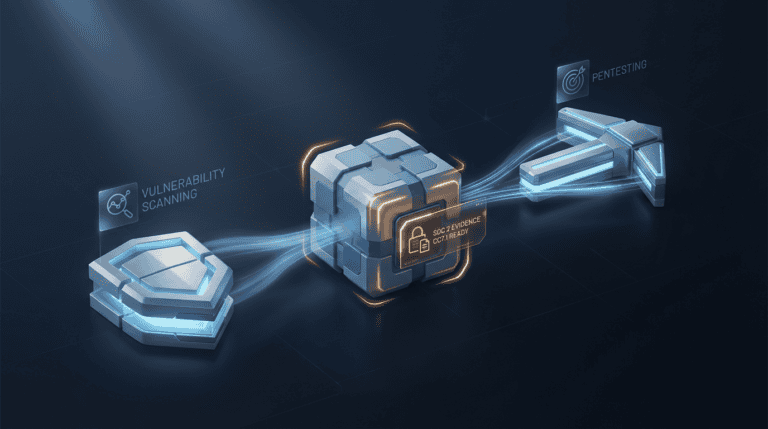
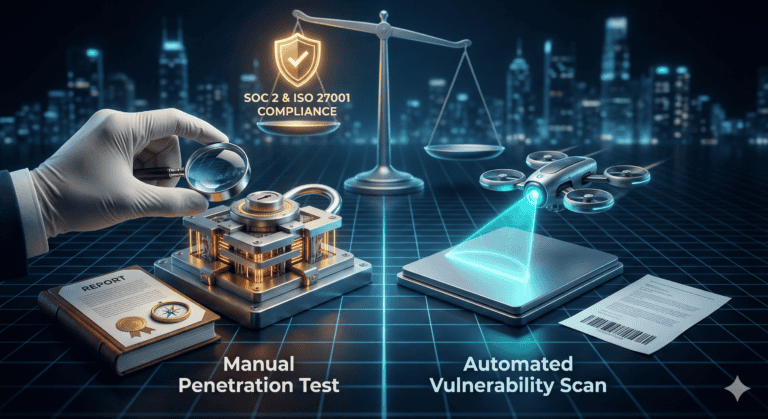
It is critical to understand the difference between automated vulnerability scanning and manual penetration testing. A vulnerability scan is a useful, automated process that generates a list of potential issues, often Common Vulnerabilities and Exposures (CVEs). However, it lacks the context of business impact or true exploitability and is known for producing false positives.
In contrast, a manual-first penetration test simulates the actions of a creative and determined human attacker. This approach is necessary to identify complex issues like:
- Business Logic Flaws: Abusing application features in unintended ways, such as manipulating a shopping cart to change prices.
- Chained Exploits: Combining multiple low-risk vulnerabilities to create a high-impact attack path.
- Context-Specific Vulnerabilities: Weaknesses unique to your custom applications or infrastructure that automated tools are not designed to find.
Insurers recognize this crucial distinction. They place a much higher value on the in-depth analysis provided by a manual penetration test, as it gives a truer picture of an organization’s risk profile than a simple vulnerability assessment.
What an Insurance-Aligned Penetration Test Covers
To satisfy insurer requirements, a penetration test must be comprehensive. It should provide a holistic view of your security weaknesses by assessing the most common attack vectors. CYBRI’s penetration testing services are designed to cover these critical areas.
External Infrastructure Testing
This test focuses on your internet-facing perimeter, which is your organization’s first line of defense. The process begins with thorough reconnaissance to map the entire external attack surface and identify all exposed assets and services. From there, our ethical hackers attempt to breach perimeter defenses like firewalls, VPNs, and web servers to find exploitable vulnerabilities that could grant an attacker initial access.
Internal Network Testing (Post-Breach Scenario)
Insurers increasingly operate on an “assumed breach” model, meaning they want to know what happens after an attacker gets in. Our internal penetration testing simulates this scenario, where an attacker has already gained a foothold inside the network. The test assesses the risk of lateral movement, privilege escalation through techniques like pivoting, and unauthorized access to sensitive data. This demonstrates your organization’s ability to contain a breach and limit its impact.
Web Application & API Testing
For most technology businesses, web applications and APIs are the most critical and exposed assets. Our web application penetration testing focuses on identifying vulnerabilities specific to these platforms, including those listed in the OWASP Top 10. Testers search for flaws like broken authentication, injection vulnerabilities, and other API risks that could lead to a data breach, which is a primary concern for cyber insurers.
Cloud Security Testing
With the vast majority of data breaches involving cloud environments, testing for cloud-specific vulnerabilities is essential. This includes assessing environments like Amazon Web Services (AWS), Microsoft Azure, and Google Cloud Platform (GCP). Our penetration testers look for common but critical issues such as misconfigured storage, overly permissive Identity and Access Management (IAM) policies, exposed credentials, and other configuration drifts that create dangerous security gaps.
How Penetration Testing Impacts Insurance Eligibility and Premiums
Regular penetration testing is a proactive measure that provides tangible benefits throughout the cyber insurance lifecycle, from the initial application and renewal to navigating a potential claim.
Demonstrating Mature Security Controls for Favorable Underwriting
A penetration test report showing few critical vulnerabilities, or one accompanied by a remediation report, is a powerful signal of a mature security program. This proactive approach to risk management is highly valued by underwriters and can lead to more favorable decisions regarding coverage and terms. It demonstrates a commitment to security that goes beyond checking a box, showcasing one of the key benefits of penetration testing.
Lowering Premiums with Verified Resilience
Organizations that conduct regular penetration tests and remediate the findings are viewed as lower-risk clients by insurers. This reduced risk profile can directly translate into lower insurance premiums, making the cost of a pen test an investment with a clear return. Industry sources confirm that insurers are willing to offer discounted premiums and lower deductibles to organizations that can prove their resilience through rigorous, independent testing.
Achieving Faster and Smoother Renewals
Scheduling penetration tests well ahead of your insurance renewal cycle can significantly streamline the process. Providing underwriters with a consistent history of up-to-date security assessments reduces friction, minimizes back-and-forth questions, and removes uncertainty. Knowing how often you should perform penetration testing and aligning it with your insurance calendar leads to a faster, smoother, and more predictable renewal experience.
Strengthening Your Position in the Event of a Claim
In the unfortunate event of a breach, your organization may need to prove it exercised ‘reasonable security’ to ensure a claim is not denied. A documented history of regular penetration testing and subsequent remediation provides tangible evidence that you took proactive and responsible steps to protect your assets. This documentation can be crucial during post-breach investigations and legal proceedings, where you must demonstrate due care.
Recommended Frequency for Insurance-Related Penetration Testing
As a baseline, most insurers and compliance frameworks expect penetration testing to be conducted at least annually. However, for high-risk organizations—such as those in SaaS, fintech, and healthcare—or those handling particularly sensitive data, a semi-annual cadence is often recommended. It is also important to consider event-driven penetration tests, which should be performed:
- Before initial policy underwriting
- During renewal cycles
- As part of mergers and acquisitions (M&A) due diligence
- Before launching a major new product or platform
Establishing a regular testing cadence is a key part of a mature security strategy that aligns with insurer expectations.
The Anatomy of an Insurance-Ready Report
The Executive Summary: Clear Insights for Underwriters
The most important part of a penetration test report for an insurer is the executive summary. It must be clear, concise, and written for a non-technical audience. It should provide a high-level risk rating (e.g., Critical, High, Medium) and focus on the potential business impact of the findings. Crucially, the summary must offer proof of exploitability, confirming which vulnerabilities pose a genuine threat.
Technical Details: Actionable Guidance for Remediation
While the summary is for underwriters, the technical section is for your internal teams. It must provide enough detail to enable effective remediation. Following a clear penetration testing methodology, this section should document the root cause of each vulnerability, describe the full attack chain used to exploit it, and provide a prioritized, actionable plan for fixing the issues.
The Importance of Remediation Validation
Identifying vulnerabilities is only the first step. Insurers want to see a closed-loop process where issues are not only found but also fixed. Providing evidence of remediation, typically through a re-test of the initial findings, demonstrates a commitment to continuous security improvement. This validation, included in CYBRI’s penetration testing services, confirms that the fixes were effective and is highly valued by underwriters.
CYBRI’s Approach to Insurance-Aligned Penetration Testing
At CYBRI, we specialize in manual-first penetration testing, a methodology designed to uncover the complex business logic and chained-exploit vulnerabilities that automated tools miss and that attackers target. Our company was built on the principle that deep, expert-led assessments are the only way to truly understand security risk.
Our testing principles are aligned with the risk domains that matter most to insurers. We provide comprehensive coverage of your cloud, web application, API, and network infrastructure, delivered by a certified U.S.-based Red Team. We deliver clear, actionable reporting through a collaborative platform, providing an executive summary for underwriters and the technical detail your team needs to remediate. Finally, we provide validation of all fixes to close the loop for your insurance provider, all based on our world-class methodology.
Key Takeaways
- Penetration testing is no longer optional; it is a standard requirement for obtaining and renewing cyber insurance.
- Automated vulnerability scans do not satisfy insurer demands for deep, contextual security validation; manual-first testing is necessary.
- A consistent cadence of penetration testing improves insurance eligibility, can lower premiums, simplifies renewals, and strengthens your position in the event of a claim.
- The goal is to establish a predictable testing program aligned with your insurance cycle and overall risk management strategy, which is one of the primary benefits of penetration testing.
Understand What an Insurance-Aligned Penetration Test Looks Like
To see how CYBRI’s manual-first penetration testing can strengthen your insurance application and overall security posture, it is best to see the process firsthand. Our experts can walk you through our methodology, provide a sample report, and discuss how we align our testing with key compliance frameworks like SOC 2 and ISO 27001, which are also key signals for insurance underwriters.
Request a demo to connect with our team and learn how to build a testing strategy that meets insurer requirements.