NetSPI is a Minneapolis penetration testing company, founded in 2001, that sells penetration testing as a service (PTaaS), an ongoing testing program in place of one-off projects. The company says it has more than 350 in-house testers and offers over 50 kinds of tests, from web apps and cloud accounts to mainframes and medical devices.
Its platform also includes tools for monitoring internet-facing systems and simulating attacks, a strong fit for large enterprises with a wide footprint. In October 2026, NetSPI completed its merger with Synack, another large testing company. Existing contracts continue as before, and some customers may simply want to see how other providers compare as the two companies come together.
This guide covers seven US-based alternatives. Each one sells testing as a program or as a repeat engagement, not as a one-time project:
- CYBRI: best for manual, signed-in testing of your SaaS app and its API on a yearly schedule, with reports ready for compliance audits
- Cobalt: best for product teams that want to launch a test within days and pay for testing in credits
- Bishop Fox: best for established companies with a large internet-facing footprint that want research-grade testers watching it
- Praetorian: best for in-house security teams that want one continuous subscription in place of several tools
- Kroll: best for large or regulated companies that want penetration testing from a firm that also handles incident response
- Rhino Security Labs: best for companies with complex AWS or multi-cloud setups that want a small, research-driven team
- TrustedSec: best for companies that want a named consulting team and a retest, without a platform subscription
What Is PTaaS?
A traditional pentest is a single project. You sign one contract, wait for a start date, and get a PDF report a few weeks later. With PTaaS, the testing itself can stay exactly the same, but the way you buy and manage it changes. You prepay for several tests spread across the year, usually three or more, and time each one to your release schedule. Scope gets agreed again before every test, so a billing page or API launched in July can become the target of the next round without a new contract.
Findings show up in an online dashboard as the testers confirm them, which lets developers start fixing before the final report is written. The same team retests each fix, and by the end of the year you have one running record of what was found and when it was fixed. Auditors can read that record as evidence; the guide to using a PTaaS platform for SOC 2 evidence walks through how.
PTaaS suits companies that ship updates every week or two, run several apps, or manage security for more than one business. A small company with one stable product may be fine with a test once a year plus another after each major release (CYBRI’s guide on how often to run a pentest helps with that call). A step further is continuous penetration testing, which adds ongoing scanning and monitoring between the human-led tests.
How These NetSPI Alternatives Were Compared
Each company on this list has its own strengths and was picked because it does a specific job well for a specific kind of buyer. All of them met these requirements first:
- US headquarters. Every company is based in the United States, which matters for contracts, data handling, and time zones.
- Testing sold as a program. A subscription, a prepaid set of tests, or a repeat engagement with the same team, so testing can keep up with your releases.
- Reports an auditor will accept. An executive summary for leadership, technical detail for engineers, and findings tied to SOC 2, ISO 27001, PCI DSS, or HIPAA.
- A track record you can check. Verified reviews on G2 or Gartner Peer Insights, or a long public history of testing work.
The “best for” line under each company says where it fits. Compare those lines against your own situation (how many apps you run, how often you ship, and what your next audit needs) before you book any demos.
The 7 Best NetSPI Alternatives
1. CYBRI
Best for: manual, signed-in testing of your SaaS app and its API on a yearly schedule, with reports ready for compliance audits
CYBRI is a New York penetration testing company founded in 2017, and its best fit is SaaS companies. Every test is manual-first and run by senior, US-based testers who hold the OSCP certificate. Two to three testers work each project. They test web apps, APIs, mobile apps, cloud accounts, and AI features while logged in as each type of user.
Companies can book a single test or a yearly PTaaS program, and onboarding takes a couple of days. In a program, the tests are prepaid and spread across the year, and scope is agreed again before each one, so a new feature or API becomes the next target without new paperwork. Critical issues get flagged the same day instead of waiting for the report. All findings land in the Blue Box dashboard, where developers can assign and track fixes and look back at earlier tests.
Each report has an executive summary for leadership and auditors, plus technical findings scored with CVSS 4.0 (the industry severity standard) and step-by-step fixes. Reports map to SOC 2, ISO 27001, PCI DSS, HIPAA, and GDPR. Testers answer questions while your team fixes, then retest over about 90 days and issue an updated report.
2. Cobalt
Best for: product teams that want to launch a test within days and pay for testing in credits
Cobalt has sold pentests through its own platform since 2013 and calls itself one of the pioneers of PTaaS. Testing comes from the Cobalt Core, a vetted community of more than 500 security experts, with a tester matched to what you need tested. You chat with them directly in the platform while the test runs, and Cobalt says most tests can start in days rather than weeks.
Buying works through credits, which you spend on web apps, APIs, mobile apps, networks, cloud, or AI and LLM features as needs come up. Every pentest includes free retesting of individual findings for 6 or 12 months, and findings can flow into more than 50 tools, including Jira and GitHub. Cobalt also offers an autonomous pentest for quick checks on each release, alongside the human-led work.
3. Bishop Fox
Best for: established companies with a large internet-facing footprint that want research-grade testers watching it
Bishop Fox started in 2005 and describes itself as the largest private firm focused on offensive security testing, with customers that include Google, Amazon, and Zoom. Its consultants cover external and internal networks, cloud, web and mobile apps, APIs, source code review, AI and LLM systems, and red team exercises, where testers act like a real attacker.
For ongoing coverage, Bishop Fox runs Cosmos, a platform it manages for you. Cosmos keeps an up-to-date map of everything you have on the internet, from domains to cloud resources, checks it daily, and sends the most promising leads to human operators, who confirm what is actually exploitable. Confirmed findings sync both ways with Jira and ServiceNow, so they show up in the tools your engineers already use.
4. Praetorian
Best for: in-house security teams that want one continuous subscription in place of several tools
Praetorian, based in Austin since 2010, sells continuous testing through a single subscription called Praetorian Guard. Guard bundles attack surface management (a running inventory of everything you expose to the internet), continuous pentesting, attack simulation, and threat intelligence. Companies that currently pay for several separate tools can move them under one contract.
The testing is run by AI agents, software that plans and carries out test steps on its own, each built for one kind of work. Customers set the schedule, for example weekly against the perimeter, logged-in testing every two weeks, and cloud accounts nightly. A finding reaches your team only after Guard has actually run the exploit and proved it works. An annual penetration test is included in the subscription, on dates you choose. Guard connects to more than 80 tools, and results from scanners such as Wiz, Tenable, and Qualys go through the same proof step before they count.
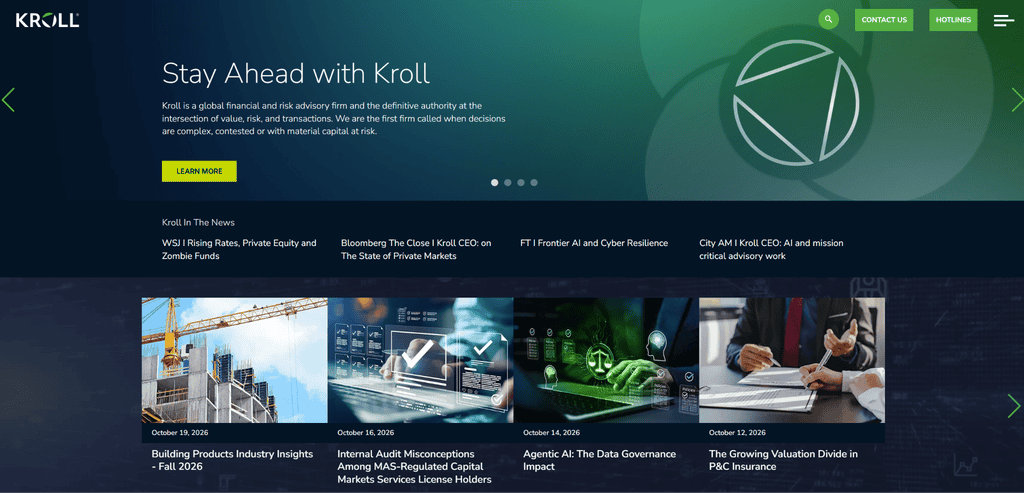
5. Kroll
Best for: large or regulated companies that want penetration testing from a firm that also handles incident response
Kroll is a risk advisory firm headquartered in New York, and its cyber team responds to more than 3,000 incidents a year. What its investigators learn from those breaches shapes its penetration testing, since testers copy the methods real attackers are using right now. The offensive security team logs over 100,000 hours of testing a year, and CREST, an industry accreditation body, has accredited Kroll as a global penetration testing provider.
Testing covers internal and external networks, web apps, APIs, mobile apps, cloud, containers, IoT and hardware devices, and AI and LLM systems, plus red team exercises and threat modeling. For teams that ship often, Kroll offers agile penetration testing, which builds regular tests into the development cycle so new features get tested as they are released. Testers also help prioritize and fix what they find, and the work supports PCI DSS, ISO 27001, and GDPR requirements. Companies that want ongoing access can buy a Cyber Risk Retainer, with credits that can be spent across Kroll’s professional services and up to 20% of unused credit carried into the next year.
Website
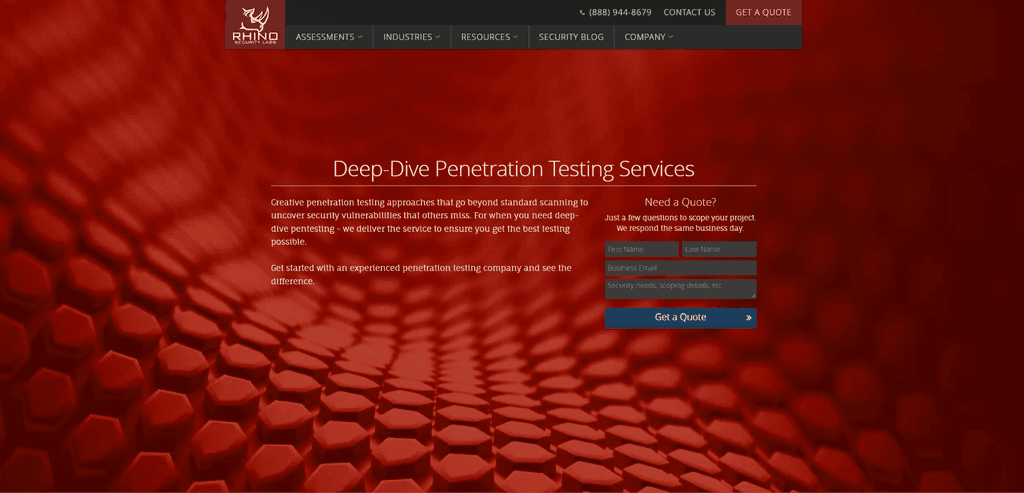
6. Rhino Security Labs
Best for: companies with complex AWS or multi-cloud setups that want a small, research-driven team
Rhino Security Labs is a Seattle firm founded in 2013. It runs a small team that does manual, in-depth testing and publishes its own security research, some of it covered by WIRED and Krebs on Security. Cloud is its specialty. Testers work across AWS, Google Cloud, and Azure and look for the misconfigurations and user permission problems that are specific to each cloud.
The team also tests web apps and APIs, mobile apps, and networks, and runs red team, phishing, and code review work. Reports open with a plain-language risk summary for leadership, then give engineers the technical detail and fix steps, and Rhino retests fixes on request. Its testing is built to satisfy PCI, HIPAA, and SOC 2 requirements. Multi-year contracts make it practical to keep the same team for repeat testing.
7. TrustedSec
Best for: companies that want a named consulting team and a retest, without a platform subscription
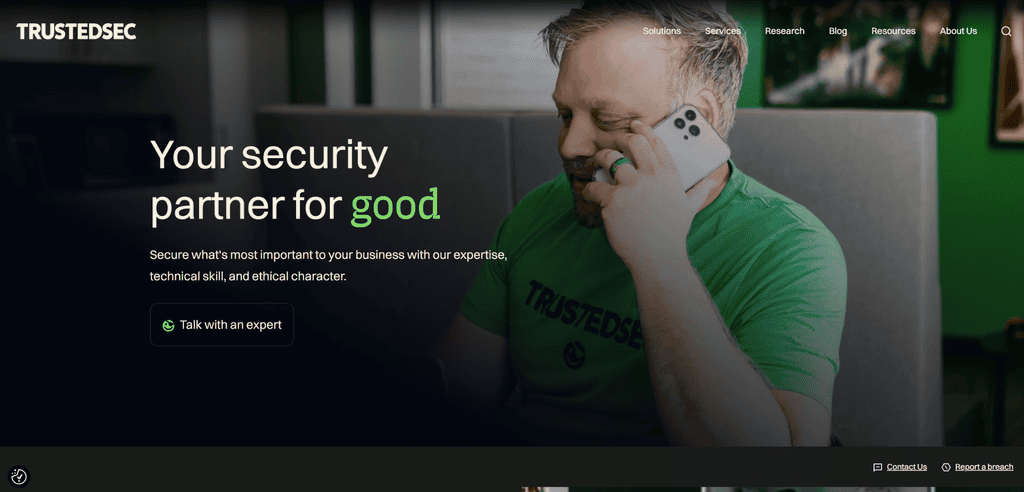
TrustedSec is based in Fairlawn, Ohio, and was founded by David Kennedy in 2012. It also publishes free security tools, including the Social-Engineer Toolkit (SET), which security teams use to test how employees respond to phishing. TrustedSec works as a consulting team: its own staff scope each engagement with you, run the test, and walk you through the results.
Services cover web apps, APIs, mobile apps, cloud, and red team work, along with incident response for companies that need help after an attack. Once your developers have fixed the findings, TrustedSec runs a validation retest to confirm the fixes hold. Buyers who like working directly with the same consultants from one engagement to the next will find this model a natural fit.
How to Choose the Right NetSPI Alternative
PTaaS providers differ in who does the testing, how it’s sold, and what you get at the end. Use these points to compare the shortlist side by side:
| Criteria | What to look for |
| Who does the testing | Employed testers, a vetted community, or AI agents with human review. Ask who confirms each finding before it reaches you. |
| Manual depth | Testers who sign in as each user role and try to break business logic, such as one customer reaching another customer’s data. |
| Scope coverage | Web apps, APIs, mobile apps, cloud accounts, and AI features, matched to the stack you actually run. |
| Engagement model | Single tests, a prepaid yearly program, credits, or a subscription. Pick the one that matches how often you ship. |
| Retesting | Whether retests are included, how long the window lasts, and whether you get an updated report afterward. |
| Reporting quality | An executive summary, CVSS severity scores, clear reproduction steps, and mapping to SOC 2, ISO 27001, PCI DSS, or HIPAA. |
| Platform and collaboration | Live findings, Jira or ticketing integration, and a direct line to the testers while the work is underway. |
| Tester continuity | Whether the same people come back for the next test, so they don’t have to relearn your app each time. |
Finally, match the provider to your stage. A startup heading into its first SOC 2 audit needs guidance and a report the auditor can use as is, while a large enterprise will weigh coverage, scale, and service levels.
Final Thoughts
Every company on this list does strong work, and the right choice depends on what you need covered and how you like to buy testing. For a SaaS company that wants manual, signed-in testing of its app and API, spread across the year and backed by reports ready for an audit, CYBRI is a strong fit. Its senior testers stay close to each engagement, findings land in one dashboard, and every fix gets retested. A short scoping call is enough to size the work, so contact CYBRI to talk through your apps and release schedule.
Frequently Asked Questions
Is PTaaS better than a one-off pentest?
It depends on how often your app changes. A one-off test fits a first assessment, a compliance deadline, or a product that rarely changes. A PTaaS program fits teams that release every week or two or run several apps, because each new release gets tested and fixes are rechecked along the way.
Can a PTaaS program cover a SOC 2 or ISO 27001 audit?
Yes. One of the scheduled tests can be timed to the audit, and its report, mapped to the framework, serves as the evidence. The running record of findings and fixes across the year also shows the auditor that issues get tracked and closed.
How often should a SaaS company run a pentest?
The recommendation is at least once a year, plus after any major release, such as a new billing flow, a new API, or a change to how users log in. Teams that ship often usually move to a program with several tests a year.
Ready to Find the Right PTaaS Fit?
CYBRI runs manual, signed-in penetration tests of SaaS apps and APIs, as a single test or a yearly PTaaS program. Senior OSCP-certified testers flag critical issues the same day, findings appear in the Blue Box dashboard, and every fix is retested over about 90 days with an updated report. Get a quote to see how a program would fit your release schedule.