Introduction: The Compliance Dilemma – Scan or Pentest?
Many technology businesses pursuing SOC 2 or ISO 27001 certification face a critical question. Is a vulnerability scan report sufficient for an audit, or is a full penetration test report required? The answer has significant implications for your budget, timeline, and the ultimate success of your compliance audit. This article clarifies the distinction between these two security assessments, explains what auditors expect, and details why the depth of a manual penetration test is essential for validating security controls effectively.
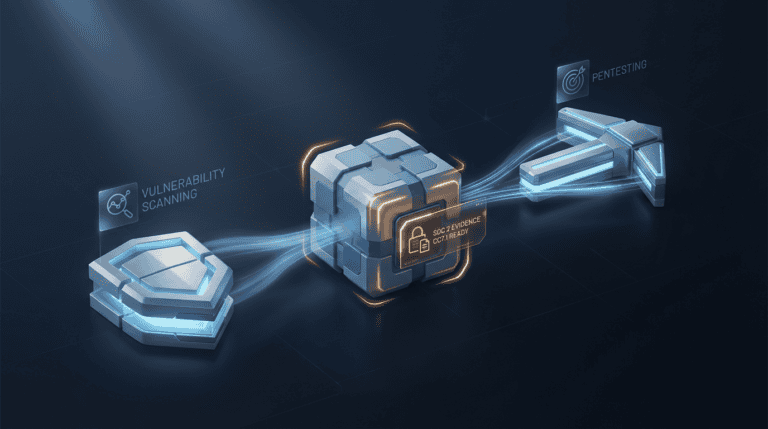
A vulnerability scan is an automated process that identifies known vulnerabilities, while a penetration test is a manual, goal-oriented exercise that simulates a real-world attack to exploit weaknesses. While both are important components of a mature security program, they serve different purposes and provide vastly different levels of assurance. For auditors, assurance is key. They need to see evidence that your security controls are not just designed correctly but are also operationally effective against a determined adversary. Understanding the difference is crucial for not only achieving compliance but also for building a genuinely resilient security posture.
The Vulnerability Scan Report: An Automated Snapshot
A vulnerability scan is an automated tool that inventories systems, networks, and applications to find known security flaws. These tools compare the configuration of your assets against a vast database of known vulnerabilities, such as outdated software versions, missing patches, or common misconfigurations. The resulting report is typically a long, unfiltered list of potential issues, often generated without the context of your specific business environment or risk tolerance.
According to security experts, the primary objective of a vulnerability scan is to identify potential security issues, whereas a penetration test seeks to actively exploit them to confirm their real-world risk [1]. This distinction is critical. Vulnerability scan reports can contain a high number of ‘false positives’, which are flagged issues that are not actually exploitable in your environment. This creates noise and can lead to wasted time for your technical teams as they chase down non-existent threats. While useful for maintaining regular security hygiene, a vulnerability scan report shows auditors that you have a process for identifying potential issues. It does not, however, prove that your security controls can withstand a dedicated, human-led attack.
The Penetration Test Report: A Manual, In-Depth Analysis
A penetration test is a manual assessment conducted by certified security experts who mimic the tactics, techniques, and procedures of real-world attackers. It is a goal-oriented engagement designed to find and exploit vulnerabilities to determine the potential business impact of a breach. This manual-first approach allows testers to be creative, adapt their attack paths, and uncover complex vulnerabilities that automated tools are designed to miss.
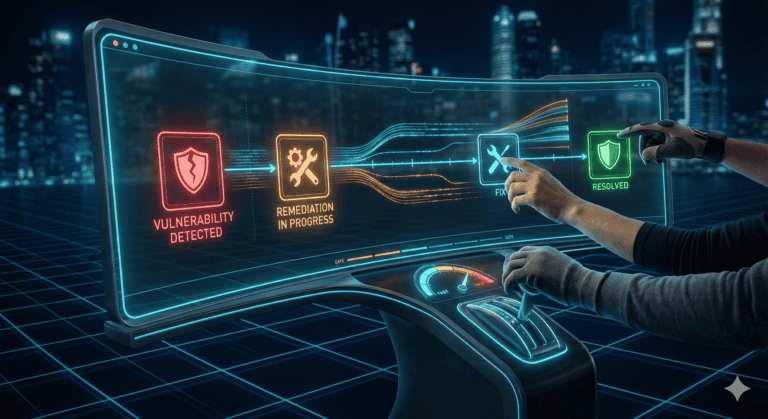
The final report from a penetration test is fundamentally different from a scan output. It provides a detailed narrative of the simulated attack, including which vulnerabilities were successfully exploited, the methods used, and the potential business impact. A compliance-ready report includes a high-level executive summary for leadership that translates technical risk into business terms. It also contains detailed technical findings with actionable, prioritized remediation steps for technical teams. Unlike an automated scan, a pentest report provides definitive evidence of exploitability, demonstrating the true risk a vulnerability poses and validating the effectiveness, or ineffectiveness, of your security controls under pressure.
Why Auditors Prefer Pentest Reports for SOC 2 Compliance
While the SOC 2 framework does not use the word ‘mandatory’ for penetration testing, it is strongly recommended by auditors and is considered essential for satisfying key Trust Services Criteria (TSC). Attempting to pass a SOC 2 audit without one is a significant risk. Specifically, auditors look for evidence to satisfy Common Criteria 4.1 (CC4.1), which states that management uses a variety of evaluations, including penetration testing, to ascertain whether internal controls are present and functioning.
Here is why a pentest report is the preferred form of evidence:
- Demonstrates Control Effectiveness: A vulnerability scan can help address CC7.1, which focuses on identifying new vulnerabilities. However, a pentest provides much stronger evidence that your controls are operationally effective against an active threat. It answers the auditor’s question, “Do your defenses actually work?”
- Provides Third-Party Validation: Auditors require impartial, expert validation of your security posture. A report from a reputable, independent penetration testing firm provides credible, third-party attestation that your controls have been rigorously tested.
- Shows Due Diligence: Investing in a manual penetration test demonstrates a higher level of security maturity and due diligence. It shows auditors that the organization has moved beyond simple automated checks to proactively test its defenses in a scenario that mirrors a real-world attack.
For organizations handling sensitive customer data, a penetration test for SOC 2 compliance is the most direct way to provide the assurance auditors need to sign off on your report.
The Role of Penetration Testing in ISO 27001 Audits
ISO 27001 is a standard for establishing, implementing, maintaining, and continually improving an Information Security Management System (ISMS). A core principle of the framework is managing information security through a risk-based approach, and penetration testing is a primary method for validating this process.
Annex A.12.6.1, ‘Technical Vulnerability Management’, requires that information about technical vulnerabilities be obtained in a timely fashion and that the organization’s exposure to such vulnerabilities is evaluated and remediated. A penetration test directly addresses this control by not just identifying vulnerabilities but actively attempting to exploit them to measure their true exposure.
Furthermore, penetration testing provides critical evidence for other parts of the standard, including risk assessment (Clause 6.1.2) and technical compliance reviews. Auditors for ISO 27001 often request recent pentest results as definitive proof that the ISMS is not just a paper-based exercise but an operationally effective framework. A penetration test designed for ISO 27001 provides the real-world data on control effectiveness that is necessary to demonstrate a functioning and continuously improving ISMS.
The Critical Difference: Uncovering Business Logic Flaws
The most significant limitation of automated vulnerability scanners is their inability to understand business context. They are programmed to find known patterns of bad code, but they cannot identify business logic flaws. These are vulnerabilities that arise from an application’s intended workflow, which an attacker can manipulate for malicious purposes.
Examples of business logic flaws include:
- Manipulating a multi-step checkout process to receive an unauthorized discount.
- Bypassing an identity verification workflow to create a fraudulent account.
- Exploiting an API sequence to access data that should be restricted.
Discovering these flaws requires human creativity, critical thinking, and a deep understanding of the application’s purpose. This is the core of a manual penetration test. An expert tester thinks like an attacker, asking, “How can I abuse this feature?” This is a question an automated scanner can never ask. A pentest report that details exploited business logic flaws is highly valued by auditors because it demonstrates a deep, contextual understanding of risk that automated tools can never provide.
What Makes a Penetration Test Report ‘Compliance-Ready’?
To satisfy auditors for frameworks like SOC 2 and ISO 27001, a penetration test report must be clear, comprehensive, and actionable. It is more than just a list of findings; it is a formal document that serves as evidence of your security testing program. Key components of an audit-ready report include:
- A Well-Defined Scope: The scope must be clearly documented and aligned with your compliance requirements, such as the systems and applications handling sensitive customer data.
- An Executive Summary: This section should clearly explain the business risks of the findings in non-technical language for leadership and stakeholders.
- Detailed Technical Findings: Each vulnerability must be documented with evidence of exploitation (like screenshots or logs), a risk rating based on a standard methodology like CVSS, and a clear description of the potential impact.
- Actionable Remediation Guidance: The report must provide clear, prioritized, and actionable steps that help your development and IT teams fix the issues efficiently.
- Third-Party Attestation: The report must come from a qualified, independent third party to ensure the assessment is impartial and credible in the eyes of an auditor.
A professional penetration testing report is structured to provide all of this information in a format that is easy for auditors to review and accept as evidence.
Conclusion: Choose In-Depth Validation Over Automated Checks
For rigorous compliance frameworks like SOC 2 and ISO 27001, auditors need definitive assurance that your security controls are not just in place, but are functioning effectively against realistic threats. While automated vulnerability scans are a valuable and necessary part of a modern security program, they cannot provide the level of validation that a manual, expert-led penetration test offers.
A comprehensive penetration test report, delivered by certified testers, serves as definitive proof of due diligence and provides the credible, third-party validation that auditors require. It moves your organization beyond a simple compliance checkbox, providing true insight into your security posture and demonstrating a tangible commitment to protecting your critical data and your customers’ trust. When preparing for your next audit, investing in a manual penetration test is the most effective way to meet compliance requirements and build a stronger, more resilient security foundation. To see how CYBRI’s expert-led penetration testing can help you achieve your compliance goals, request a demo to speak with one of our security specialists.