This guide highlights eight top PTaaS companies in 2025—Cybri, Bishop Fox, Astra Security, Cobalt, BreachLock, Rhino Security Labs, Pentera, and SecureLayer7—and compares them based on strengths like tester expertise, platform usability, retesting support, developer workflow integration, compliance outputs, pricing transparency, and responsiveness. It includes a vendor-by-vendor breakdown, tailored recommendations for different company sizes and technical needs, and a FAQ section covering PTaaS basics, speed, cost, and compliance readiness.
Penetration Testing as a Service (PTaaS) has emerged as a modern approach to security testing. It addresses the speed, scalability, and continuous delivery needs of today’s businesses. According to Gartner, PTaaS is positioned “as a high-benefit solution that is two to five years from mainstream adoption, with 20–50% of the target audience already adopting it to meet compliance requirements and conduct more impactful security testing while keeping costs down” [1].
PTaaS vs Traditional Penetration Testing: Speed, Cost, and Efficiency
From a business perspective, PTaaS is especially important because it is cost-effective and fast. In contrast, traditional penetration tests often require weeks of scheduling and lead time. They also produce a large PDF report that arrives long after development has moved forward. As a result, teams struggle to act on findings in time.
By comparison, PTaaS platforms allow teams to launch tests on demand. In addition, they provide real-time visibility into discovered issues. This can significantly reduce testing cycles. Experts estimate that PTaaS engagements complete about 50% faster than traditional consulting engagements.
Therefore, this guide explains the key criteria for evaluating PTaaS providers. It helps executives in tech roles compare leading vendors and choose the right fit for 2025. Furthermore, it includes vendor profiles, key strengths, and a FAQ section covering common questions about speed, cost, compliance, and more.
Key Evaluation Criteria for PTaaS Providers
| Criteria | What to Look For |
| Tester Quality & Expertise | Ensure testing is led by real humans, not just tools. Look for certified, senior ethical hackers with proven experience. |
| Platform Usability | The PTaaS platform should be intuitive for both technical and non-technical users. Features like real-time updates, clear visuals, and collaboration tools are essential. |
| Retesting & Remediation | Top providers help with fixing issues, not just reporting them. Look for fix recommendations, tester Q&A access, and retesting options. |
Divider |
|
| Dev Workflow Integration | PTaaS should integrate smoothly with your existing tools. Check for APIs and plug-ins for Jira, GitHub, GitLab, CI/CD, etc. |
| Compliance Reporting | Ensure the service supports audit-friendly reporting. Look for templates or formats aligned with frameworks like SOC 2, HIPAA, PCI, GDPR etc. |
| Pricing Transparency | Clear, upfront pricing avoids surprises. Look for models like fixed-fee or subscriptions based on test scope and frequency. |
| Responsiveness & Support | Fast, reliable support is key during testing and remediation. A dedicated point of contact and time-zone aligned help are big pluses. |
Top PTaaS Service Providers in 2026: Vendor-by-Vendor Breakdown
| Company | Best For | Tech Stack Experience | Retesting & Remediation Support |
| Cybri | PTaas built for engineering-led SaaS; lightning-fast; expert-driven; real results | Hand-picked U.S.-based certified ethical hackers. | Real-time collaboration in BlueBox; compliance-mapped reports; easy scheduling of retests |
| Bishop Fox | Large enterprises needing continuous coverage & advanced security testing | Deep technical expertise; strong in large-scale, complex, multi-cloud environments | Deep technical support; ongoing testing; red teaming options alongside remediation recommendations |
| Astra | Fast-growing SaaS and mid-size firms seeking DevSecOps integrated testing | Combines manual pentesting with an automated scanner; covers web apps, APIs; CI/CD and Jira integrations | Includes retests; actionable fix advice; manual validation to support remediation; real-time tracking |
| Cobalt | Agile teams and startups requiring quick, flexible pentest cycles | Vetted freelance tester network (Cobalt Core); rapid test kickoff; strong Jira/GitHub integration | In-platform chat with testers; continuous updates; easy retest requests |
Divider |
|||
| Breachlock | Compliance-driven organizations wanting an all-in-one, scalable testing platform | Hybrid platform with CREST-certified testers + automation; OWASP, OSSTMM, and NIST aligned; suitable for broad asset coverage | Unlimited retests included in subscription; centralized dashboard for issue resolution and ticketing |
| Rhino Security Labs | Companies needing deep cloud security testing and personalized, expert assessments | Boutique expertise in AWS, cloud, and network environments; less platform-focused but highly technical | Detailed, personalized reports; follow-up advisory available; offers periodic retests as part of managed service |
| Pentera | Internal security teams seeking a tool to continuously auto-penetration-test and validate defenses | Automated Security Validation across network, endpoints, and identity layers; requires in-house operation | Self-service remediation roadmap based on exploit chains; no direct human-led retesting unless paired with other services |
| SecureLayer7 | Smaller enterprises and DevOps teams needing quick pentests and ongoing vulnerability scanning | Web and API testing focus; rapid test launch via BugDazz platform; Jira integration for dev workflows | Continuous vulnerability monitoring; real-time findings; Jira alerts; retest options available |
1. Cybri
Best for: Organizations that want a streamlined, high-touch pentesting service.
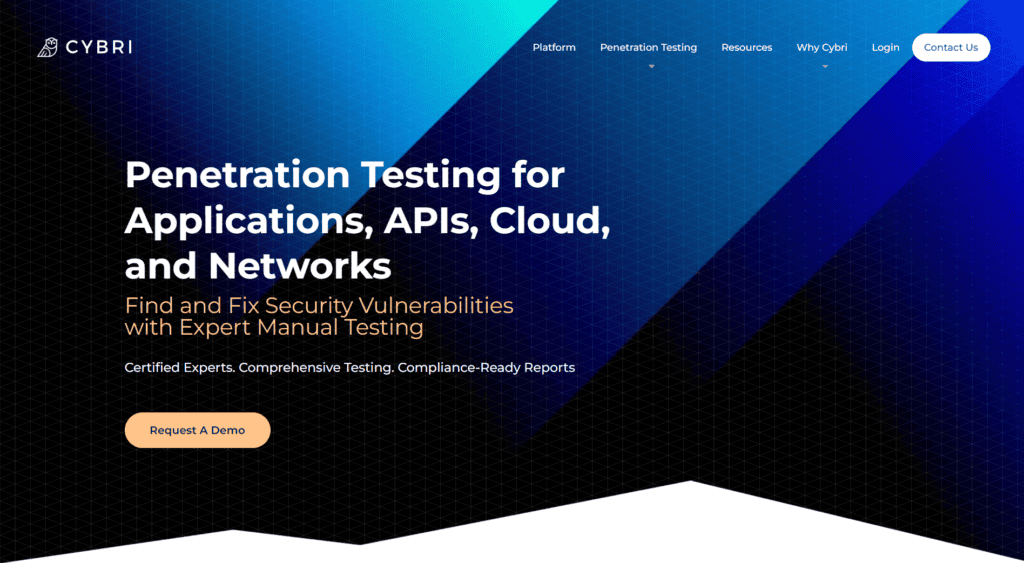
Cybri is a PTaaS penetration testing company focused on high-quality, low-friction security testing. Founded in 2017, Cybri delivers application and network penetration tests. These tests are conducted by hand-picked, U.S.-based testers who specialize in modern SaaS stacks such as React, Node.js, AWS, GCP, and Azure. In addition, tests are typically completed within weeks, which aligns with SOC 2 and other compliance frameworks.
Cybri is trusted by CTOs, DevOps teams, engineers, and security leaders at SaaS companies. It helps them meet enterprise buyer requirements without slowing down release cycles. As a result, it is a strong fit for growing SaaS and tech-driven mid-market companies. These companies often need to strengthen their security posture, especially when onboarding clients in healthcare, finance, or enterprise sectors that require strict third-party validation.
The platform also includes BlueBox. It provides a real-time dashboard for security testing. In addition, it integrates with Jira, GitHub, and CI/CD pipelines. This streamlines remediation workflows and aligns reporting with compliance standards such as SOC 2, GDPR, and HIPAA.
Website: https://cybri.com/
2. Bishop Fox
Best for: Large enterprises and high-security organizations that want an enterprise-grade continuous testing partner.
Bishop Fox is one of the more established players in the penetration testing space, with roughly 20 years of experience. In addition, the company focuses on large enterprise clients with complex systems and significant budgets. Their PTaaS solution revolves around the Cosmos platform. This platform provides continuous testing and attack surface management for organizations with multi-cloud or hybrid environments.
Furthermore, Bishop Fox offers a wide range of offensive security services. These include strategic advisory, red teaming, and penetration testing. As a result, the company is often a strong fit for businesses with large and complex infrastructures. For example, this includes multi-cloud and hybrid environments. However, despite this broad service offering, their focus remains largely enterprise-oriented. Therefore, they may be less aligned with modern SaaS teams that prioritize fast, iterative, and development-driven security testing workflows.
Website: https://bishopfox.com/
3. Astra Security
Best for: Engineering-centric organizations that want a DevOps-integrated, continuous pentesting solution.

Teams that prioritize user-friendly dashboards and high-level insights may prefer Astra’s security suite. In addition, it combines automation with a limited amount of manual testing. However, compared to other vendors on this list, its approach is more generic. It focuses mainly on general website and application security. As a result, it is not always suited for complex SaaS environments or engineering-led workflows.
Astra provides automated scanning. In addition, it includes some manual testing in every engagement and covers frameworks such as OWASP Top 10 and SANS 25. Although this hybrid model can help businesses with fast release cycles or limited security resources, the manual component usually enhances automation rather than replaces it. Therefore, Astra is often better suited for baseline security testing. It is less effective for teams that require deeper technical coverage or complex SaaS infrastructure testing.
Website: https://www.getastra.com/
4. Cobalt
Best for: Agile teams and mid-size companies that need on-demand pentesting with tight integration into development workflows.

Cobalt is one of the pioneers of the PTaaS model and remains a prominent platform in 2025. In addition, its platform offers relatively fast test launches and a SaaS interface for managing engagements. It connects businesses with independent pentesters from the vetted “Cobalt Core” network. As a result, companies can access external security talent without building internal capabilities.
Furthermore, the Cobalt Central platform focuses on communication and collaboration. It supports scoping, tester assignment, reporting, and retesting in one place. However, the platform follows a marketplace-first model. This model works well for managing multiple tests across larger teams.
However, for engineering-led SaaS teams that require strict control and close collaboration, the workflow may feel less flexible. In addition, testing quality and speed can vary depending on the freelancer pool.
Website: https://www.cobalt.io/
5. BreachLock
Best for: Organizations that want a comprehensive, one-stop pentesting platform with both manual and automated testing.

The PTaaS provider BreachLock places a strong emphasis on automation and integration with existing security processes. In addition, the platform supports frameworks such as OWASP, NIST, and OSSTMM. It also offers manual testing options, usually performed by CREST-certified testers. Furthermore, it supports continuous scanning. Although it includes manual capabilities, the overall model focuses more on speed and scale than on high-touch collaboration or guidance. This is especially important for SaaS teams preparing for enterprise security reviews.
Results are managed through an integrated ticketing system. In addition, turnaround times are relatively fast, with some tests starting within 24 to 48 hours. As a result, businesses with large attack surfaces and frequent testing needs can benefit from BreachLock’s methodology. This is particularly true for teams that prefer a simplified, automated-first approach. However, teams that require deeper strategic feedback or closer alignment with application architecture may find the engagement model more generalized than collaborative.
Website: https://www.breachlock.com/
6. Rhino Security Labs
Best for: Companies that require deep expertise, especially in cloud and network penetration testing, with a personalized touch.
Rhino Security Labs is a penetration testing company that also offers PTaaS capabilities for ongoing engagements. In addition, the company is well known for web application, network, and cloud-focused testing, especially in AWS environments. It provides services such as recurring scans and retesting as part of ongoing consulting packages. However, its offering is not centered around a dedicated PTaaS platform or dashboard.
Clients often praise Rhino for its detailed documentation and reporting. In particular, reports include step-by-step attack narratives and clear mitigation guidance. As a result, organizations with complex infrastructure or strict regulatory requirements often find Rhino appealing. However, for modern SaaS teams with frequent release cycles, the lack of a centralized platform or self-service tooling may reduce flexibility.
Website: https://rhinosecuritylabs.com/
7. Pentera
Best for: Mature security teams or service providers that want an automated penetration testing tool for continuous validation.

Pentera is slightly different from other entries on this list because it is primarily a software platform rather than a service. However, it operates in the same space of “continuous security validation” through its Automated Security Validation platform. This platform performs automated penetration testing across networks and systems. In addition, it can simulate a range of attacks, including network breach attempts, credential theft, and lateral movement. These simulations run without a human operator.
Furthermore, Pentera’s core capabilities include testing security layers for misconfigurations and exploitable paths. It also provides a clear remediation roadmap for successful exploit chains. However, it requires an internal team to operate and monitor results. As a result, it is best suited for organizations with large network infrastructures or on-prem systems. For example, this includes financial institutions, large enterprises, and managed security providers that need to assess systems at scale.
Website: https://pentera.io/
8. SecureLayer7
Best for: Budget-conscious organizations and fast-moving dev teams that still demand a robust pentest.

SecureLayer7 is a security services company that has developed its own PTaaS platform called “BugDazz”. In addition, a key selling point of SecureLayer7 is speed and ease of use. The company advertises “Pentest on the fly” with a platform that can onboard customers and launch tests quickly. This rapid kickoff is enabled by a streamlined scoping and onboarding workflow. As a result, delays are significantly reduced. For companies that need an urgent penetration test, this speed is especially valuable. For example, this includes last-minute audits or sudden security concerns.
The BugDazz platform provides real-time vulnerability insights and continuous monitoring. In addition, it integrates with development tools such as Jira for direct notifications and reporting. However, its lack of advanced features and limited customization may reduce its suitability for complex environments or high-stakes compliance testing. Therefore, SecureLayer7 is a strong option for startups and small to midsize businesses. These teams often prioritize speed, affordability, and continuous visibility.
Website: https://securelayer7.net/home
How to Choose the Right PTaaS Partner
One of the main considerations when choosing a new PTaaS partner should be to match your company maturity with the provider. In other words, startup companies require different providers than a well-established enterprise organisation for instance. Therefore looking for someone that understands your business model and requirements can go a long way.
Credentials are another important factor, whether they are GIAC, OSWE or CREST certified for instance. However, as Ewelina Baran from Blaze Infosec states, it is also “desirable that the provider has a hacker mindset and ‘think out of the box’ creativity to go beyond common checklists” [4].
Therefore, you should aim to choose a partner that understands your stage, as startups may prioritize fast onboarding, while enterprises may need advanced integrations and SLAs. Next, consider matching the partner to fit your testing frequency needs, as some platforms excel at ad hoc testing, while others offer continuous pentesting with real-time monitoring and integrations.
Another important factor is compliance. Do you need to comply with an audit quickly, then opting for vendors with pre-mapped compliance report templates might be the way to go. And finally, it is also a good idea to consider your internal engineering team and their preferences, so that your teams can benefit from the shared knowledge and feedback.
Evaluate Cybri for Your Next Pentest
Cybri is ideal for companies prioritizing speed, clarity, and compliance. All testers are US-based and certified, while the powerful BlueBox platform enables real-time collaboration with testers, fast kickoff, and reports ready for audits. If your team needs a reliable partner that balances service quality with fast results, Cybri should be on your shortlist. Want to learn more? Request a free consultation or see a sample report today!
Frequently Asked Questions
Q: What is Penetration Testing as a Service (PTaaS)?
A: PTaaS is a modern approach to penetration testing that delivers the service via a cloud platform on an ongoing or on-demand basis. With PTaaS, you typically subscribe to a platform that combines automated scanning tools with human-led pentesting, and you interact through an online dashboard.
Q: How fast are PTaaS reports delivered compared to traditional pentesting?
A: One of the big advantages of PTaaS is speed. In a traditional pentest, you often wait weeks to schedule testers, then wait until the end of the engagement to receive a static PDF report. PTaaS accelerates that timeline in multiple ways, as engagements can start faster and results often are delivered in real-time through the platform.
Q: What is the cost range for PTaaS? Is it more expensive than regular pentesting?
A: The cost for PTaaS varies depending on the provider and the scope of what you’re testing, but it’s often comparable to traditional pentesting – and sometimes more flexible. Many vendors offer subscription pricing that covers a certain number of tests or assets, as well as one-off pricing. For a rough benchmark, traditional penetration tests might cost on the order of $10k–30k for a mid-sized web application test, and upwards of six figures for very large or complex scopes [5].
Q: Are PTaaS reports and services compliant with frameworks like SOC 2, HIPAA, or ISO 27001?
A: Yes, most PTaaS providers design their services to help customers meet common compliance requirements. The reports issued by reputable PTaaS vendors typically contain the necessary details such as scope, methodology, findings with severity ratings, and remediation steps – all of which are useful for an audit. Many providers will map their findings to relevant compliance criteria.