SOC 2 penetration testing is a critical process where ethical hackers simulate real-world cyberattacks to validate an organization’s security controls against the SOC 2 Trust Services Criteria.
Organizations should schedule testing just before a Type I attestation and within the audit review period for Type II to ensure credible evidence of compliance. A robust SOC 2-aligned report should clearly present vulnerabilities, exploitation evidence, actionable remediation steps, and detailed technical insights.
Key Areas Covered in This SOC 2 Penetration Testing Guide
Effective remediation and retesting post-assessment, along with choosing an experienced testing provider, are vital for passing audits and maintaining a strong, continuous security posture.
Use this article to understand the purpose, when to conduct, and how SOC 2 penetration testing works, what to do after a test, and how to prepare effectively for compliance audits.
Why SOC 2 Penetration Testing Matters for Compliance
You’ve just landed a major enterprise client. The contract is ready, but it comes with a critical request: “Please provide your SOC 2 Type II report.” Suddenly, the question isn’t if your SaaS platform is secure, but how you can prove it against a real-world attack.
Even with robust security measures, a SOC 2 audit requires proof that your defenses can withstand a real-world attack simulation. Penetration testing provides this critical validation. By mirroring the techniques of malicious actors to proactively identify and exploit vulnerabilities, it delivers tangible evidence that your security controls are effective against real-world threats, directly supporting your compliance journey.
What This SOC 2 Penetration Testing Guide Covers
This guide is for the leaders and teams—from founders and CEOs to security and engineering officers—tasked with navigating SOC 2 compliance. It covers everything you need to know about integrating penetration testing into your strategy, from its core definition to preparing for an engagement and selecting a partner.
What is SoC 2 Penetration Testing?
At its core, penetration testing (or “pen testing”) is an authorized, simulated cyberattack against your systems conducted by ethical hackers. Think of it as hiring a professional burglar to test your office’s security. They won’t just check if doors are unlocked; they will actively try to bypass locks and alarms to see how far they can get.
So, how does this apply specifically to a SOC 2 audit? A SOC 2 penetration test isn’t a generic security assessment. It’s a targeted engagement designed to validate the effectiveness of the security controls your organization has implemented to meet the SOC 2 Trust Services Criteria (primarily the Security TSC).
Your SOC 2 report makes specific claims—for example, “We have implemented controls to prevent unauthorized access to customer data.” The penetration test is where you prove it. Our job as testers is to challenge those claims directly. If you say a door is locked, we will pull the handle, try to pick the lock, and see if the frame is weak. The results provide your auditor with objective, third-party evidence that your controls are either operating effectively or have gaps that need to be addressed.
Penetration Testing vs Vulnerability Scan
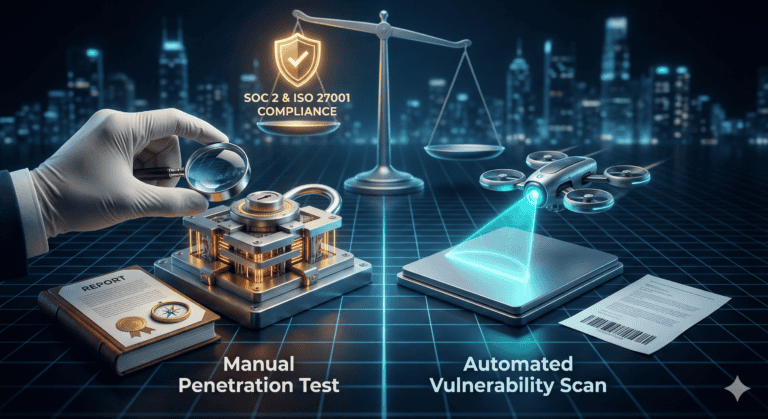
A pen test should not be confused with a vulnerability scan. They serve different, complementary purposes.
| Vulnerability Scan | Penetration Test |
Method | Automated tool-based scan | Human-driven, manual process |
Goal | Identifies a broad list of potential known weaknesses | Actively exploits weaknesses to confirm real-world risk |
Answers | “What weaknesses might exist here?” | “Can these weaknesses be exploited and what is the business impact?” |
As Penetration Testers we chain together low-risk vulnerabilities to create high-impact attack paths, bypass security controls, and demonstrate what a real attacker could achieve. Notably, “vulnerability exploitation as a breach initiation path has increased by 180%” [1].
Is Penetration Testing Required for SOC 2 Compliance?
Overall, yes. Penetration testing is required for SoC 2 compliance based on the Security Trust Service Criterion.
The short answer is no, the SOC 2 framework doesn’t explicitly state “you must perform a penetration test.”
However, the practical answer – yes, it is a de facto requirement. The framework is built on principles, not prescriptive checklists, giving organizations flexibility in how they meet the criteria.
The reason lies in the Security Trust Service Criterion, which is the mandatory foundation of every SOC 2 report. This criterion requires organizations to actively protect their systems and information from unauthorized access and damage.
Considered essential
Here’s why it’s considered essential:
- Auditor Expectation: Auditors need objective evidence. A policy document is a statement of intent, but a third-party penetration test report is hard proof that your controls were tested against a skilled adversary.
- AICPA Guidance: The AICPA, which governs SOC 2, explicitly lists penetration testing as a prime example of a “separate evaluation” used to determine if security controls are functioning under criterion CC4.1 (Monitoring Controls).
- Burden of Proof: Without a pen test, the burden falls on you to convince an auditor that your alternative methods are sufficient. This is a difficult position to be in, as auditors are trained to look for robust, real-world validation. The strategic importance of proactive security investment in this context cannot be overstated.
> “If you spend more on coffee than on IT security, you will be hacked. What’s more, you deserve to be hacked.” (Richard A. Clarke)
When Should You Conduct Penetration Testing for SOC 2?
Strategic timing is crucial for maximizing the value of your penetration test for a SOC 2 audit. The right time depends on the report type you are pursuing.
Report Type | Focus | When to Conduct Pen Test |
SOC 2 Type I | Assesses the suitability of the design of controls at a single point in time. It answers: “Are the security controls designed properly?”. | Shortly before your attestation date. This validates your security design. |
SOC 2 Type II | Assesses both the suitability of the design and the operating effectiveness of controls over a specified period (typically 3-12 months). It answers: “Do the security controls a company has in place function as intended over time?”. | Within the review period covered by the audit (e.g., 6-12 months). A test performed outside this window will not be considered valid evidence by your auditor. |
While you must test within the audit window, the best practice is to establish an annual testing cadence to maintain a continuous security posture.
Strategic Takeaway: Work backward from your audit deadline. Schedule your penetration test to finish at least 2-3 months before your review period ends. This provides a critical buffer for your team to remediate findings, have them retested, and present a clean report to your auditor.
What Makes a SOC 2-Aligned Penetration Test Report?
A critical deliverable, your SoC 2 report must be clear, actional and credible. Afterall, alongside the c-suite, it’ll also be viewed by auditors and technical teams. Formats may vary, but a SoC 2 report must contain the following elements:
- Executive-Level Summary – A high-level overview that contains a summary of the testing scope, objectives and key findings. It shouldn’t contain any jargon.
- Risk-Severity Findings – Each vulnerability must be clearly documented and assigned a risk rating, often based on a standard like the Common Vulnerability Scoring System (CVSS).
- Clear Evidence of Exploitation – This includes evidence like screenshots, command outputs, or logs that demonstrate exactly how a vulnerability was exploited.
- Actionable Remediation Recommendations – Recommendations should be mapped back to the specific Trust Services Criteria (TSC) they impact, directly connecting a technical flaw to a compliance requirement – what an auditor needs to see.
- Detailed Technical Appendix – It should contain raw data and deep technical details, so that dev and infrastructure teams have specific info required to implement fixes.
How to Prepare for a SOC 2 Pen Test?
A successful penetration test for your SOC 2 audit begins with meticulous preparation to ensure the engagement is efficient and yields results directly relevant to your compliance objectives.
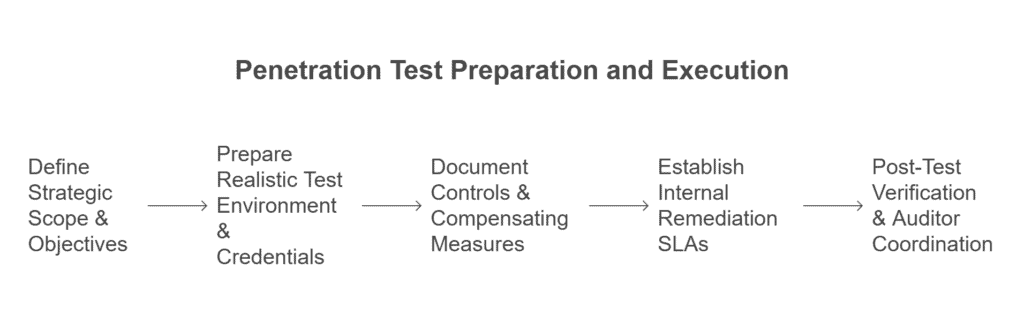
1. Define Strategic Scope & Objectives
Clearly define the test’s scope and objectives with your provider, mapping out the applications, APIs, cloud infrastructure, and network segments relevant to your SOC 2 audit. Proper scoping is essential to cover all critical compliance areas and maximize value.
2. Prepare Realistic Test Environment & Credentials
Use a test environment that is a high-fidelity replica of production to gain actionable insights without disrupting live services. Provide temporary, role-based test credentials to allow testers to probe for vulnerabilities, which should be revoked immediately after the engagement.
3. Document Controls & Compensating Measures
Ensure your documentation for security controls, policies, and procedures is up-to-date. This information can be shared with testers to aid their assessment, especially for white-box or grey-box tests. Also, document any compensating controls you have in place.
4. Establish Internal Remediation SLAs
Before the test begins, establish clear internal Service Level Agreements (SLAs) for remediating findings. This demonstrates a mature vulnerability management process to your auditor. Critical and high-risk issues often require immediate attention, with remediation expected within 7-14 days.
5. Post-Test Verification & Auditor Coordination
After the test, review findings with your teams and develop a remediation plan. Document all remediation steps, including changes and dates, as evidence for your auditor. Plan for a retest to verify fixes and coordinate with your auditor on how the findings will be presented.
Choosing a Penetration Testing Provider for SOC 2
Selecting a SOC 2 penetration testing provider demands proven audit experience, relevant certifications, rigorous methodologies, retesting protocols, and transparent pricing. When performing due diligence, focus on partners with proven expertise in the context of compliance.
We cover the key factors in more detail below.
Factor | Aspect | Key Considerations |
Provider’s Expertise and Experience | SOC 2 Relevant Experience | Prioritize vendors with specific SOC 2 experience who understand auditor expectations and how to map findings to TSCs. |
Industry & Technology Stack Relevance | Seek expertise relevant to your industry (e.g., SaaS, FinTech, HealthTech) and technology stack (e.g., AWS, Azure, GCP, React.js, Node.js). | |
Team Certifications | Look for recognized, hands-on certifications like OSCP, OSWE, CRTO, GWAPT, or CREST. | |
Methodology | Their methodology should adhere to recognized standards like OWASP, NIST or PTES. | |
Report Quality & Actionability | SOC 2 Alignment | Ensure reports are designed for auditors, with an executive summary, risk-prioritized findings, and remediation guidance. |
Retesting & Verification | Inquire about their process for retesting and verifying remediation, which is crucial for auditors. | |
Engagement Model & Logistics | Timelines | Align testing and retesting timelines with your audit deadlines to ensure completion before your observation period ends. |
Flexible Models | Consider Penetration Testing as a Service (PTaaS) models for on-demand scheduling after system changes or new deployments. | |
Pricing Transparency | Understand their pricing model and be wary of unusually low prices, which may indicate superficial assessments. | |
No Unnecessary Add-ons | Avoid vendors pushing expensive add-ons or bundled services you don’t need; focus on a high-quality, tailored test. | |
Liability Insurance | Confirm the provider carries adequate professional liability insurance (Errors and Omissions). |
Common SOC 2 Pen Test Findings
Authentication flaws, exposed development environments, cloud misconfigurations, insecure APIs, and outdated third-party libraries are the most critical vulnerabilities uncovered in SOC 2 penetration tests.
Penetration tests often reveal gaps between documented policies and operational reality. These findings are a critical reality check for your security controls. Here are common issues you should be aware of:
Authentication Flaws
Weaknesses in how users log in and access systems are a primary concern. Common issues like weak passwords or missing multi-factor authentication (MFA) create easy entry points for attackers. This vulnerability is significant, as “human error, encompassing issues like weak authentication and phishing, is implicated in 68% of security breaches, with approximately 95% of security issues involving a human element. [2]“
Publicly Exposed Dev/Test Environments
Non-production systems, such as those used for development or testing, are sometimes left exposed to the internet without adequate security. This issue contributes to the broader problem of misconfigurations, with “over 90% of web applications having at least one misconfiguration, underscoring a significant vulnerability avenue. [3]”
Publicly Exposed Dev/Test Environments
Non-production systems, such as those used for development or testing, are sometimes left exposed to the internet without adequate security. This issue contributes to the broader problem of misconfigurations, with “over 90% of web applications having at least one misconfiguration, underscoring a significant vulnerability avenue. [3]”
Cloud Misconfigurations
Simple configuration errors in cloud platforms (like AWS or Azure) are a leading cause of data breaches. Issues such as publicly accessible data storage or overly permissive user access can expose sensitive information. Indeed, “80% of companies reported experiencing cloud security breaches in 2024, with 31% directly attributed to misconfiguration or human error, highlighting a prevalent and costly threat. [4]”
Insecure APIs or Broken Object-Level Authorization
APIs are the communication pathways that connect different software services. If they are not properly secured with strong authentication and authorization, they can become a prime target for attackers seeking to access or manipulate sensitive data and critical backend functions.
Outdated Third-Party Libraries
Modern applications are often built using pre-made, open-source software components. If these components are not kept up-to-date, they can introduce known vulnerabilities into your platform. This presents a substantial risk, as “70% of applications have security issues stemming from third-party code, and these flaws are often more severe and take longer to fix than those in first-party code. [5]”
What to Do After the Test
Effective post-test remediation requires documented plans, rapid resolution of critical findings, rigorous retesting, and transparent auditor communication.
Completing a penetration test initiates a critical phase of remediation and continuous improvement, essential for maximizing the test’s value and strengthening your SOC 2 security posture.
- Review Findings with Teams: Thoroughly review the report with your engineering and security teams. This debrief is crucial for understanding risk posture, technical details, and potential impact of identified vulnerabilities.
- Document Remediation Steps: Develop and document a formal remediation plan, prioritizing vulnerabilities by severity and potential SOC 2 impact. Critical and high-risk issues often require prompt attention, with remediation expected within 7-14 days for critical vulnerabilities. Document all changes, dates, and personnel involved for auditor evidence.
- Plan for Retest & Audit Binder: After implementing fixes, conduct a retest, ideally with the original provider, to verify resolution. Include these retest results in your audit binder, fulfilling the “ongoing evaluation” aspect of SOC 2 Common Criterion CC4.1.
- Coordinate with Auditor: Proactively coordinate with your SOC 2 auditor on how findings and remediation efforts will be presented. This demonstrates control effectiveness and preparedness.
- Lessons Learned: Use the test findings and remediation process for continuous improvement. This valuable input should refine your risk management, update policies, and enhance security training, integrating penetration testing into your ongoing security lifecycle.
Need SOC 2-Aligned Pen Testing?
Cybri can help your organization with SoC 2 penetration testing across a wide variety of infrastructures like AWS, Azure, GCP and more. We help SaaS, startups, fintech, healthtech, enterprise and other organizations achieve their SoC 2 compliance through pen testing.
Navigating the complexities of SOC 2 compliance, especially the technical demands of penetration testing, can be challenging. Whether you’re preparing for your first SOC 2 Type I or maintaining your Type II attestation, robust security validation is paramount.
Download our SOC 2 Penetration Testing Checklist to guide your preparation, or talk to our team at Cybri about your upcoming audit timeline and how we can help you achieve effective and auditor-ready security assurance.
References:
- Verizon. (2024). Data Breach Investigations Report.
- Terramind. (2025). 15 Security Breaches Caused By Employees & How To Prevent Them.
- SentinalOne. (2025). What is Security Misconfiguration? Types & Prevention.
- Mariusz M. (2025). 100+ Cloud Security Statistics for 2025.
- Tim A. (2025). Third-party libraries cause more security woes than first-party code, open-source flaws take longer to fix.
Frequently Asked Questions
Penetration testing is widely recognized by SOC 2 auditors as essential evidence of effective security controls—even if the framework doesn’t explicitly mandate it.
Critical and high-risk findings must be promptly remediated and retested, with documented evidence of resolution provided to your auditor.
It is generally recommended to use an independent third-party penetration testing firm to ensure objectivity and credibility for SOC 2 audit purposes.
Penetration testing for SoC 2 is widely considered a de facto requirement by auditors for demonstrating the effectiveness of security controls, particularly for the Security Trust Service Criterion.
No. SOC 2 Type II reports usually cover a period of one year. A new penetration test is typically required annually or after significant system changes.
For SOC 2 Type II compliance, conduct testing annually. You can also do it more frequently if significant system changes occur.
A SoC 2 penetration test typically ranges from $4,000 to $25,000. Pricing will vary based on testing scope and complexity.