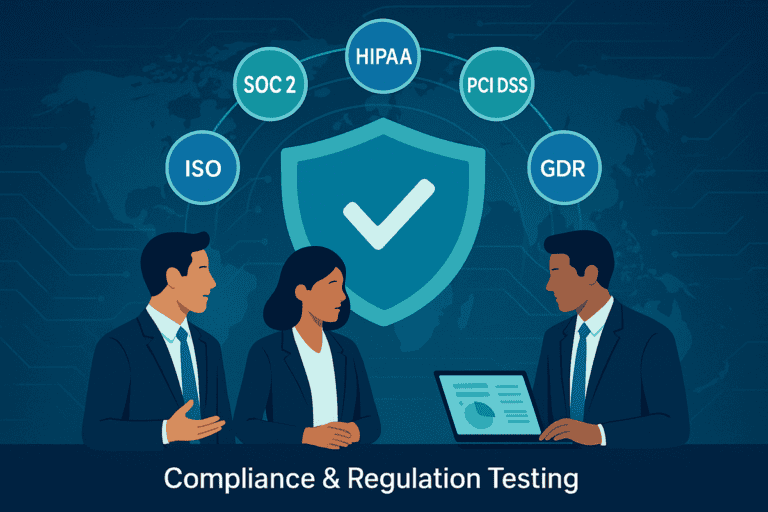
This guide helps SaaS, fintech, and healthtech leaders find the right SOC 2 penetration testing partner. Learn what services are offered, how to vet vendors, expected pricing models, and how to successfully engage a provider. Cybri is highlighted for its tech stack versatility and audit-ready reports.
Already familiar with SOC 2? You know penetration testing matters—but which vendors actually deliver?
This guide helps SaaS and tech leaders compare real options—not marketing fluff. What you need now is clarity on which vendors can actually deliver. This guide is for SaaS and tech leaders who aren’t starting from zero. You’ve identified the need. Now, you’re evaluating partners who can help you meet compliance goals without sacrificing speed or credibility.
SOC 2 penetration testing isn’t a formality—it’s a critical trust signal. The vendor you choose directly shapes your audit outcome and customer trust. The right partner won’t just run scans—they’ll validate your controls against real attack scenarios, provide audit-ready reporting, and support remediation efforts through to completion.
In this guide, we’ll help you make an informed choice. You’ll learn about the types of SOC 2 penetration testing services available, how to evaluate vendor credibility and methodology, what pricing models to expect, and how to structure your engagement for success. We’ll also compare top providers and explain how Cybri stands out in delivering audit-ready, industry-aligned penetration tests for SaaS, fintech, and healthtech platforms.
Let’s get started.
Why You Need a SOC 2 Penetration Testing Vendor
SOC 2 audits demand more than policies—they require proof that your security controls can withstand real-world attacks. That’s where penetration testing comes in.
While some teams consider performing these tests in-house, third-party vendors are almost always the better choice for SOC 2 compliance. Here’s why:
- Auditor expectation: External, independent validation carries more weight than internal testing. Auditors trust third-party reports because they’re unbiased.
- Objectivity matters: In-house teams often suffer from familiarity bias. Outsiders bring fresh eyes and may uncover critical gaps your team overlooks.
- Breadth of experience: Vendors test across industries, cloud stacks, and threat models. Their insight into real attack patterns is hard to replicate internally.
- Tooling and certification: Established vendors bring advanced tools and certified testers (e.g., OSCP, CREST) that meet both technical and audit standards.
- Cost and scalability: Hiring, training, and retaining skilled pentesters is costly. Vendors offer project-based pricing and scale on demand.
In short, independent vendors provide stronger audit evidence, deeper technical coverage, and greater operational efficiency.
As Deloitte (2024) notes, “77% of organizations outsource cybersecurity functions due to audit credibility concerns and talent shortages” [1].
Types of SOC 2 Penetration Testing Services Offered by Vendors
SOC 2-aligned penetration testing vendors offer a variety of service types tailored to different components of a modern application stack. The right testing mix depends on your infrastructure, compliance scope, and customer expectations. Here’s what vendors offer—and how each test maps to SOC 2 compliance:
Service Type | Scope | Audit Relevance |
External Network Testing | Public-facing IPs, firewalls, open ports, and DNS exposures | Simulates how an attacker would probe your external perimeter; auditors want this visibility |
Internal Network Testing | Corporate LANs, employee workstations, internal servers | Tests for lateral movement, privilege escalation—especially useful for Type II assessments |
Web & Mobile App Testing | SaaS apps, client portals, mobile apps (iOS/Android) | Directly validates access controls, session management, and input validation |
API Penetration Testing | REST, GraphQL, gRPC endpoints | Ensures secure authentication, authorization, and data exposure hygiene in APIs |
Cloud Infrastructure Testing | AWS, Azure, GCP IAM roles, storage buckets, misconfigurations | Auditors expect cloud controls to be tested; 80% of breaches involve cloud misconfigurations¹ |
Social Engineering | Phishing campaigns, credential harvesting, insider manipulation | Optional for SOC 2, but occasionally scoped under CC4.1 or CC7.1 for organizations with insider threat controls. |
PCI Penetration Testing | Systems in PCI-DSS scope: cardholder environments, payment apps | PCI-specific tests may support SOC 2 if payment workflows are part of audit scope |
Retesting & PTaaS | Follow-up tests after remediation; ongoing subscription-based testing | Essential for demonstrating effective control operations (SOC 2 Type II) and audit readiness |
SOC 2 Vendor Evaluation Criteria
Choosing the right penetration testing provider can make or break your SOC 2 audit. With hundreds of vendors promising “enterprise-grade” assessments, separating expertise from marketing fluff is a serious challenge—especially under audit pressure. Below is a structured checklist to guide your decision.

Proven SOC 2 Experience
Look for vendors with a track record in SOC 2-specific engagements. Case studies and client references in SaaS, fintech, or healthtech signal real-world readiness.
Expert Tip: Ask if they’ve worked with your audit firm before—familiarity can smooth the reporting process.
Certifications & Standards Adherence
Ensure their team holds credentials like OSCP, CREST, or GPEN, and follows frameworks such as OWASP, NIST SP 800-115, or PTES.
Auditor-Ready Reports
A high-quality report should include CVSS-rated findings, proof-of-exploit evidence, mapped remediations, and a clean executive summary tailored for SOC 2 review.
Transparent Methodologies & Tools
Confirm they combine manual testing with automation to simulate real-world attack paths—not just scan outputs.
Pricing & Engagement Clarity
Insist on clear pricing—whether fixed-fee, per engagement, or subscription-based. Avoid upsells on compliance bundles you don’t need.
Support & Retesting
Post-engagement support, remediation guidance, and a documented retest process are non-negotiable for successful audit delivery.
Typical Pricing Models and What to Expect
Penetration testing costs depend heavily on the scope of your project and the vendor’s methodology. SOC 2–aligned tests tend to be costlier than baseline pentests, due to the requirements for audit-ready reporting and alignment with compliance controls.
Vendors structure pricing in a few predictable ways—here’s what to expect:
Pricing Model | Description |
Fixed-Fee per Engagement | A one-time charge based on defined scope (e.g., app + infrastructure). |
Retainer / Subscription | PTaaS model with scheduled, ongoing testing (monthly/quarterly). |
Per-Asset / Scope-Based | Price tied to API endpoints, IP addresses, cloud accounts, etc. |
Key Cost Drivers
- Scope Complexity: More apps/APIs/infrastructure raises the fee.
- Testing Depth: Manual-heavy or gray/black-box tests cost more but offer richer findings.
- SOC 2 Reporting: CVSS-rated findings, retesting, and remediations add to the total.
- Rescans & Support: Some vendors include remediation follow-ups; others bill separately.
What You’ll Typically Pay
Most comprehensive penetration tests—including SOC 2–aligned web, network, and API assessments—cost between approximately $10,000 and $40,000, according to independent security research. Deeper services such as extensive cloud infrastructure scans, formal retesting, or remediation support typically add an additional $5,000–$15,000, pushing the total into the $45K–$50K+ range for more robust audit-ready coverage.
Value vs. Cheapest Option
Cheap tests fail audits. Invest in depth to avoid rework and delays. A low-cost scan without manual validation may satisfy budget constraints, but won’t hold up if auditors request proof. Investing in a thorough SOC 2 vendor yields credible evidence, real remediation guidance, and reduced audit friction—saving rework and delays later.
How to Engage and Work with a SOC 2 Penetration Testing Vendor
Working with a penetration testing vendor isn’t just about booking a test and waiting for a report. To generate audit-ready evidence and uncover meaningful risks, the process must be well-planned, collaborative, and aligned with your SOC 2 audit timeline. Below is a structured approach to ensure a successful engagement:

1. Define the Scope and Objectives
Start by identifying the systems, applications, APIs, cloud environments, and network assets that fall under your SOC 2 audit. This scoping should reflect:
- What’s in-scope for the audit (based on your Trust Services Criteria)
- What your enterprise clients care about (e.g., API endpoints, cloud configurations)
- Critical systems storing or transmitting customer data
“A misaligned scope is a leading cause of audit delays and failed tests.”[2]
2. Prepare the Testing Environment
Ensure the test environment mirrors production as closely as possible. Vendors typically recommend:
- High-fidelity staging environments
- Temporary test credentials with defined roles
- Pre-whitelisting of testing IPs on WAFs or IDS tools
“Unclear environments and access delays are among the top pitfalls in real-world engagements”[3]
3. Agree on Rules of Engagement (ROE)
Document everything:
- Test start and end dates
- Communication protocols (Slack, email, war room)
- Scope boundaries (e.g., no denial-of-service tests)
- Emergency contacts
- Reporting and escalation timelines
4. Monitor the Engagement Progress
Stay involved during testing. Leading vendors use PTaaS platforms or shared dashboards for real-time insight. Keep your security or DevOps team available for:
- Log monitoring
- Incident simulation responses
- Access troubleshooting
5. Review the Report Thoroughly
Look for reports that include:
- Executive summary (for leadership & auditors)
- CVSS-based severity ratings
- Proof-of-exploit screenshots or logs
- Mapping to SOC 2 Trust Services Criteria
- Clear remediation advice
6. Remediate and Retest
Treat remediation like sprint planning:
- Prioritize findings by criticality
- Assign owners and set internal SLAs (e.g., 7 days for critical issues)
- Schedule retesting with the same vendor to validate fixes
As Linford & Company (2023) explains, “once management confirms the process has been remediated, the auditor will perform formal testing post-remediation.”[4] In other words, retesting is not optional—it’s the only way to show auditors that issues are resolved and controls are functioning as intended.
7. Coordinate with Your Auditor
Don’t wait until audit time. Share your pentest report and remediation evidence early:
- Provide both the original and retest results
- Map remediated vulnerabilities to affected controls (especially CC4.1, CC7.1)
- Include vendor attestations or support letters if required
8. Embed Continuous Testing Into Your Security Program
If you’re operating in a DevOps or CI/CD environment, consider ongoing PTaaS engagements:
- Run tests after major releases
- Validate new API or cloud deployments
- Maintain evidence between audits
This is especially useful for SaaS companies with frequent feature pushes and high audit visibility.
Leading SOC 2 Penetration Testing Vendors & Providers
Choosing a SOC 2 penetration testing provider can feel like navigating a crowded marketplace. To simplify the process, here’s a curated list of reputable vendors that specialize in SOC 2-aligned testing, starting with Cybri—a provider uniquely positioned to serve modern SaaS and cloud-native businesses.
1. Cybri
Cybri stands out by aligning its penetration testing services with the specific compliance and operational demands of SaaS startups, fintech platforms, and healthtech providers. With deep expertise across the software stack and regulatory requirements, Cybri tailors its assessments to mirror real-world attack paths while meeting SOC 2 audit expectations.

Cybri’s experience spans a variety of customer profiles:
- SaaS platforms (multi-tenant environments, CI/CD pipelines)
- Web and mobile applications (React, Node, Android/iOS)
- Cloud-native stacks (AWS, Azure, GCP)
- Heavily regulated sectors (HIPAA-bound healthtech, PCI-aware fintech)
Cybri delivers:
- Tailored scoping and methodology aligned to audit scope and tech stack
- Reports with CVSS severity, mapped controls (e.g., CC4.1, CC7.1), and proof-of-exploit
- Built-in retesting and post-audit remediation support
- Flexibility across fixed-scope and PTaaS models
Here’s how Cybri supports the full modern SaaS stack—mapped by technology layer:
Category | Technologies & Platforms Supported | Notes |
Cloud Platforms | AWS, Azure, GCP | Covers IAM role testing, misconfigured storage, and privilege escalation pathways. |
Front-End | React.js, Angular, Vue.js, Next.js | Focus on XSS, client-side logic flaws, and session handling. |
Back-End | Node.js, Python/Django, Java/Spring, .NET | Business logic flaws, authorization bypasses, and injection attacks. |
Infrastructure | Kubernetes, Docker, Serverless | Tests container escapes, misconfigured orchestrators, and insecure serverless functions. |
Databases | MySQL, PostgreSQL, MongoDB, DynamoDB | Focus on access control, injections, and misconfiguration issues. |
APIs | REST, GraphQL, gRPC | Validates authentication, rate-limiting, parameter tampering, and schema exposures. |
CI/CD | Jenkins, GitHub Actions, GitLab CI | Targets exposed secrets, build chain compromises, and artifact injection risks. |
Why Cybri?
- Transparent pricing, including fixed-scope or PTaaS subscriptions
- Audit-optimized reporting with mapped controls (e.g., CC4.1, CC7.1)
- Rapid retesting to verify remediation before audit deadlines
- Dedicated project managers for seamless communication
To see a sample SOC 2 penetration testing report or book a consultation, contact Cybri with your stack and audit timeline.
Website: https://cybri.com/
2. Coalfire
Coalfire is a cybersecurity advisory firm authorized to perform SOC 2 audits and provide supporting penetration testing services. As an AICPA-affiliated CPA firm, they are also qualified to deliver formal compliance assessments. They work with SaaS, fintech, and healthcare clients. Testing covers external/internal networks, cloud infrastructure, and web applications. Their assessments also include mobile applications and are aligned with audit timelines.
Their reports are audit-friendly and aligned with Trust Services Criteria. Coalfire’s strength lies in combining compliance insight with technical assessments for regulated industries.
Website: https://coalfire.com/
3. Trustwave
Trustwave delivers cybersecurity testing through its global SpiderLabs team, a specialized division known for advanced ethical hacking and red teaming. Trustwave’s penetration testing services include external and internal network assessments, cloud infrastructure reviews, and deep application testing. Their clients range from financial services and retail to government agencies and global enterprises with complex compliance needs.

The SpiderLabs team conducts assessments of APIs, mobile apps, and traditional IT infrastructure. Trustwave also supports testing for compliance-driven environments including SOC 2, PCI DSS, and HIPAA. Their global footprint allows for multi-region engagements, and testing methodologies align with frameworks such as NIST and OWASP. Reporting is structured for risk prioritization and includes both business-level summaries and technical remediation advice.
Website: https://www.trustwave.com/
4. Bishop Fox
Bishop Fox is a specialized offensive security company focused on high-touch manual penetration testing, red teaming, and security research. Their Cosmos platform supports continuous offensive testing for organizations operating in fast-moving DevOps environments. Bishop Fox works extensively with SaaS, fintech, healthcare, and government contractors, and has conducted security assessments for Fortune 500 clients and startups alike.
Their teams assess a wide array of assets including external attack surfaces, internal networks, APIs, custom applications, and cloud-native environments. Bishop Fox testers frequently hold certifications like OSCP and are active contributors to the security research community. Their assessments can be aligned to audit requirements, including SOC 2, though their engagements are typically customized beyond checkbox-style compliance testing.
Website: https://bishopfox.com/
5. NCC Group
NCC Group is a global security consultancy that offers both traditional and specialized penetration testing services. With a large team of certified testers (CREST, CHECK, OSCP), NCC Group supports multinational clients across sectors including financial services, telecommunications, SaaS, and manufacturing. Their SOC 2-aligned offerings include security assessments for applications, networks, and cloud platforms.

NCC Group’s technical testing covers web applications, APIs, internal and external infrastructure, and advanced cloud configurations in AWS, Azure, and GCP. They also offer mobile app and IoT security testing where relevant. Their methodology incorporates PTES and OWASP standards, and they frequently provide targeted testing in support of compliance frameworks such as SOC 2, ISO 27001, and PCI DSS. NCC’s global delivery capabilities allow for localized testing and risk modeling aligned to regional data residency and regulatory requirements.
Website: https://www.nccgroup.com/
6. Rapid7
Rapid7 provides penetration testing through its consulting division and supplements these engagements with capabilities from its Insight platform. Their services support both pre-audit and remediation-driven testing, commonly focused on SOC 2, HIPAA, and PCI DSS contexts. Rapid7 serves a wide customer base that includes cloud-native businesses, mid-size SaaS vendors, and large regulated enterprises.
Rapid7’s testers assess applications (web/mobile), APIs, cloud configurations, and internal and external network assets. Tests can include authenticated user paths, DevOps infrastructure, and known misconfiguration patterns. Their reports follow audit-ready structures with severity ratings and remediation detail, and InsightVM or InsightAppSec users benefit from integrated findings across the Rapid7 platform. Rapid7’s approach may appeal to teams that want both expert validation and tooling synergy.
Website: https://www.rapid7.com/
7. Qualys
Qualys is best known for its cloud-based vulnerability management and compliance platform. While it is not traditionally focused on manual penetration testing, Qualys offers security assessments through its consulting services and certified partner network. These services are often packaged with its broader vulnerability scanning, asset inventory, and policy compliance tools.

In SOC 2-aligned contexts, Qualys assessments typically involve external and internal scans, application-level reviews, and cloud misconfiguration checks across AWS, Azure, and GCP. They support remediation workflows through their platform, which helps security and IT teams monitor and resolve issues proactively. Though not ideal for highly custom or manual pentest scenarios, Qualys can fit into the security stack of organizations that want to blend automated visibility with point-in-time security assessments.
Website: https://www.qualys.com/
8. Synopsys
Synopsys specializes in application security testing and software integrity, offering services that include penetration testing, secure code review, and threat modeling. Their security assessments are highly tailored for software-driven organizations, particularly those with mature development pipelines in SaaS, fintech, or embedded software environments. Their services are delivered through the Software Integrity Group and often support secure SDLC goals alongside compliance efforts like SOC 2 and ISO 27001.

Synopsys testing engagements target web applications, APIs, mobile apps, and back-end services, often integrating with developer tools and CI/CD pipelines. Their approach is both code-aware and attack-aware, leveraging manual testing to identify logic flaws, injection points, and misconfigurations. Reports are developer-friendly and auditor-ready, mapping issues to relevant Trust Services Criteria when aligned to SOC 2 needs.
Website: https://www.synopsys.com/
9. Kudelski Security
Kudelski Security is a Swiss-based cybersecurity firm known for deep technical expertise across infrastructure, cryptography, IoT, and embedded systems. Their penetration testing services focus on complex environments where traditional app and network assessments must be supplemented with protocol-level analysis, hardware security, or non-standard tech stacks. Kudelski serves clients in healthcare, defense, high-tech, and manufacturing industries.

Their pentest engagements often include web and mobile applications, cloud configurations, and custom firmware or hardware interfaces. While not marketed specifically for SOC 2 penetration testing, their capabilities can support audits where environments involve custom-built platforms or data-sensitive workflows. Testing is typically manual and informed by cryptographic and architectural review.
Website: https://kudelskisecurity.com/
10. Red Canary
Red Canary is best recognized for its Managed Detection and Response (MDR) services but has expanded its offensive security capabilities to include adversary simulation, red teaming, and scoped penetration testing. Their testing services are geared toward understanding attacker behavior and validating the effectiveness of detection and response capabilities across internal and hybrid networks.

Red Canary assessments typically include internal infrastructure, endpoint behavior, and user privilege testing. Their approach focuses more on operational risk validation rather than audit compliance. That said, scoped penetration testing can be aligned with SOC 2 Trust Services Criteria when evaluating internal threat resilience, particularly for companies with mature security operations centers or SIEM integrations. Red Canary’s strengths lie in blending attacker emulation with defense tuning, making them a resource for organizations emphasizing detection-centric assurance.
Website: https://redcanary.com/
Final Thoughts & Next Steps
Choosing the right SOC 2 penetration testing vendor is more than checking a box—it’s a strategic decision that can directly impact the credibility of your audit, the effectiveness of your controls, and your speed to enterprise readiness. The right vendor validates your controls—and helps fix what fails.
Cybri helps SaaS companies navigate SOC 2 and similar compliance frameworks. Whether you operate in fintech, healthtech, or cloud-native infrastructure, our team delivers audit-ready penetration testing tailored to your stack. From AWS to React, GraphQL to Kubernetes, we understand the risks that matter—and how to present them clearly to your auditors.
- Want to see what a real SOC 2-aligned pen test report looks like?
- Need retesting ahead of your audit deadline?
- Looking for fixed-scope or PTaaS pricing?
Request a sample report or audit-aligned quote from Cybri now and we’ll help you prepare the evidence your auditors expect—without the complexity.
Frequently Asked Questions
Yes. Most reputable vendors support multiple frameworks (e.g., SOC 2, ISO 27001, HIPAA) and can tailor their reporting to each. Just ensure they understand each standard’s expectations.
Most SOC 2-aligned penetration tests take 1–3 weeks from kickoff to final report, depending on the scope and complexity. Retesting may take an additional 3–5 days.
While internal tests are valuable for internal risk management, auditors prefer independent third-party reports for credibility and objectivity. In-house testing alone may not meet audit expectations.
Not always. Some vendors include one round of retesting in the base price, while others charge separately. Clarify this upfront during vendor evaluation.
Ask for certifications (e.g., OSCP, CREST), client references, and sample reports. Vendors with SOC 2 experience should have verifiable SaaS, fintech, or healthtech client success stories.
Your team should remediate them promptly—usually within 7–14 days. A retest should then be conducted to confirm fixes before audit submission.
Yes. Many vendors offer flexible scheduling or PTaaS models to align with release cadences, especially in DevOps-heavy environments.
No, if properly scoped. Most vendors recommend testing in high-fidelity staging environments. If production testing is required, it will be controlled and non-disruptive.