Picture your product: a React, Vue, or Angular frontend talking to a handful of APIs. Then an auditor or a major client asks for a penetration test. You start clicking through vendor sites, and every one of them makes the same promises: expert testers, full coverage, actionable reports.
What you have to understand is that they’re not selling the same thing at all. A few are boutique teams that test your app by hand. Others hand it off to a rotating pool of researchers through a platform. Some are automated tools that scan on a schedule with limited human involvement. On a frontend, that difference is what decides whether anyone ever tests the risk that matters most, which is broken access control, the top entry in the OWASP Top 10. A scanner may flag part of it. Working out whether one user should be able to reach another user’s data is a judgment call, and that still takes a person who understands how the app is meant to work.
This guide walks through seven companies, what each one does best, and how to match one to your app, your budget, and your audit deadline.
Why Frontend Apps Require Specialized Penetration Testing
A generic web-app pentest and a frontend-focused one aren’t the same job. Frontend risk tends to sit in one particular place, and the vendor you hire should be set up to test it there.
Access-Control Flaws Are the Number-One Frontend Risk
A single-page application (SPA, a web app that loads once and then redraws itself with JavaScript instead of pulling new pages) does little that matters for security in the browser. What decides your exposure is whether the APIs behind it enforce who can do what. Two failures show up again and again. IDOR (Insecure Direct Object Reference) is when swapping an ID in a request hands you someone else’s record. BOLA (Broken Object Level Authorization) is the same problem one layer down, at the API. Neither is obscure. Broken Access Control ranks A01 in the OWASP Web Top 10, and BOLA is API1 in the API Security Top 10. Skip that, and you’ve skipped the part of the frontend most likely to get you breached.
Scanners Catch Patterns, People Catch Logic
Scanners are great at the repetitive stuff, like known CVEs, missing security headers, stale libraries, and obvious injection points. Role boundaries are another matter. To pin down broken access control, a tester typically logs in under two accounts, maps out what each role is meant to reach, and then intentionally crosses that line to find out whether the app pushes back. Automated tooling can send those identical requests, but it rarely recognizes that an “editor” reaching into an “admin” endpoint is a flaw rather than the way things were designed to work. That verdict has to come from a person, which is where a tester picks up from the tooling.
SPAs and APIs Need Framework-Specific Expertise
React, Vue, Angular, and Svelte each have their own conventions and their own ways of breaking. A permission check that lives only in the browser (button hidden, endpoint still answering), routes readable straight from the bundled JavaScript, source maps left in production, tokens sitting where any script can reach them. These recur constantly, and all of them trace back to how frontends get built. Someone who has tested SPAs before picks these up fast. A generalist pointing a network scanner at the site tends to walk right past them.
Compliance and Enterprise Buyers Expect Human-Led Evidence
SOC 2 (a report on how well a company’s security controls hold up in practice), ISO 27001, HIPAA, and PCI DSS all lean on independent, human-led testing. An enterprise security reviewer can tell a scanner export from a real pentest report in about ten seconds. If your app touches personal, health, or payment data, what gets you past the auditor and the customer’s questionnaire is a named tester and a written methodology, not an automated report on its own.
Which vendor is right comes down to whose model fits that risk. The seven below are ordered with that in mind.
Best Frontend Penetration Testing Companies
1. CYBRI
Best for: manual web application and API penetration testing with compliance-ready reporting.
Based in New York, CYBRI has run manual, human-led testing since 2017, built around web applications and the compliance work that comes with them. A typical project runs with a small, fixed group of two or three testers, each holding recognized offensive certifications like OSCP, OSWE, and CEH. That depth is where a web app pentest pays off. Access-control gaps between user roles and business-logic bugs get caught by a person signing in under different accounts and probing what each one can reach, which is the kind of work a scanner can’t finish on its own. Coverage runs across web and mobile apps, the APIs behind them, and cloud on AWS, Azure, and Google Cloud.
Results come through Blue Box, CYBRI’s own platform, where the testers, your engineers, and your executives track vulnerabilities, fixes, and retests on one shared dashboard. Fixes don’t just get marked resolved and forgotten. Every engagement carries a 90-day remediation validation window, so whatever you patch gets retested. Compliance sits at the center of the work too. Each finding ties back to the framework you’re accountable to, whether that’s SOC 2, ISO 27001, HIPAA, PCI DSS, GDPR, or SEC. If you’ve got an audit to clear and you’d rather keep the same team that already knows your app, CYBRI fits, from a first SOC 2 all the way to a mature program running a complex web app with a lot of user roles. If a background scanner is all you’re after, this is overkill, and the value here lives in the manual work. On cost, a web app pentest usually lands somewhere between $5,000 and $30,000, depending on scope.
Services: web and mobile app, API, network, and cloud penetration testing; compliance-driven testing (SOC 2, ISO 27001, HIPAA, PCI DSS, GDPR, SEC); remediation support and retesting through Blue Box.
2. Synack
Best for: ongoing, crowdsourced testing across sprawling enterprise and government attack surfaces.
Synack’s model is PTaaS (penetration testing as a service, run through a platform), powered by the Synack Red Team, a vetted community of over 1,500 researchers worldwide. Automation and researchers work in tandem: the tooling widens reach across the attack surface, and the people prove what is truly exploitable. Scope runs across web apps, APIs, cloud on AWS, Azure, and Google Cloud, hosts, and attack surface management, and you can take it as an ongoing program or a one-off assessment. Synack also carries real public-sector weight, including FedRAMP authorization (the U.S. government’s cloud security program) and federal agency clients, which is a big reason government and heavily regulated shops gravitate toward it.
The crowdsourced model is a real strength here. A large, rotating community means a wide attack surface gets many expert eyes on it and a broad spread of specialisms, and testing keeps running instead of stopping after a single engagement. The platform layers on the analytics and reporting an enterprise security program leans on, and it scales cleanly across a big estate. If you’ve got a broad attack surface and want continuous coverage backed by that platform, Synack is a strong pick, especially for larger organizations and public-sector teams that need testing at scale.
Services: web app, API, cloud, host, and attack surface testing; social engineering and AI/LLM testing; continuous or point-in-time PTaaS through the Synack platform.
3. Cobalt
Best for: fast, on-demand PTaaS for agile teams with a steady compliance cadence.
Cobalt is a well-known PTaaS provider with a focus on fast turnaround. Testing is human-led with AI support, including a Cobalt Sage AI assistant that follows along from scoping to remediation, and the work is done by the Cobalt Core, a vetted bench of more than 500 pentesters. You can go from scope to a live pentest in hours and watch findings land in the platform as they happen, then push them straight into your existing remediation workflow through 50-plus integrations. Coverage takes in web apps, APIs, AI and LLM systems, cloud and network testing, secure code review, and red teaming. Pricing runs on a flexible credit model that scales with how much you use, which fits SaaS teams that need to run repeatable tests to keep clearing SOC 2 and similar audits.
Cobalt’s strong points are turnaround and developer experience. Booking is quick, findings land right inside the tools your engineers already use, and the platform keeps things moving without much back-and-forth. The vetted Core bench also lets you line up the right specialism for each engagement, which works well for teams running frontend and API tests on a regular cadence who want results they can act on quickly.
Services: web app, API, cloud, and network penetration testing; secure code review, red teaming, and AI/LLM testing; PTaaS delivered on a credit-based model through the Cobalt platform.
4. Kroll
Best for: large or regulated organizations that want pentesting grounded in live incident response and threat intelligence.
Kroll is a global risk and advisory firm whose cyber capability grew after it bought Redscan, a CREST-accredited UK testing firm, in 2021 (CREST is a respected security-testing accreditation). Inside Kroll, pentesting is one part of a wider operation covering red teaming, managed detection and response, and incident response across thousands of breaches a year. That reach gives the testing a threat-informed edge, since findings track what attackers are pulling off right now in live investigations. Across the team there are well over 100 security qualifications and upward of 100,000 assessment hours logged each year, and Kroll runs threat-led penetration testing aligned to financial-sector frameworks like DORA and TIBER-EU.
Everything about it is geared to enterprise and heavily regulated organizations, so the scope, the process, and the pricing all fit large programs and get settled in a sales conversation rather than off a fixed quote. If you want one firm handling testing, detection, and breach response together, or you have to satisfy financial-sector testing mandates, you get a deep bench and genuine regulatory know-how.
Services: web app, API, network, and cloud penetration testing; red teaming and threat-led penetration testing; vulnerability assessment, managed detection and response, and incident response.
5. Invicti
Best for: continuous automated application security scanning across a large app portfolio.
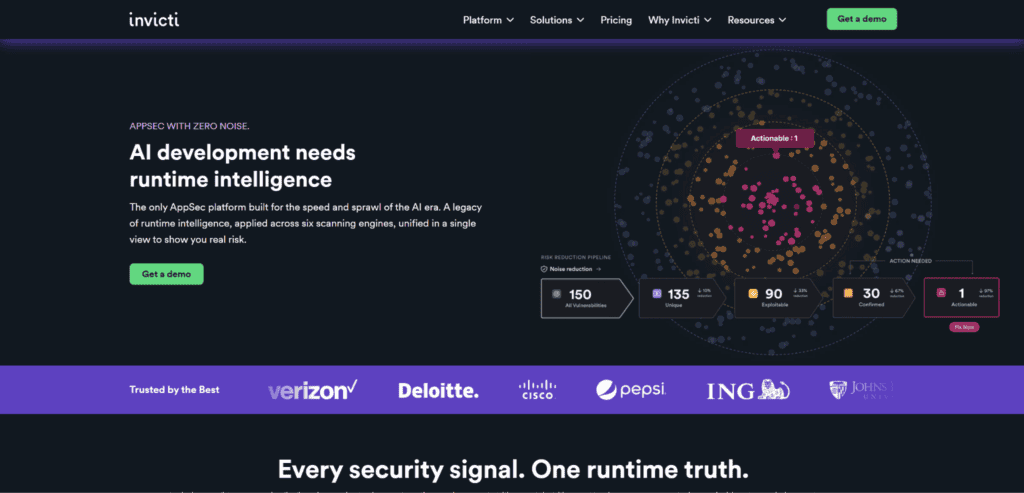
Invicti is an application security platform, not a manual pentest service, and it’s the company behind Acunetix and Netsparker. At its core is DAST (dynamic application security testing, which scans a running app), backed by SAST (static application security testing, which reads the source code), software composition analysis for open-source dependencies, and API discovery that turns up undocumented “shadow” APIs. Its calling card is proof-based scanning, which tries to verify that a bug can be exploited for real before it ever lands in the report, so you’re not drowning in the false positives that make raw scanner output such a slog. The whole thing is built to scale, with 110-plus integrations into CI/CD pipelines and issue trackers so scans run nonstop across a big application portfolio, and it recently picked up an agentic-AI pentesting feature called Octo.
On a frontend, its value is continuous coverage and regression detection: it catches known bugs, misconfigurations, and outdated dependencies across a lot of apps at once, quickly and continuously. Invicti itself frames the platform as a complement to manual testing, and that pairing is where it works best. For a team with a big application portfolio that wants scanning running year-round, it’s a capable tool, and it sits naturally alongside a manual pentest that goes deep on access-control and business-logic work.
Services: DAST, SAST, software composition analysis, API security, and infrastructure-as-code and container scanning; agentic automated pentesting (Octo); 110-plus integrations for DevSecOps workflows.
6. Pentera
Best for: round-the-clock, automated validation of network, credential, and cloud attack paths in big, complex environments.
Pentera is an automated security validation platform. Designed to run safely against live production, it works through complete attack chains, from the first foothold through lateral movement and privilege escalation, to reveal which exposures an attacker could chain together on the way to your crown-jewel systems. It’s agentless and always on, and it re-checks fixes on its own to confirm the risk has truly dropped. The product line spans internal networks (Pentera Core), external networks (Pentera Surface), and cloud and identity (Pentera Cloud), with automated remediation orchestration in Pentera Resolve. It’s especially good at credential attacks like Active Directory password cracking (Active Directory being the system that manages user accounts on a corporate network), ransomware emulation, and moving laterally across infrastructure.
Pentera’s strength is infrastructure and internal attack paths. It answers a question a web-app pentest doesn’t, whether someone who already holds a foothold can pivot through the network and reach sensitive systems, which is valuable context for any security program. It fits enterprise environments that want attack-path validation running continuously and automatically at scale.
Services: automated security validation across internal and external networks, cloud, and identity; credential testing, ransomware emulation, and lateral-movement validation; automated revalidation and remediation orchestration.
7. Rapid7
Best for: organizations consolidating vulnerability management, app scanning, and periodic human-led pentests under one platform.
Rapid7 is a platform company first, behind InsightVM for vulnerability management, InsightAppSec for application scanning, and a managed detection and response service. It also runs a human-led pentest consulting practice. Its testers help maintain Metasploit, the open-source exploitation toolkit used widely across the industry, and they spend part of their week studying how attackers break in. That keeps the work current. Pentests cover web apps, networks, wireless, IoT, social engineering, and red team simulation. The main draw is consolidation, since you can run continuous scanning and vulnerability management on the platform and then bolt periodic manual pentests on from the same vendor.
For a frontend, Rapid7 gives you a legitimate human-led web-app pentest, backed by real Metasploit credibility. Its biggest advantage is breadth: scanning, vulnerability management, detection, and pentesting all under one roof. That makes it a natural fit for a mid-to-large enterprise already standardized on its platform, or any team that would rather buy tooling and testing from a single vendor, with pricing and engagement sized to match.
Services: web application, network, wireless, IoT, and social engineering penetration testing; red team simulation; vulnerability management (InsightVM), application scanning (InsightAppSec), and managed detection and response.
Key Evaluation Criteria: How to Choose the Right Partner
Once you’ve placed a vendor in one of those buckets, a few criteria tell you whether they’ll really test your frontend or just hand you a scan report.
| Criteria | What it means | Why it matters for frontend apps |
| Testing model | Manual, crowdsourced, or automated | Cross-role authorization (IDOR/BOLA) needs a person comparing roles; automation alone rarely catches it |
| Access-control depth | Whether they test authorization between multiple user roles, and at the API layer, not just the UI | This is the number-one frontend and API risk (OWASP A01 and API1) |
| Framework and API expertise | Real experience with React, Vue, Angular, and Svelte apps and the APIs behind them | Client-side access control, token handling, and exposed routes need SPA-specific knowledge |
| Reporting and remediation | Report clarity, remediation support, and a retest included | A dev team needs confirmed, actionable findings and a retest, not a raw scanner export |
| Compliance alignment | Findings mapped to SOC 2, ISO 27001, HIPAA, PCI DSS, and GDPR | Reports have to satisfy auditors and enterprise vendor-security reviews |
| Certifications | OSCP and equivalent hands-on offensive credentials | Signals real exploitation skill, which enterprise buyers and cyber insurers look for |
| Engagement fit and price | Dedicated team versus rotating crowd; published pricing versus contact-sales | Decides whether a vendor fits a single-app startup or a large enterprise program |
Run the table against your own situation in three passes. First, line up the testing model with your risk. If the thing keeping you up at night is one user reaching another user’s data, put access-control depth and manual testing ahead of raw scan volume, because that kind of flaw gets found by a person, not a signature. Second, weigh scale against your organization. A boutique gives you a steady team and tight focus on one app. A bigger firm or platform hands you reach, always-on coverage, and a lot more process instead. Then there’s budget. A few vendors post a price range. Most quote only after a call, so ask early what a comparable job runs. One thing to hold onto above the rest: on a single-page app, where it all comes down to who’s allowed to do what, deep manual access-control testing counts for more than the volume of automated checks.
Final Thoughts & Next Steps
The seven firms here are solving four different problems. Automated platforms like Invicti and Pentera give you continuous, at-scale coverage that catches known issues and regressions between the deeper tests. Crowdsourced services like Synack and Cobalt bring breadth and quick turnaround from a large pool of researchers. An enterprise firm like Kroll bundles testing with incident response and threat intelligence for big, regulated organizations. A manual-first shop like CYBRI zeroes in on human-led depth, the part of frontend security that settles who can reach sensitive data across roles. Rapid7 straddles several of these for teams that want their tooling and testing under one roof.
For most teams it comes down to the shape of the frontend risk. When the real exposure is authorization between roles, plus IDOR, BOLA, and business logic, manual testing belongs at the center of the program, with automated scanning backing it up between rounds. The next step is small. Walk a tester through your app, the roles in it, and when your audit lands, and they can size the work and show you where manual depth earns its place. If that’s where you’re sitting, book a scoping call with CYBRI and start there.
Frequently Asked Questions
What is frontend penetration testing?
Frontend penetration testing is a hands-on look at a web app’s client side (React, Vue, Angular, or Svelte) and the APIs feeding it. The question it keeps asking is simple. Can one user role reach data or actions meant for someone else? That’s where the bugs live, IDOR and BOLA especially, the kind automated scanners tend to skip.
How often should you perform a web application penetration test?
Once a year is the floor. Test again after any big release or architecture change. Teams that ship constantly, or sit on health, financial, or payment data, usually go semi-annual or quarterly. PCI DSS goes further: an annual pentest, plus a test after any significant change.
What is the difference between penetration testing and a vulnerability scan?
A vulnerability scan runs on autopilot. It hands you a list of known weaknesses, and that’s where it stops. A penetration test adds a person who exploits those weaknesses and strings them into a real attack. One says what might be broken. The other shows what an attacker could do with it. Auditors and enterprise buyers want that second one.
How long does a frontend penetration test take?
One to three weeks is typical, and the exact number tracks how many user roles, APIs, and workflows are in scope. Budget extra time afterward for fixing what turns up and a retest to confirm those fixes held. Scoping usually happens in the days right before testing kicks off.
Ready to Test Your Frontend?
If your app runs on React, Vue, Angular, or any other framework and an audit or a big customer is asking for proof, CYBRI’s manual-first team can scope the work fast and test the access-control risks scanners miss.
Book a scoping call to get started.