If you are comparing providers for a penetration test (a hired, authorized attempt to break into your app before a real attacker does), “PTaaS” has probably come up on a vendor site or a sales call, usually with little explanation. The term stands for Penetration Testing as a Service. In practice, you prepay for a set number of tests spread across the year, and new releases get tested as the product adds features, so the work does not end with a single report. This article explains what PTaaS is and what a PTaaS program looks like across a year, then helps you judge whether your company needs one or whether a single test will do the job.
Quick Answers
What is PTaaS?
Penetration Testing as a Service is a way of buying pen tests as an ongoing service rather than a one-time project. One provider schedules the tests, tracks the findings, and re-checks your fixes, all in one place.
What is a PTaaS program?
It is the year you sign up for: a set of prepaid tests, usually three or more, spread across your release schedule. After each test the team re-checks what you fixed, and the next test is ready to schedule whenever you request it.
Does PTaaS replace a one-off test?
For teams that ship updates often, yes. A one-off test (a single, standalone engagement) describes your app on the day it ran, and every release after it goes unchecked. If your app barely changes between tests, that gap matters much less.
Who is PTaaS built for?
Companies with frequent releases, many apps and screens, or a holding group managing several businesses’ security at once. Smaller teams with a stable product often do better with a one-off test or a lighter schedule.
Penetration Testing as a Service: Key Benefits
A traditional pen test means one contract, a wait for a start date, and a PDF a few weeks later. With PTaaS, tests run through the provider’s platform (an online portal where findings appear as they are confirmed), retesting is included, and the next test does not need a new contract. PTaaS is about how you buy and manage testing; what gets tested can stay exactly the same.
Say a company prepays for four tests. The first one covers the main web app ahead of a spring launch and turns up a broken permission check that lets one customer open another customer’s invoices. Developers fix it, and a few weeks later the testers return to confirm the fix holds. By summer the company has shipped a new billing page and changed some of its business logic (the rules for how the app should behave), so the second test focuses on the updated scope. Each new test starts when the company asks for it, with no fresh contract to sign. On CYBRI’s ongoing PTaaS programs, every finding, fix, and retest lands in one dashboard Blue Box, so the year leaves a running history instead of a stack of long PDF reports.
Why Ongoing Testing Matters Now: Fast Releases and AI-Written Code
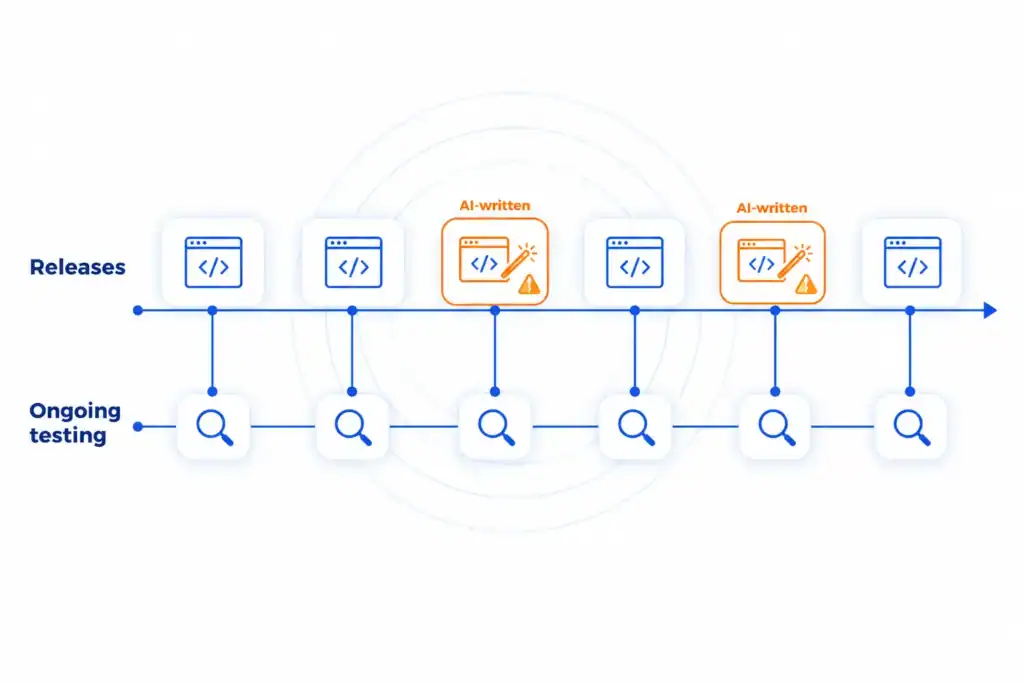
Many teams now ship updates weekly or even daily, so a test from March says little about the code that went live in July.
AI widens the gap. Plenty of teams write code with AI assistants, and some practice vibe coding: describing what they want in plain language and letting the tool write it. Features ship fast, but AI tends to get two things wrong. One is authorization, the checks that decide which user can see or change which data. The other is business logic, the rules for how the app should behave. An AI-built store might happily accept an order for minus three items.
Automated scanners may catch some of these flaws, but a human tester finds the serious ones by thinking about what the app should allow, then proving each problem with tools and hands-on checks.
PTaaS vs. a One-Off Test
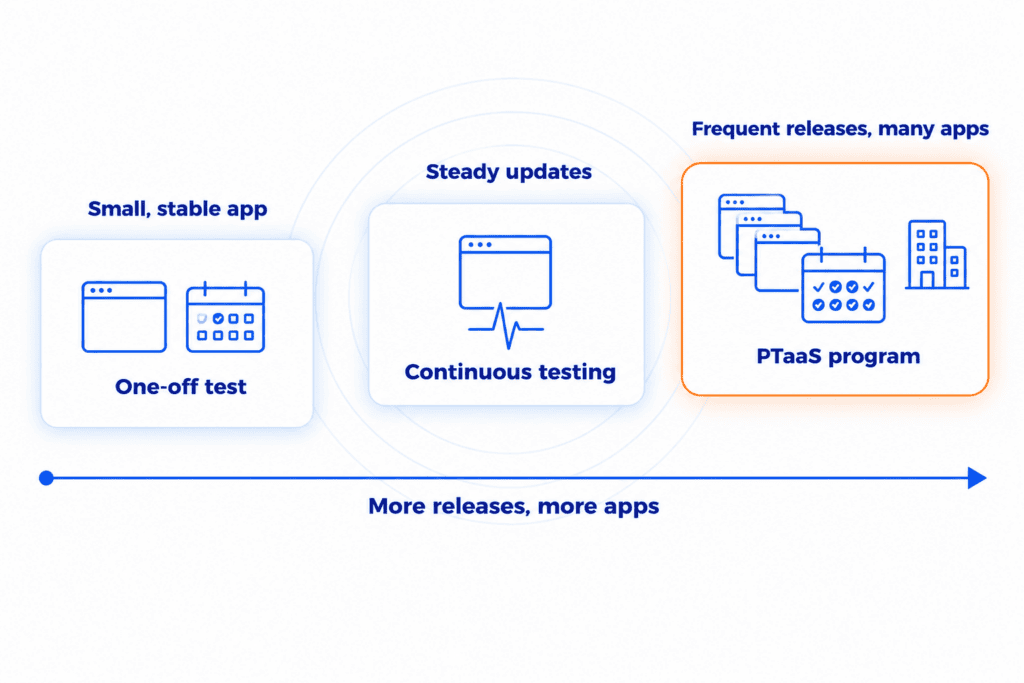
Neither option is better testing in itself. What differs is coverage over time. A one-off test suits a first assessment, a compliance deadline, or an app that rarely changes. A PTaaS program fits companies that release often, run many apps and screens, or manage security for several businesses under one group.
| One-off test | PTaaS program | |
| How you buy it | One contract for one engagement | Several tests prepaid for the year |
| When testing happens | Once, on an agreed date | Spread across the year, timed to your releases |
| Checking your fixes | Limited, sometimes a separate order | Built into every test |
| Results | A report at the end | Findings in a shared dashboard as they are confirmed, plus a report per test |
| History | Each report stands alone | One running record of findings and fixes across the year |
| Best for | First tests, compliance deadlines, stable apps | Frequent releases, many apps and screens, holding groups |
Who Should (and Shouldn’t) Buy a PTaaS Program
Two things decide it: how often your app changes and how many apps you run. A software company pushing updates every week or two, or running separate web, mobile, and admin apps, keeps producing new code to test. A holding group adds another layer, with several companies, each with its own apps and developers, all needing coverage. For teams like these, a year of scheduled testing is the only practical way to keep up.
A small company with one stable app is in a different spot. If the product changes a few times a year, one test now and another after the next big release covers the real risk, without prepaying for tests that have nothing new to cover. Another option is continuous testing, which pairs regular human-led tests with ongoing scanning and monitoring of your apps and systems.
How CYBRI Runs a PTaaS Program
A CYBRI program starts with onboarding. Before the first test, the client and the testers agree on scope (which apps, APIs, and environments are in play), set up test accounts for each user role, and add the testers’ addresses to any firewall allowlist. The client also names one technical contact. The clock on the first test starts once the testers have full access, so this setup is worth finishing early.
From there, each test in the year follows the same loop. Testers work through the app by hand, logged in as real users, and flag anything critical the same day instead of saving it for the report. At the end comes a written report and a call to walk through it. The client’s developers then fix what was found, with remediation support and testing from the same team. When the next release ships, the next test begins.
Every test follows recognized industry methods rather than one tester’s personal checklist. The work is built on OWASP (the Open Worldwide Application Security Project, a guide that sets the standard for testing web apps and APIs) and NIST (the U.S. National Institute of Standards and Technology, whose testing guide lays out how an engagement is planned, run, and reported). For the client, each test in the program covers the same ground in the same way, and auditors recognize the method when they read the report.
What every test in a CYBRI program includes:
- Manual-first testing by senior testers holding the OSCP, a hands-on hacking certification
- Authenticated testing across each user role, such as admin, standard user, and guest
- Same-day alerts for critical issues
- An executive summary for leadership and auditors, plus technical findings ranked by severity (CVSS 4.0, the industry scoring standard) with clear fix steps
- Remediation support and testing: testers answer questions while your developers fix, then re-test each fix over about three months and issue an updated report
- Reports mapped to the framework you need, such as SOC 2, ISO 27001, PCI DSS, or HIPAA
- The Blue Box dashboard, where findings appear as they are confirmed and your team can assign, track, and look back on every fix
To see how a program would fit your release schedule, get a quote.
Frequently Asked Questions
How many tests does a PTaaS program include?
It depends on how often you ship and how many apps you run. Most programs start at three or more tests a year, and the number is set during scoping.
Can a PTaaS program cover our annual compliance test?
Yes. One of the scheduled tests can be timed to your audit, and its report, mapped to your framework, serves as the evidence.
Can we change what gets tested during the year?
Yes, and that flexibility is one of the main advantages of PTaaS. Scope is discussed before each test, so a new app, feature, or API launched mid-year can become the target of the next one.
Get a Quote
The right setup depends on how often you ship and how many apps you run. A short scoping call turns that into a clear recommendation (a single test, continuous coverage, or a full PTaaS program) and a quote to match. Contact CYBRI to get started.