Imagine you’re finalizing a game-changing contract, and your potential client asks for your SOC 2 report. Customers are increasingly being faced with this scenario, as the SOC 2 report lets clients know that an outside auditor has confirmed security procedures in important areas like data security, system availability, processing integrity, confidentiality, and privacy.
As such, SOC 2 compliance is becoming a standard requirement for SaaS buyers in today’s market. In order to demystify SOC 2, this guide will explain why it is important for SaaS companies, when to pursue it, how to achieve and maintain compliance, and even what to think about before beginning your compliance journey.
Why SOC 2 matters for SaaS companies
As of yet, there is no law requiring SaaS companies to undergo a SOC 2 audit [1]. Nevertheless, SOC 2 compliance has become the market standard for service providers looking to do business in the U.S. Simply put, customers demand it. Also, many mid-market and large companies will not finalize a deal without a SOC 2 report from their SaaS vendor [2].
A positive SOC 2 audit report enables bigger deals thanks to an increased level of trust and credibility, as the certification signals to prospects and customers that you take data security seriously. It streamlines security due diligence, often eliminating the need for lengthy questionnaires or assessments. And in a competitive SaaS market, a SOC 2 badge differentiates your company by showing you meet a high standard of security and privacy.
Complying with SOC 2 often has positive side effects on your internal operations as well. To meet the SOC 2 criteria, organizations must implement formal security policies, procedures, and monitoring practices. Finally, achieving SOC 2 can unlock other compliance achievements down the road. The rigor and discipline companies build for SOC 2 will set them up for frameworks like ISO 27001 or HIPAA if those become relevant.
When Does SOC 2 Become Essential?
Not every fledgling software startup needs to rush into a SOC 2 audit. In the earliest stages, resources might be better spent on product-market fit. However, there are clear inflection points when pursuing SOC 2 becomes essential. Ask yourself the following questions, and if you answer “yes” to one or more, it’s likely time to start the SOC 2 journey.
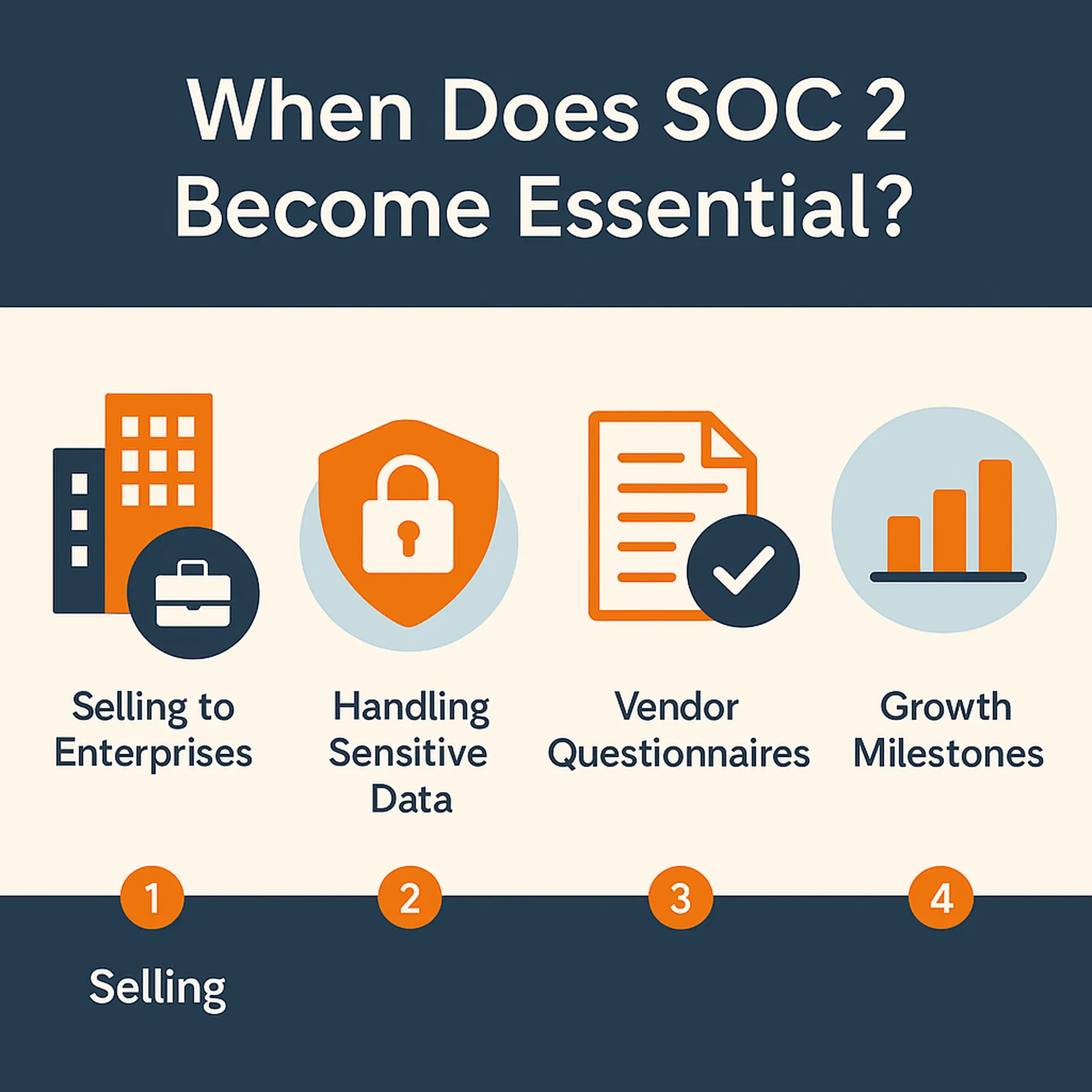
Selling Into Enterprise or Regulated Sectors
If your sales pipeline includes large enterprises or customers in regulated sectors like finance, healthcare, or legal, expect SOC 2 to be required sooner rather than later. These clients typically have strict vendor security due diligence. In today’s market it has become commonplace for mid-market and enterprise companies to write the SOC 2 requirement directly into contracts or security questionnaires.
Handling Sensitive Customer or User Data
Startups dealing with highly sensitive data should plan for SOC 2 early. Even if you’re small, handling critical data makes security a top concern for customers. It’s no surprise that SOC 2 is recommended for companies handling sensitive data and is becoming an expected norm in the tech and SaaS space. Beyond customer expectations, it’s just good hygiene for protecting sensitive data properly.
Streamlining Security Questionnaires with SOC 2
Are prospects asking about your security posture? If you’re fielding lengthy security questionnaires or risk assessments about data protection, it’s a signal that SOC 2 could greatly simplify your life. Many SaaS providers find that after getting SOC 2, the vendor due diligence process with new customers becomes much smoother, as the audit report speaks for itself.
Consider Your Growth Milestones
Often, startups aim to achieve SOC 2 compliance around Series A/B funding or when approaching a certain revenue scale, knowing that enterprise deals and investor due diligence will demand it. It can be a competitive disadvantage to be the only vendor in a deal without a SOC 2, or to scramble to get compliant under a tight deadline because a big customer insists on it.
The Bottom Line
If enterprise customers or sensitive data are in your future, start preparing for SOC 2 now, long before the signed contract requires it. Doing so will prevent rushing the process and allow you to leverage SOC 2 as a selling point rather than a last-minute hurdle.
Simplify Your Path to Compliance
Cybri helps SaaS companies accelerate SOC 2 compliance through our penetration testing services [3]. A targeted pentest can be a smart early step to uncover security gaps before the audit, giving you evidence and confidence that your controls are effective when it’s time for the SOC 2 audit.
Key SOC 2 Concepts for SaaS Teams
Achieving SOC 2 compliance involves a mix of technical know-how and understanding the audit expectations. Below are key concepts and terms that SaaS teams should grasp.

Scope
When dealing with SOC 2 compliance, scope refers to the systems, processes, and assets that will be evaluated by the auditor. For a SaaS company, scope typically includes any system that touches customer data or could impact security. This often means your cloud infrastructure, product environment, databases, CI/CD pipeline and code repositories, identity and access management systems, and supporting services.
Trust Services Criteria
These are the five categories of controls that SOC 2 auditors can evaluate: Security, Availability, Processing Integrity, Confidentiality, and Privacy. Every SOC 2 report must include Security, while the other four criteria are optional. This flexibility allows you to tailor the audit to your specific services. For instance, a company with uptime guarantees might add Availability, while one handling personal data would include Privacy.
Controls
In a SOC 2 audit, controls are the specific technical and procedural safeguards you implement to meet the Trust Services Criteria. These are the tangible answers to security questions, ranging from technical tools like encryption and multi-factor authentication to administrative procedures like security policies and employee training. The essence of the audit is mapping each TSC requirement to the specific controls you have in place to fulfill it.
Type I vs. Type II
SOC 2 offers two types of audit reports [4]. In a Type I audit, the CPA firm evaluates whether your stated controls are suitably designed and implemented as of a particular date. Thus, Type I is useful to get an initial SOC 2 quickly, as it shows you have the right controls on paper, but it does not prove they are effective over time. Type II, on the other hand, is the gold standard. A SOC 2 Type II audit observes your controls over an extended period to ensure they operate reliably, but also has tougher requirements.
Evidence & Documentation
A SOC 2 audit hinges on evidence and documentation. It’s not enough to simply have a policy or perform a control in place. Companies must provide proof to the auditor, which could be in the form of system logs, screenshots or configuration exports, policy documents and revision history, tickets showing changes and approvals, training attendance records, monitoring alerts and their resolution, and so on. Auditors will scrutinize your documentation and records to verify each control.
Time & Cost Factors
For a small SaaS team starting from scratch, expect a 3-6 month preparation period and $20k–$40k+ in audit fees for a Type I report. Scaling to a Type II report often requires another 6 months of monitored operation and can cost $50k+. These timelines and costs cover the initial implementation of controls, security tools, as well as the audit itself. Many companies now budget for annual SOC 2 costs as part of their ongoing security spend.
Automation Tools
The complexity of managing SOC 2 evidence and controls for months has given rise to a wave of compliance automation platforms. These tools connect to your systems and automatically collect evidence or monitor control status. Automation can significantly reduce manual effort, by up to 60–80% according to some estimates [5]. They also often provide policy templates and a centralized dashboard for audit preparation.
Difference from Penetration Testing
It’s important to clarify that SOC 2 is a compliance audit that verifies security processes and controls, but it is not a penetration test. An auditor will check existing processes for vulnerability management, but they will not actively try to hack your systems. While a pentest is not a mandatory requirement for SOC 2, the two are highly complementary. Conducting regular penetration tests provides strong evidence for your security controls and demonstrates a proactive security posture to both auditors and savvy customers.
How SaaS Companies Achieve SOC 2 Compliance
So, what does the road to SOC 2 certification actually look like in practice? It can be broken down into a series of steps or phases. Below is a step-by-step approach that many SaaS companies follow to achieve their first SOC 2 audit.
1. Define Scope & Objectives
Begin by determining the scope of your SOC 2 audit, such as which systems, departments, cloud accounts, and services will be included. Identify where your customer data resides and which trust criteria you will include. Also decide whether you’re aiming for a Type I or Type II report initially. It’s wise to involve your auditor early in scoping if possible, to ensure you haven’t missed anything crucial.
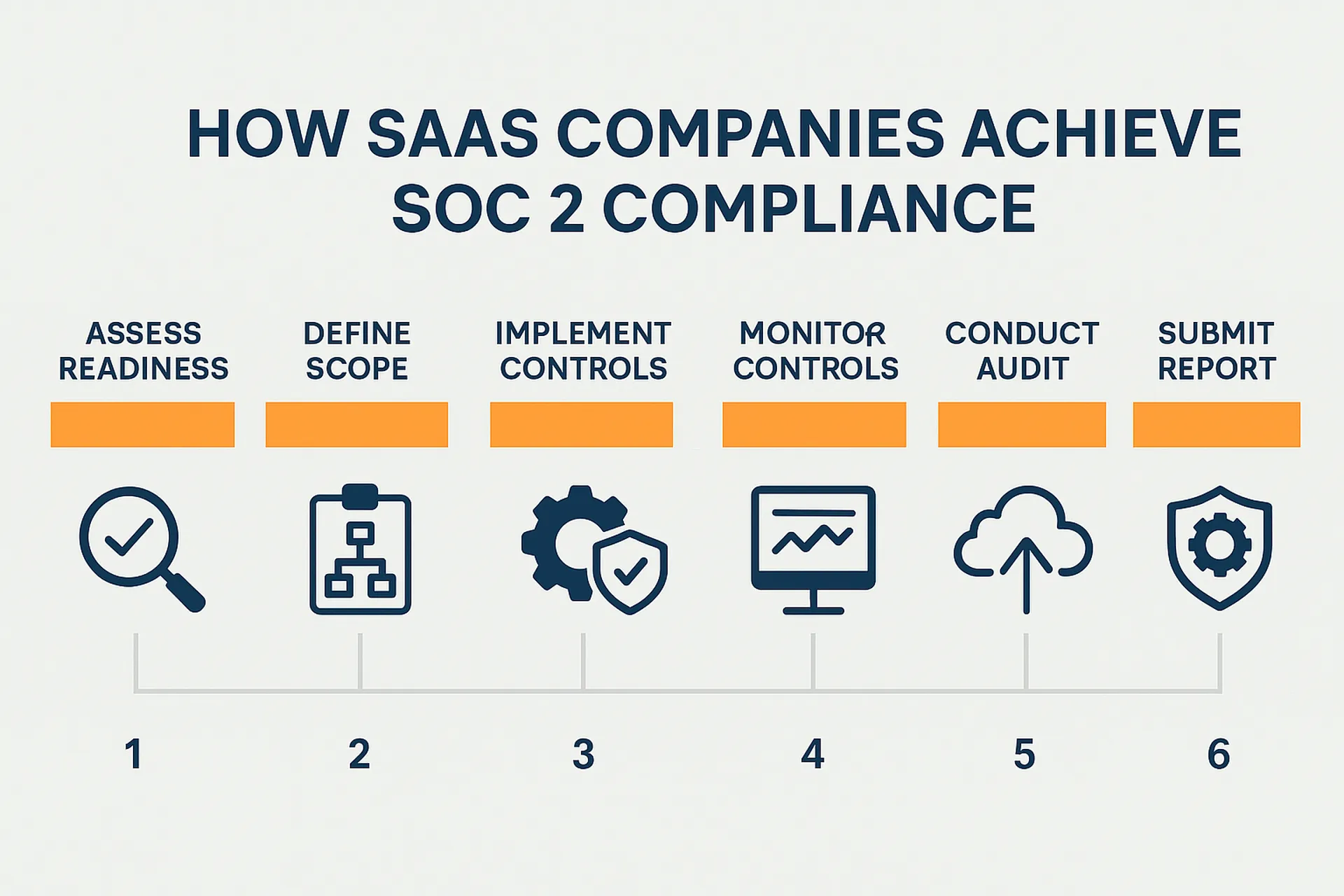
2. Perform Readiness Assessment
Before formally auditing, smart teams do an internal gap analysis or readiness audit. At this stage, companies review their current policies and controls against the SOC 2 criteria to identify gaps. Often, companies use a checklist or hire a consultant for this. The readiness assessment will highlight missing controls or documentation, before the real auditor does. Many compliance platforms also offer readiness scans that can help at this stage.
3. Implement or Improve Controls
In this phase, you will design and implement the necessary controls and processes to meet the SOC 2 criteria. For SaaS startups this often involves instituting role-based access control and MFA on critical systems, writing missing security policies, deploying log monitoring tools, setting up a formal onboarding/offboarding checklist for employees, and enforcing code review and change approval in your engineering workflow.
4. Gather Evidence & Monitor
With your controls in place, you now enter the evidence-gathering phase. For a Type II report, this means operating your controls consistently over a defined observation period, typically 3 to 6 months. Systematically collect logs, reports, and records that prove your controls are working as intended. This includes everything from access review logs and backup success reports to documented policy acknowledgments.
5. Engage an Auditor
Now it’s time to bring in the independent auditor to perform the actual SOC 2 examination. Choose a CPA firm that is experienced with SOC 2 and ideally familiar with SaaS or technology companies. Many SaaS startups go with a boutique audit firm that specializes in startups, while others might use larger firms if enterprise clients expect it. Once engaged, the auditor will typically hold a kickoff to confirm scope and collect preliminary documents.
6. Conduct the Audit
The auditors will now examine your controls and evidence in detail. During the audit, respond promptly and fully to requests. For SOC 2 Type I, this might be a matter of reviewing documentation and perhaps a short on-site or remote review to validate everything on that as-of date. For Type II, the auditors will sample data from across the period. They will also likely interview staff to ensure people understand the processes. Once the audit work is done, the auditor will issue the official SOC 2 report.
7. Maintain & Improve
Achieving SOC 2 is not a one-time finish line. In fact, it should be treated more like reaching base camp on a mountain and preparing for the ascent. After certification, companies enter a continuous compliance phase. Most SOC 2 reports cover a 12-month period and need to be renewed annually. Treat incidents or near-misses as opportunities to bolster controls for the next audit. In return, you’ll continue reaping the trust and efficiency benefits year after year.
The SOC 2 Checklist for SaaS Providers
When preparing for SOC 2, it’s helpful to have a checklist of essential controls and practices commonly expected from SaaS companies. While specific controls will depend on your scope and business, below are some key areas that most SOC 2-compliant SaaS providers cover.
Access Control
Implement strong controls over access to systems and data. This includes enforcing role-based access control and the principle of least privilege. Require multi-factor authentication for logins to sensitive systems. Ensure there are processes for timely user provisioning and de-provisioning. Regularly review user roles and permissions. These measures guarantee that only authorized individuals can reach critical assets.
Change Management
Establish a formal process for making changes to your software, infrastructure, or configurations. Use version control and pull requests for code changes, with peer review approvals required. Maintain a changelog or ticketing system to document modifications and who approved them. For infrastructure changes, have a policy for testing and rollback. The goal is no changes are done on the fly, as everything needs to be tracked and authorized.
Incident Response
SOC 2 will expect that you can detect, respond to, and recover from security incidents effectively via documented procedures. This means having a defined incident response plan that outlines steps to take in the event of a security incident or breach. The plan should define roles, communication protocols, and remediation procedures. Train your team on how to recognize and report incidents. Conduct drills or tabletop exercises to practice the plan.
Data Encryption
Data encryption is an expected control under SOC 2’s Security and Confidentiality criteria. So, protect customer data through robust encryption. Encrypt data at rest and in transit, manage encryption keys securely, and use strong encryption levels to prevent eavesdropping and unauthorized access in case data is compromised. Also consider encrypting backups and ensuring older protocols are disabled.
Backup & Recovery
Ensure you regularly back up critical data and have the ability to restore it in case of failure. This ties into Availability and also security, as you don’t want to lose data. Maintain automated backups for databases and systems, stored off-site or in geo-redundant locations. More importantly, test your restore procedures, and have a disaster recovery plan that outlines RTO/RPO and steps to recover services if an outage occurs.
Vendor Management
Your security is only as strong as your weakest third-party. Implement a vendor risk management and assessment program for any third-party services or sub-processors that handle your data or could affect your security. Continually monitor or review vendors annually. For critical vendors, obtain their security attestations or have them answer a security questionnaire.
Logging & Monitoring
Implement continuous system monitoring and logging to have visibility into security events. This means logging key activities, such as logins, admin actions, data access, configuration changes and more. Aggregate these logs in a central system where they are retained and protected from tampering. Regularly review logs or at least the alerts from them.
Security Awareness Training
People are often the weakest link, so educate your employees on security best practices. Provide formal security awareness training at least annually, where the training should cover topics like phishing and social engineering, proper handling of sensitive data, use of work devices, reporting incidents, and compliance responsibilities. Make training relevant to your company’s risks and also keep records of who has completed the training and when.
Note
Every SaaS company’s exact checklist will vary based on size, tech stack, and customer expectations. A 10-person developer tool SaaS might not need the same depth of controls as a 500-person fintech platform. However, the items above are quite universal and form a baseline for trust. By ensuring these areas are covered, you’ll address a large portion of the SOC 2 common criteria and demonstrate a solid security posture to your auditor and clients.
Common Challenges and How to Avoid Them
Even with the best intentions, companies new to SOC 2 can stumble in a few predictable ways. Here are some common SOC 2 compliance pitfalls for first-timers and some tips on how to avoid them.
Underestimating Effort
A frequent mistake is treating SOC 2 as a one-time documentation project rather than a company-wide initiative and culture change. In reality, SOC 2 compliance cannot be achieved with paperwork alone, as it requires genuine operational discipline and ongoing commitment. To avoid this, secure executive sponsorship early, appoint a dedicated owner, and set realistic timelines of months, not weeks. This ensures you build a genuine security foundation rather than just checking a box.
Poor Scoping
Getting the scope wrong can derail your SOC 2 efforts. If you include too much, you drown in unnecessary controls and evidence. If you exclude something critical, you risk a qualified audit or having to expand scope later. To avoid this, tailor your scope by only including the Trust Services Criteria that align with your specific business needs and customer expectations. Engage your engineering and product teams to accurately map which systems handle customer data, and deliberately exclude non-critical components.
Insufficient Evidence
Some organizations implement good controls but fail to maintain the evidence to prove it. As such, it is important to foster a company culture that leads employees to create audit trails. If a security task occurs, ensure it leaves a record. Use tools that log activities automatically when possible. Maintain a checklist of all evidence needed and regularly update it. Also, organize evidence in a central repository or system for easy retrieval.
Lack of Ownership
A common pitfall that derails SOC 2 compliance is the lack of a clear internal lead. Without a single point of accountability, coordination across IT, DevOps, HR, and management breaks down. To avoid this, establish a strong governance structure from the start. Designate a project manager or compliance lead to coordinate the entire effort and assign specific owners for every control. Crucially, secure active executive sponsorship to ensure the initiative has the visibility and authority to succeed.
Neglecting Continuous Compliance
A major pitfall is stopping compliance efforts after receiving the initial report. Companies that let controls lapse face a scramble at renewal and undermine their security. To avoid this, treat SOC 2 as an ongoing program from day one. Operationalize compliance tasks by integrating them into your regular schedule, and conduct quarterly internal reviews to catch drift. This continuous cycle ensures your next audit is smooth and, more importantly, that your security posture remains consistently strong.
The Business Impact of SOC 2
Achieving SOC 2 compliance isn’t just an IT exercise, as it can have a transformative impact on your business. Here are several ways a SOC 2 certification can tangibly benefit a SaaS company.
Sales Enablement
SOC 2 is often a mandatory requirement for enterprise deals, and lacking one can stall your sales cycle. However, achieving compliance provides a significant competitive advantage. One analysis found that SOC 2 can shorten sales cycles by up to 42% [6] by providing immediate third-party validation of your security, building prospect trust, and accelerating the final security review.
Customer Retention
Beyond winning new customers, SOC 2 helps keep the ones you have. It strengthens trust and transparency in ongoing customer relationships. By sharing your SOC 2 report with customers, you demonstrate you’re committed to protecting their data year after year. This assurance can improve customer satisfaction and reduce the likelihood that security concerns become a reason for churn. Clients, especially those in regulated industries, feel safer knowing an independent auditor has verified your controls.
Operational Efficiency
While compliance work might sound like added bureaucracy, in practice SOC 2 often drives internal efficiency and accountability. The process of implementing controls tends to streamline workflows, as instituting structured change management can reduce errors and downtime. Also, the documentation produced for SOC 2 serves as valuable reference for employees and can improve onboarding for new hires.
Brand Credibility
In the eyes of investors, partners, and the market at large, achieving SOC 2 sends a strong signal about your company’s maturity and reliability. It shows that even as a young SaaS company, you have put in place the kind of rigorous controls associated with more established firms. Displaying a SOC 2-compliant badge can boost your brand’s credibility, not just to customers but also investors and partners.
Long-Term ROI
While SOC 2 requires an upfront investment, it can yield significant return on investment over the long term. On the revenue side, we discussed faster sales and access to bigger markets. On the risk side, SOC 2-driven improvements greatly reduce the chance of a costly security breach. Avoiding even one serious incident can save millions in breach costs, fines, and reputation damage.
Conclusion
For SaaS companies aspiring to serve enterprise and regulated customers, SOC 2 compliance is no longer optional. In 2025 and beyond, a SOC 2 report has become the entry ticket to serious B2B engagements. But more than just meeting a client requirement, pursuing SOC 2 brings elevated trust in your product and fosters operational maturity in your organization.
So, embrace SOC 2 as a milestone in scaling your SaaS business securely. By investing in trust now, you set the stage for bigger deals, happier customers, and smoother operations going forward. The sooner you weave compliance into your growth story, the more naturally it will fit.
Ready to fortify your SaaS platform’s security posture for SOC 2? Visit Cybri to learn how our experienced penetration testing team can help you demonstrate and improve your SOC 2 readiness.
References
- Compliance Hub. (2025, March). SOC 2 Compliance for SaaS Companies: A Technical Deep Dive
- Aggarwal CPA. (2025, July). SOC 2 Demystified: 20 FAQs Every Business Needs to Know
- Cybri. (n.d.). SOC 2 Penetration Testing: A Complete Guide
- SOC. (n.d.). What Is SOC 2?
- BEMO. (2025, April). How Much Does SOC 2 Certification Cost? Complete Price Breakdown
- Aeolitech. (2025, January). SOC 2 Compliance Guide