Ask five security firms whether they do manual penetration testing, and all five will say yes. The word has stretched. At one firm it means a senior tester spends two weeks signed in to your app, trying to reach data that belongs to other customers. At another, it means automated scans with a person reviewing the results. Both reports carry the same title, and from the outside they can look almost the same.
The difference matters when someone else reads the report. SOC 2 and ISO 27001 auditors, and the security teams at the large customers you sell to, often want to see that a person tried to break in. A report built mostly on scan output can lead to extra questions, sometimes in the middle of a deal. For a walkthrough of the work itself, CYBRI’s guide on what a manual pentest involves covers it stage by stage.
This guide compares five US-based companies where people do the testing, and covers what to look for when choosing one.
The five companies on this list:
- CYBRI: best for SaaS and fintech teams that want a manual-first pentest by senior testers, with reports ready for an audit
- Bishop Fox: best for established large companies that want one firm to cover applications, cloud, hardware, and red team work
- TrustedSec: best for companies with a large Windows network that want consultants backed by an active research team
- Black Hills Information Security: best for network and cloud identity testing from a team that explains its findings and helps your staff learn from them
- Raxis: best for teams that want hand-run testing all year through a subscription
Why Manual Testing Still Matters When Everyone Sells AI
Scanners and AI testing tools have earned their place. They cover a lot of ground fast and catch known problems with very little setup. The best results come when they run next to a human tester, because some of the most serious flaws only show up when a person thinks through how the app is meant to be used.
Scanners Look for Known Problems. People Find the Ones Nobody Listed.
A scanner compares your systems against a library of known weaknesses, such as outdated software, a missing security setting, or a common coding mistake. It does that job well. What it can’t do is understand how your product is supposed to work.
The most expensive flaws usually sit in that gap. Security people call them business logic flaws, meaning the app follows its own code perfectly but the rules behind it are wrong. A tester signs in as one customer, changes an account number in the request, and gets another customer’s invoices. Or skips the payment page and still receives an order confirmation. To a scanner, each of those pages loaded without an error, so nothing gets flagged. People also chain findings together: two issues rated “low” on their own can add up to a full account takeover once someone thinks to combine them. CYBRI’s piece on the automation blind spot goes through more examples.
Auditors and Enterprise Buyers Ask for It
PCI DSS, the card-payment standard, requires internal and external penetration tests at least once a year and after any significant change, unless a payment provider handles all card data for you. SOC 2 and ISO 27001 don’t make a pentest mandatory. SOC 2’s criteria do list penetration testing as one way to evaluate your controls, and ISO 27001 auditors commonly accept a pentest report as clear proof that vulnerabilities were found and fixed. Enterprise customers can be stricter still. Their vendor questionnaires often ask when your last third-party pentest took place and request a summary letter, and their security teams read the findings closely. The breakdown of pentest versus scan evidence for SOC 2 shows where auditors draw the line.
How These Companies Were Chosen
Each company on this list says in its own materials that people do the testing, and each does a specific job well for a specific kind of buyer. All five also had to meet these requirements:
- US headquarters. Every company is based in the United States, which keeps contracts and accountability under US law.
- People run the test. Automation is fine for discovery and coverage. A person still has to prove each finding and go after the logic of your app.
- Senior, certified testers. Look for OSCP, a hands-on certification for manual testing. Candidates don’t answer multiple-choice questions; they have to break into live machines by hand within about 24 hours.
- A retest after fixes. Once your developers patch something, the tester should confirm the fix holds, ideally with an updated report you can hand to an auditor. The guide to retesting in penetration testing covers how it usually works.
- Reports written for two audiences. A short summary that leadership and auditors can read, plus technical detail engineers can act on. The checklist of what a pentest report should contain is a useful yardstick.
- A record you can check. Verified reviews, published research, free security tools, or CVEs (the public ID numbers assigned to newly discovered security flaws) credited to the firm’s testers.
Crowdsourced testing platforms and AI-first products were left out on purpose. Many of them do strong work. They follow a different model, and this list is for buyers who want a known, senior person doing the testing.
The 5 Best Manual Penetration Testing Companies in 2026
1. CYBRI
Best for: SaaS and fintech teams that want a manual-first pentest by senior testers, with reports ready for an audit
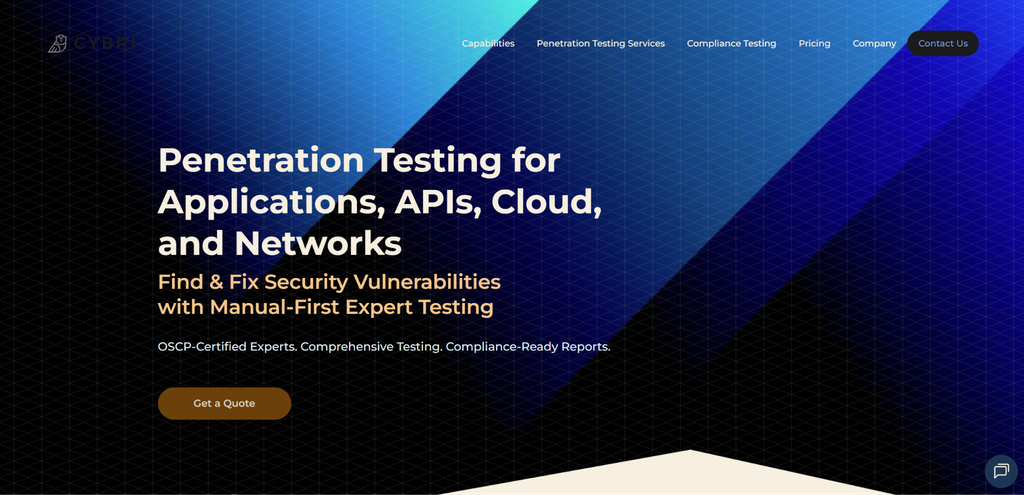
CYBRI was founded in New York City in 2017 and built its service around one idea: a person, not a tool, should decide whether your app is safe. Its testers hold OSCP, a hands-on certification earned by breaking into live systems manually, and each project is handled by one or two testers. Automated tools help with the groundwork. The testers then sign in as each type of user in scope and work through the logic by hand, looking for the places where one customer can reach another customer’s data or a step in a workflow can be skipped.
Testing covers web apps, APIs, mobile apps, cloud accounts, networks, and AI features. Companies can book a single test before an audit or a launch, or set up a yearly program with tests spread across the release calendar. Progress and findings show up in Blue Box, CYBRI’s online platform, where developers can track fixes and talk to the testers while they work.
Reports come in two layers: an executive summary for leadership and auditors, and technical findings with severity scores and step-by-step fixes. They map to SOC 2, ISO 27001, PCI DSS, HIPAA, and GDPR, and a sample report is public. After your team patches the findings, a 90-day remediation validation window lets the testers confirm each fix and issue an updated report. Customers rate CYBRI 4.9 out of 5 on G2, based on 10 reviews.
2. Bishop Fox
Best for: established large companies that want one firm to cover applications, cloud, hardware, and red team work
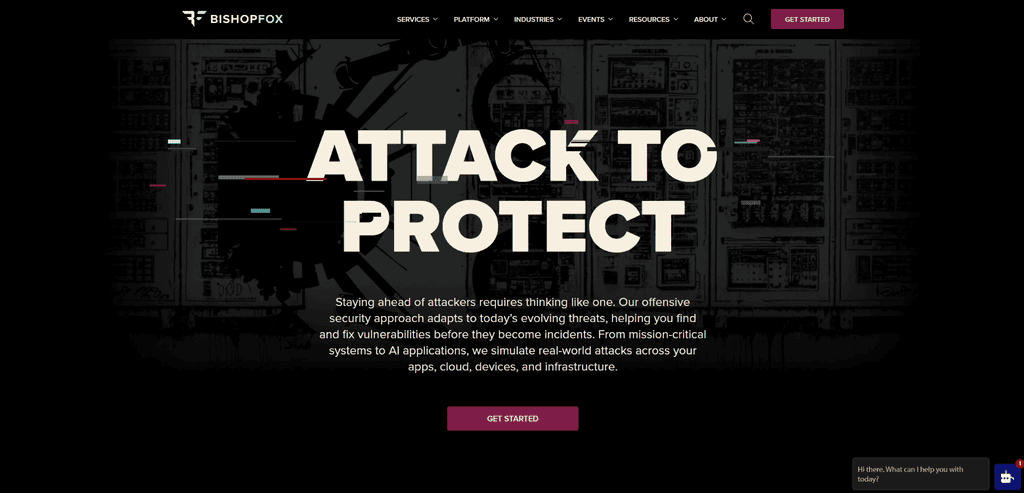
Vinnie Liu and Francis Brown founded Bishop Fox in 2005, and the Tempe, Arizona, company now describes itself as the largest private professional services firm focused on offensive security testing. Its client list includes Google, Amazon, and Zoom. The services page puts the philosophy plainly: “Real-World Simulations, Not Automated Scripts.”
The range of work is wide. Consultants test applications (including mobile apps and source code), AI and LLM systems, cloud accounts on AWS, Azure, and Google Cloud, internal and external networks, and physical hardware such as connected devices. Red team exercises, where testers behave like a real attacker over an extended period, and ransomware readiness reviews round out the list. Reports and post-engagement reviews are customized to each client.
Research is a big part of the firm’s identity. Bishop Fox Labs publishes free tools, such as Sliver for red teams and CloudFox for finding attack paths in cloud accounts, along with security advisories on flaws its researchers discover in commercial products. For companies that also want coverage between engagements, its Cosmos platform keeps watch over internet-facing systems. See also: Bishop Fox alternatives.
3. TrustedSec
Best for: companies with a large Windows network that want consultants backed by an active research team
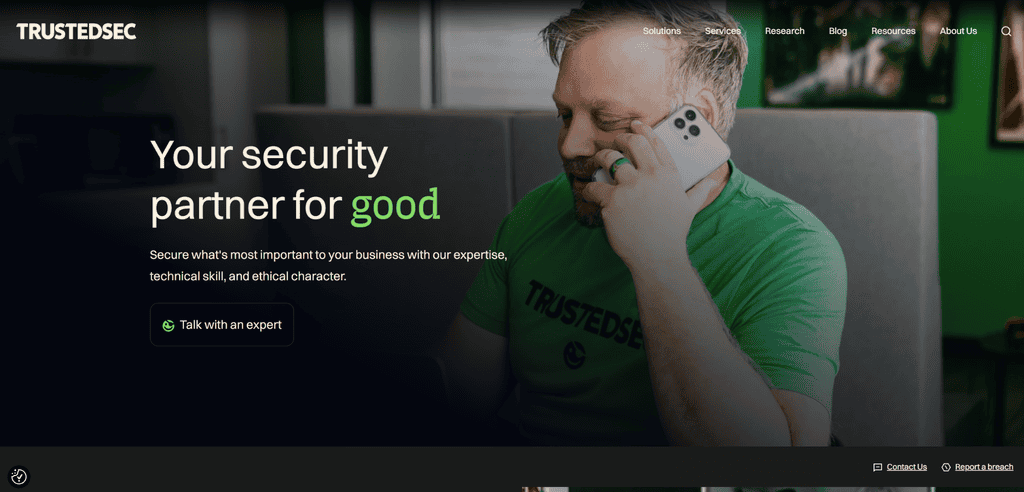
TrustedSec was founded in 2012 by David Kennedy and is based in Fairlawn, Ohio. Its pentest page describes “seasoned ethical hackers” who combine tools with manual techniques, and the process runs in six steps: scoping, reconnaissance, finding weaknesses, exploiting them, reporting, and a validation test after your team fixes the issues. Reports rank findings by risk and come with specific recommendations, and the work supports PCI DSS, HIPAA, and SOC 2 requirements.
Active Directory gets special attention. It’s the system that controls logins and permissions on most corporate Windows networks, so one weak setting there can give an attacker access to the entire company. TrustedSec offers dedicated Active Directory assessments alongside its pentests, and in 2025 it added the team from Trimarc, a firm that specialized in this area. Outside client work, the firm publishes free open-source tools and research for the security community.
4. Black Hills Information Security
Best for: network and cloud identity testing from a team that explains its findings and helps your staff learn from them
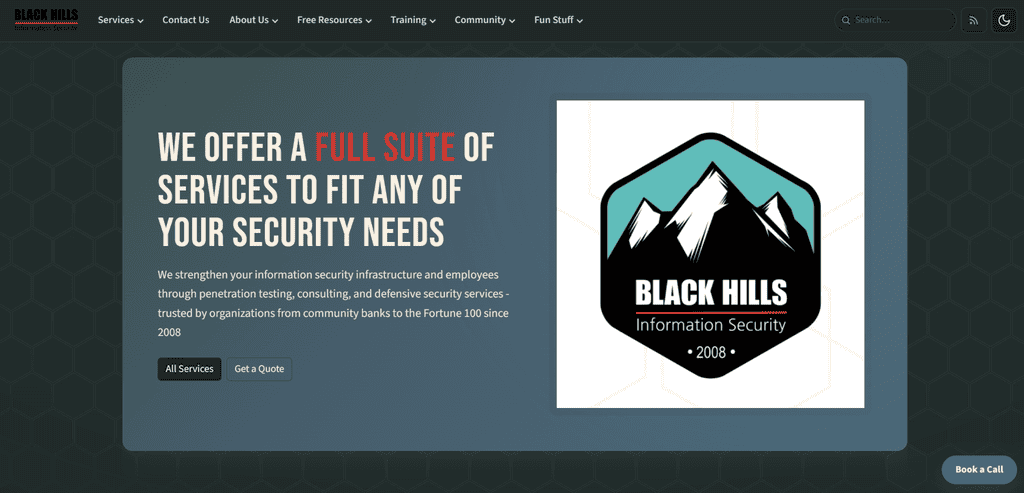
John Strand founded Black Hills Information Security (BHIS) in 2008, and the company is based in South Dakota. Its testers manually verify every vulnerability and look for how separate issues connect into a real attack path. Network tests focus on how attackers get in today, through Microsoft 365 and cloud logins, the internal network, and wireless. BHIS also tests web apps and AI systems.
Teaching is part of the job. BHIS hosts free webcasts, its sister company Antisyphon Training runs security courses, and testers explain their steps as they go so your own team can repeat them. For ongoing coverage, its ANTISOC program offers a year of continuous red teaming with quarterly debriefs.
5. Raxis
Best for: teams that want hand-run testing all year through a subscription
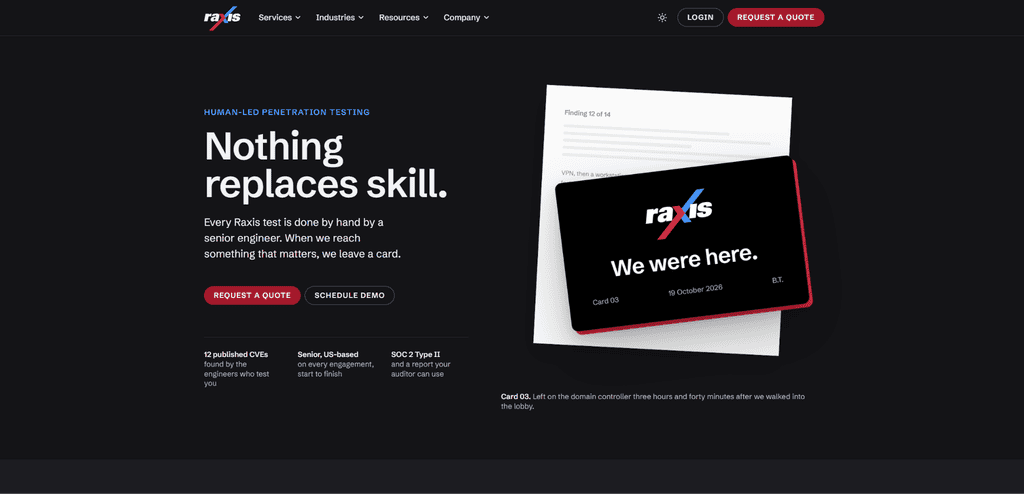
Raxis was founded in Atlanta in 2011 by Mark Puckett, who previously led the global red team at Home Depot. The company states that every test is done by hand by a senior engineer, and that automation is limited to the early discovery work. Its engineers have found and published CVEs in enterprise software.
Buyers choose between two models. Raxis Strike is a point-in-time test for a launch, an audit, or a first assessment. Raxis Attack is a penetration testing as a service subscription that keeps manual testing going through the year, which suits teams that release every sprint. Both run through Raxis One, a platform that shows live progress, posts findings as they are confirmed, and pushes them into Jira.
Scope is broad: web apps, APIs, mobile and desktop apps, Salesforce, AI and LLM features, networks, Active Directory, cloud, wireless, IoT, and physical and social engineering tests. Every engagement includes a retest of the fixes, and each critical finding comes with a proof of concept. Results are walked through in a live debrief.
How to Choose the Right Manual Pentest Partner
Manual testing firms differ in who sits at the keyboard, how much of the work is manual, and what your team receives once testing ends. Use these points to compare the shortlist side by side:
| Criteria | What to look for |
| Who does the testing | The firm’s own testers, named before the project starts. Ask whether the same people will return for the next test, so they don’t have to relearn your app each time. |
| Manual depth | A clear answer on what the tools handle and what people handle. Testers should sign in as each user role and try to break business logic, such as a regular user reaching admin-only functions. |
| Tester qualifications | OSCP or a comparable hands-on certification, plus real experience with apps like yours. Published research or CVEs are a good sign. |
| Scope coverage | Web apps, APIs, mobile apps, cloud accounts, internal networks, or AI features, matched to what you actually run. |
| Communication during the test | A direct line to the testers while the work is underway, and a heads-up on serious findings before the final report. |
| Retesting | Whether a retest is included, how long the window stays open, and whether the report gets updated once fixes are confirmed. |
| Reporting quality | An executive summary, severity scores (CVSS, the industry standard scale), step-by-step reproduction for each finding, and mapping to SOC 2, ISO 27001, PCI DSS, or HIPAA. Ask for a sample report. |
| Engagement model | A single test before an audit or launch, several tests a year, or a year-round subscription. The right one follows how often you ship. |
Final Thoughts
All five companies put people at the center of their testing, and the best pick comes down to what needs testing and how you like to work with a vendor. For a SaaS or fintech company that wants OSCP-certified testers working through each user role by hand, and a report ready for an auditor or an enterprise customer, CYBRI is a strong fit. Testers stay reachable throughout the engagement, findings land in one dashboard, and fixes get retested within 90 days. A short scoping call is enough to size the work, so contact CYBRI to talk through your apps and your deadlines.
Frequently Asked Questions
What is the difference between a manual pentest and a vulnerability scan?
A vulnerability scan is an automated check for known weaknesses, such as an old software version or a known misconfiguration. A manual pentest uses those results as a starting point, then a person tries to exploit what was found, tests how the app’s rules can be bent, and chains smaller issues into a real attack. Scans suit frequent checks between tests. Auditors and enterprise customers generally look for the pentest.
How long does a manual penetration test take?
A focused test of one web app or API usually runs one to two weeks, including the report. Larger scopes with several apps, cloud accounts, or an internal network can take three to four weeks. The clock usually starts once testers have working access to every system in scope, so having test accounts ready at kickoff keeps the timeline short.
Ready for a Manual Pentest?
CYBRI runs manual-first penetration tests of web apps, APIs, mobile apps, cloud accounts, and AI features, with each user role in scope. OSCP-certified testers lead every project, findings appear in the Blue Box dashboard, and every fix is retested within 90 days with an updated report. Get a quote to scope a test for your app.