Most network breaches begin with something ordinary. A VPN login without multi-factor authentication, an old server nobody remembered to retire, or one employee password that also opens the file server. A network penetration test hires security experts to find those openings first. They attack your systems the way a criminal would, with your permission and inside limits you agree on in advance.
The work usually comes in two parts. An external test covers everything anyone on the internet can reach: your firewall, VPN, email login, and public websites. An internal test starts from the inside, as if an attacker had already tricked one employee into opening a malicious attachment, and shows how far that single foothold could spread.
Picking who runs the test is the harder decision. The ten companies below range from firms with thousands of employees to boutiques with a few dozen testers. All of them are well established and do strong network work. Each fits a different kind of buyer, though, so the right choice comes down to your company’s size, your industry, and how much guidance your team wants along the way.
This guide covers seven US-based alternatives. Each one sells testing as a program or as a repeat engagement, not as a one-time project:
- CYBRI: best for growing SaaS, fintech, and tech companies that want manual-first testing of their network, apps, and cloud by one senior team, with reports ready for an audit
- Bishop Fox: best for well-established, large companies with a big internet footprint
- TrustedSec: best for mid-size and large organizations that run on Microsoft, from Active Directory to Entra ID and Microsoft 365
- GuidePoint Security: best for large enterprises and government-facing organizations that want one big security partner
- Black Hills Information Security: best for organizations of any size whose IT team wants to learn from the test
- Rapid7: best for enterprises already using Rapid7’s security tools
- Raxis: best for regulated mid-size organizations, such as banks and healthcare providers, with several locations to cover
- Coalfire: best for large cloud and SaaS providers with FedRAMP, PCI DSS, or HIPAA audits to pass
- Triaxiom Security: best for mid-size companies with PCI DSS or government-contract requirements
- Red Siege: best for small and mid-size organizations with a lean IT team
Why Network Testing Needs a Specialized Pentest Partner
Plenty of firms that test websites and apps will also quote you a network test. The two jobs call for different skills, and two things about networks explain why the vendor you pick matters.
One Stolen Password Can Open the Whole Network
Most companies manage employee logins through Microsoft. On the office network, that’s usually Active Directory, the Windows system that controls every account and what it can open. Anyone on Microsoft 365 also has Entra ID (formerly Azure AD), its cloud counterpart, and in most mid-size and larger companies the two are linked so one password works in both places. That setup makes IT easier to manage, and attackers know it well. With one ordinary account, an intruder can often use small setup mistakes to climb step by step until they reach domain admin, effectively the master key to the network, and then follow the link into email, shared files, and cloud apps. Hopping from one machine to the next along the way is called lateral movement, or pivoting.
Auditors, Customers, and Insurers Ask for Both Tests
PCI DSS, the security standard for card payments, requires an internal and an external pentest at least once every 12 months and after any significant change, for companies whose own systems store, process, or transmit card data. (Businesses that send every payment through a provider’s hosted checkout page usually follow a shorter checklist without this requirement.) If you keep payment systems walled off from the rest of the network (segmentation), PCI also expects a test of those walls on the same yearly schedule, or every six months for payment service providers. SOC 2 and ISO 27001 don’t name a pentest outright, yet most auditors expect one as proof that security controls work. Enterprise customers ask about it in vendor questionnaires, and many cyber insurance applications ask when your last network test took place. A vendor who knows these frameworks can scope the work so one report answers all of them.
How These Network Pentest Companies Were Chosen
Each company here was picked because it serves a particular kind of buyer well. Before any of them made the list, they had to clear the same bar:
- US headquarters. Every company on the list is headquartered in the United States.
- Eight or more years in business, with a record you can check. That means funding or ownership on public record, published research, accreditations such as CREST (an independent body that vets pentest firms), or verified client reviews. Each company was also checked for complaints and legal disputes.
- Network testing is a core service. External and internal tests are offered by name, with Active Directory in scope, rather than bolted onto an app-testing business.
- A human proves every finding. Scanners and AI tools can help cover ground. A tester still has to confirm each issue is real and exploitable before it goes in the report.
- Reports hold up in an audit. A plain summary for leadership, technical steps for IT, and findings tied to PCI DSS, SOC 2, ISO 27001, or HIPAA.
With ten strong options, the order matters less than the fit. Read each “best for” line against your own headcount, industry, and next audit date before you book any calls.
The 10 Best Network Penetration Testing Companies
1. CYBRI
Best for: growing SaaS, fintech, and tech companies that want manual-first testing of their network, apps, and cloud by one senior team, with reports ready for an audit
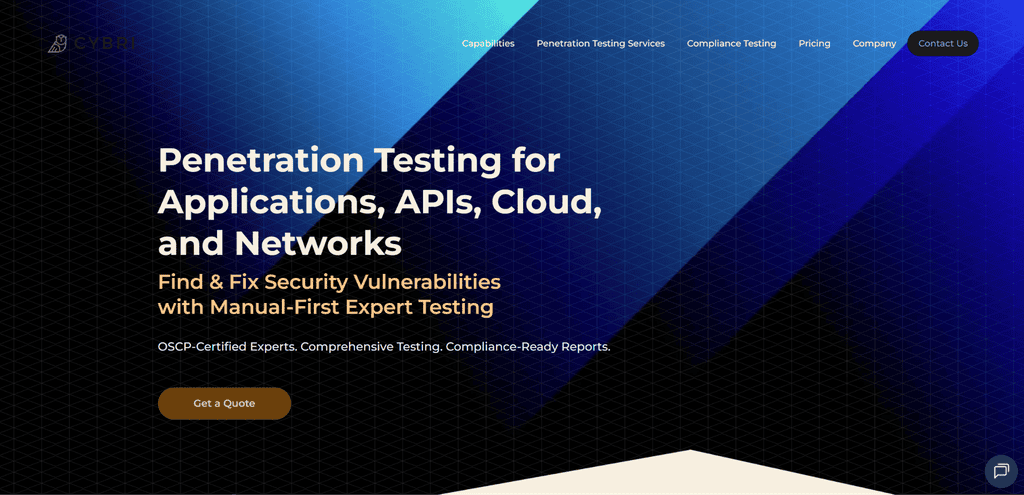
CYBRI is a New York penetration testing company founded in 2017, and every test it runs is manual-first. Scanners help map what’s there, but senior, US-based testers holding OSCP and OSWE certifications do the actual attacking by hand. On a network and infrastructure test, they go after firewalls and other network devices to find the weakest way in, then move laterally from that first foothold to see how far it reaches. Servers, operating system patching, and user configuration all fall within scope.
What sets CYBRI apart for growing companies is that the network rarely gets tested alone. The same team can cover web apps, APIs, mobile apps, and cloud accounts in one engagement, so the report shows how an attacker could move from the internet, through the network, to customer data. Companies can book a single test or a yearly PTaaS program, where tests are spread across the year as the environment changes.
Findings appear in the Blue Box dashboard as soon as testers verify them, and critical issues are flagged the same day. Each report pairs an executive summary for leadership with technical findings scored on CVSS 4.0, along with step-by-step fixes, and maps them to SOC 2, ISO 27001, HIPAA, PCI DSS, and NYDFS. After your team fixes the issues, testers run a remediation test and confirm each fix holds.
2. Bishop Fox
Best for: well-established, large companies with a big internet footprint
Founded in 2005 and based in Arizona, Bishop Fox has spent two decades testing for some of the world’s largest organizations. Its clients include many Fortune 100 and leading technology companies. On internal tests, Bishop Fox plays the role of a malicious insider, showing how someone could escalate access, take over privileged accounts, and get around security controls. External tests copy the methods real attackers use to gain a first foothold.
Large companies often have more internet-facing systems than anyone can track by hand: hundreds of domains, acquired businesses, and cloud accounts spun up by different teams. Bishop Fox’s Cosmos service is built for that scale. It keeps an up-to-date map of what a company exposes, tests it on an ongoing basis, and goes past the first break-in to show what an attacker could reach next.
3. TrustedSec
Best for: mid-size and large organizations that run on Microsoft, from Active Directory to Entra ID and Microsoft 365
David Kennedy founded TrustedSec in Fairlawn, Ohio, in 2012, and the firm has since been named a Leader in The Forrester Wave for cybersecurity consulting services (Q2 2024). Its penetration tests follow a clear path from scoping and reconnaissance to hands-on exploitation, a walkthrough of the results, and a validation retest once fixes are in.
The firm’s depth in Microsoft identity sets it apart. In 2025, the Trimarc team joined TrustedSec, led by Sean Metcalf, one of roughly 100 people worldwide who hold Microsoft’s Certified Master credential for directory services. TrustedSec’s Active Directory Security Assessment reviews domains, group policies, and privileged and service accounts, and maps each weakness to known attacker techniques. After testing, the same firm offers hardening reviews for Active Directory, Microsoft 365, and Microsoft’s cloud, so the fixes don’t land entirely on your IT team.
4. GuidePoint Security
Best for: large enterprises and government-facing organizations that want one big security partner
GuidePoint Security, founded in 2011 and headquartered in Reston, Virginia, runs its testing through a dedicated Threat and Attack Simulation team. The company says those testers come from Fortune 100 companies, the Department of War, and US intelligence agencies. Its penetration testing earned CREST accreditation in 2024.
Internal tests show how far an attacker could get from a single foothold, and they also check whether your security monitoring would notice. External tests pair perimeter testing with a review of the public information an attacker could gather about your company. GuidePoint also runs scenario-based tests built around a specific worry, such as ransomware or identity attacks, and it offers testing as a single engagement or as an ongoing PTaaS program. Because the company also offers consulting, incident response, managed services, and help choosing and running security tools from more than 800 vendors, large organizations can keep testing under the same roof as the rest of their security program.
5. Black Hills Information Security
Best for: organizations of any size whose IT team wants to learn from the test
John Strand started Black Hills Information Security in South Dakota in 2008, and network work makes up the bulk of what it does. Its own published findings show that external and internal network tests are its most common engagements, along with tests that start from an already-compromised account. Its clients range from community banks to Fortune 100 companies.
BHIS stands out for how much it explains along the way. Engagements include a kickoff call, daily check-ins during testing, and a report written so your team can understand each step and repeat it. The company also runs Antisyphon Training and the Wild West Hackin’ Fest conference, and much of that teaching shows up in how it reports. Beyond one-time tests, BHIS offers Fusion, an external assessment that pairs its own AI system with a senior tester who validates the key findings and owns the final report, and ANTISOC, a year-long continuous red team with findings delivered as they happen and quarterly debriefs.
6. Rapid7
Best for: enterprises already using Rapid7’s security tools
Rapid7 is a security company, founded in 2000 and based in Boston, and the owner of Metasploit, which it calls the world’s most widely used penetration testing tool. Its testers contribute to Metasploit directly and spend up to 20% of their time between engagements on attacker research.
The company offers internal and external network tests, along with wireless, social engineering, and red team work. Its stated aim is to make each year’s pentest harder than the last, so reports include strategic advice on controls and training alongside the technical findings. For ongoing coverage, Vector Command runs continuous red team operations against a company’s internet-facing systems, and the Advanced tier extends that work into the internal network. Companies that already rely on Rapid7’s platform can keep testing and day-to-day security work with one vendor.
7. Raxis
Best for: regulated mid-size organizations, such as banks and healthcare providers, with several locations to cover
Mark Puckett founded Raxis in Atlanta in 2011 after leading the global red team at Home Depot. Every test is done by hand by a senior, US-based engineer, and the tester on the scoping call is the one who breaks in and later retests the fixes. The team has published 12 CVEs (publicly catalogued software flaws), and its clients include banks, hospitals, defense contractors, and critical infrastructure operators.
Internal testing is where Raxis makes life easier for companies with more than one site. Instead of scheduling travel, Raxis ships a device called the Transporter overnight. Your team plugs it in, and testers reach the internal network the same day. From there they work through Active Directory, lateral movement, and segmentation, including the walls around payment card systems. Companies can book a fixed-window test (Raxis Strike) or year-round PTaaS (Raxis Attack), with findings flowing into the Raxis One portal and on to Jira.
8. Coalfire
Best for: large cloud and SaaS providers with FedRAMP, PCI DSS, or HIPAA audits to pass
Coalfire was founded in Colorado in 2001 and is best known as an assessor for FedRAMP, the US government’s security program for cloud services. The company says many of the largest cloud providers and SaaS businesses trust it year after year. Its offensive security work runs through a dedicated team called DivisionHex, which covers penetration testing, red teaming, and social engineering.
Coalfire’s testers work on both internal and external networks, and its federal practice also runs Active Directory security evaluations. DivisionHex describes its testing as threat-informed: testers use the same tools and tactics as real attackers and rely on human judgment for the problems automation misses. Compliance testing is where Coalfire stands apart. It pairs more than two decades of audit experience with hands-on testing built to meet PCI, HIPAA, and FedRAMP requirements, which helps companies whose growth depends on passing those reviews on schedule.
Website
9. Triaxiom Security
Best for: mid-size companies with PCI DSS or government-contract requirements
Triaxiom Security, founded in 2017 and based in Charlotte, North Carolina, has operated as a division of Strata Information Group since 2023. It is CREST-accredited, its team includes PCI Qualified Security Assessors (people certified to run PCI audits), and its engineers have at least five years of security experience. Separate services cover internal, external, wireless, and physical testing.
The process is predictable from start to finish, which helps companies on audit deadlines. A scoping call leads to a written proposal within a few hours, active testing usually takes one to two weeks, and every report goes through two rounds of quality review before a walkthrough with your team. The internal test aims for domain admin and sensitive files, and Triaxiom positions it as a check of ransomware readiness. Testers avoid denial-of-service attacks entirely and pause if anything becomes unstable.

10. Red Siege
Best for: small and mid-size organizations with a lean IT team
Tim Medin founded Red Siege in 2017. He created Kerberoasting, a widely known technique for cracking service-account passwords in Active Directory, and for years was the lead author of SANS SEC560, a leading course on enterprise penetration testing. Every engagement opens with one question: what data, if lost, stolen, or compromised, would hurt your organization most?
Its Assumed Breach Assessment starts as a low-privilege user, the position an attacker or a rogue insider would hold after compromising one account, and works toward that data. A Ransomware Readiness Assessment checks whether ransomware could get in, what it could reach, and whether your endpoint protection would stop it, and a Cloud Assumed Breach test covers Microsoft 365 and AWS. Reports include the exact commands testers used, so a small IT team can assign tickets, fix each issue, and retest it on its own. Red Siege publishes a sample report for buyers who want to see the format first.
How to Choose the Right Network Pentest Partner
Network testing providers differ in what they cover, how they reach your internal network, and what your team is left with at the end. Use these points to compare the shortlist side by side:
| Criteria | What to look for |
| External, internal, or both | A quote that says clearly which parts are covered: what faces the internet, the network behind it, or both. Most audits and insurers expect both. |
| Identity in scope | Active Directory, plus Entra ID and Microsoft 365 if your company uses them. Ask how testers will try to climb from one ordinary account to full control. |
| How the internal test connects | An on-site visit, a device shipped to your office, or a secure remote connection. Ask how long setup takes and what your IT team has to do. |
| Segmentation | If you keep payment or other sensitive systems walled off, a test that proves those walls hold. PCI DSS requires it. |
| Safety | A plan to avoid outages: no denial-of-service attacks, agreed testing windows, and a contact who can pause the test if something looks wrong. |
| Retesting | Whether retests are included, how long the window stays open, and whether the report gets updated once fixes are confirmed. |
| Reporting quality | An executive summary, CVSS severity scores, clear steps to reproduce each issue, and findings tied to PCI DSS, SOC 2, ISO 27001, or HIPAA. |
| Engagement model | A single yearly test, several tests a year, or continuous testing. The right one follows how often your network changes. |
Final Thoughts
Any of these ten firms can test a network well, and the best pick comes down to your size, your industry, and how much guidance your team wants. For a growing SaaS, fintech, or tech company that wants manual-first testing by senior US-based testers, with the network, apps, and cloud covered in one engagement and a report ready for an auditor or an enterprise customer, CYBRI is a strong fit. Testers stay reachable throughout the engagement, critical issues are flagged the same day, and fixes get retested. A short scoping call is enough to size the work, so contact CYBRI to talk through your network and your next audit.
Frequently Asked Questions
What is the difference between an internal and an external network pentest?
An external test looks at what anyone on the internet can reach: your firewall, VPN, email login, and public websites. It answers whether an outsider can get in. An internal test starts from inside the network, as if an attacker already controlled one employee’s laptop or account, and shows how far they could spread from there. Most companies need both, and PCI DSS requires both.
Do testers need to come on-site for an internal test?
Usually not. Many providers connect remotely, either through a small device your team plugs into the network or through a secure virtual machine set up on your systems. On-site visits still make sense for physical security testing or networks that are fully cut off from the outside. Ask each provider which options they offer and how long setup takes.
How often should a network be tested?
The common recommendation is at least once a year, plus after significant changes: a new office, a firewall or VPN replacement, a cloud migration, or a merger. Companies whose networks change often, or that face frequent audits, usually move to several tests a year or continuous testing so each change gets checked. CYBRI’s guide on how often to run a pentest covers this in more detail.
Ready to Test Your Network?
CYBRI runs manual-first network penetration tests, external and internal, alongside web app, API, and cloud testing when you need it. Senior OSCP-certified testers flag critical issues the same day, findings appear in the Blue Box dashboard, and every fix is retested. Get a quote to scope a test for your network.