Your pentest quote asks a question you may not have expected: black box or gray box? Black box tends to feel like the serious pick, since the tester gets no login and no help and comes at the app cold. For most companies it is the weaker buy. The two differ only in how much the tester is told before starting, and that decides whether the budget goes to finding problems or to hunting for the front door.
Quick Answers
Which gives better value, gray box or black box?
Gray box, for nearly any company whose app has user logins. The tester starts from a working account, so the hours go into finding flaws rather than into getting in. The same budget tests more of the app.
What is the difference between black box and gray box testing?
The starting information. A black box tester gets nothing and works from the outside. A gray box tester gets a login and some context, then works from inside an account.
Is black box the more thorough test?
No. It covers the least ground. Without an account, the tester rarely reaches the parts of the app behind the login, which is where the most damaging flaws tend to sit.
When is black box worth paying for?
For an outside-in check of your perimeter, meaning whether a stranger on the internet can get in at all, or as part of a red team exercise that also tests whether your team spots the attack. For regular testing of an app with logins, choose gray box.
What Gray Box Testing Is
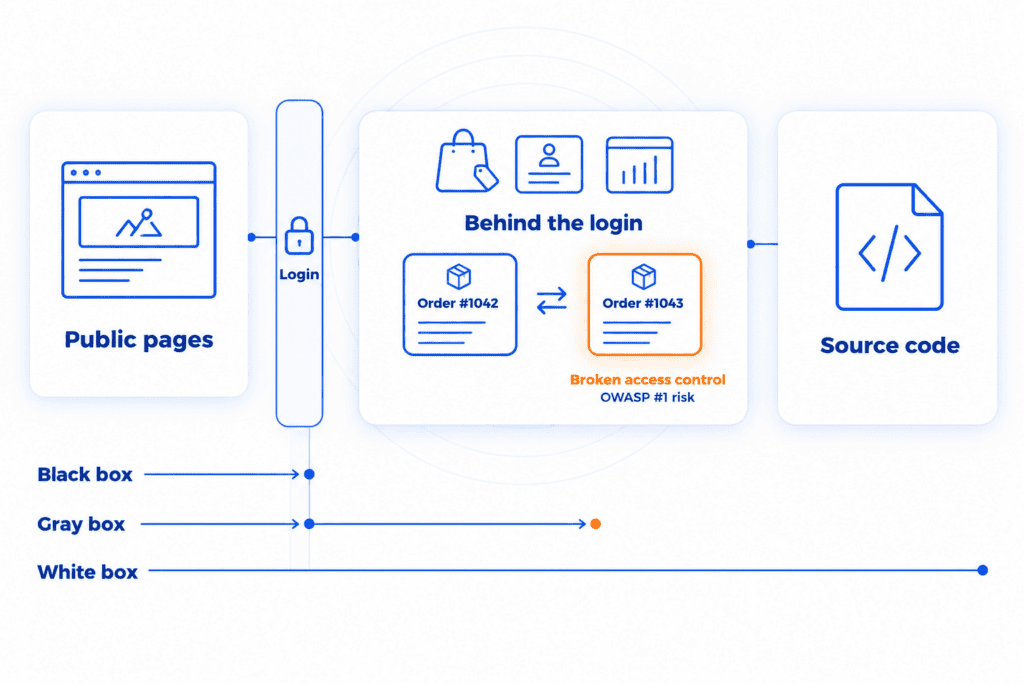
In a gray box test, the tester gets a valid login (credentials for one or more user accounts) and some notes on how the system is built, but not the source code, the instructions the app runs on. Testing happens from inside a logged-in account, which the industry calls authenticated testing. Picture someone already in the lobby with a working keycard, checking which interior doors open.
On one side of it is black box. The tester starts with nothing and spends the early days on reconnaissance, gathering public information about the target, like a stranger on the sidewalk working out which doors the building has. White box goes the other way and hands over everything, source code included, so the tester can review the app the way an auditor works from full blueprints. It goes deepest of the three.
The testing method and the report can be the same in all three. The rest of this article stays on the two options most buyers weigh: gray box and black box.
Gray Box vs. Black Box, Head to Head
Many buyers assume black box is the more realistic test. It does copy one kind of attacker well: the stranger with no access at all. Real breaches rarely look like that. Year after year, breach reports rank stolen, reused, and phished passwords among the most common ways in, and insiders already have an account. The typical intruder holds a valid login, and gray box tests from exactly that position.
The cost argument points the same direction. Pentests are quoted on scope (the number of apps, APIs, and user roles), so the box rarely changes the price. It changes what the price buys. Each day a black box tester spends on reconnaissance is a day taken from finding flaws, while a gray box tester puts nearly all the hours into the app itself. For the same invoice, gray box returns more findings.
Laid out side by side, the tradeoff is clearer:
| Black box | Gray box | |
| What the tester starts with | Nothing but public information | A working login and some context |
| Attacker it recreates | A stranger with no access | Someone already logged in |
| Where the budget goes | Finding a way in first, then testing | Straight to testing |
| Coverage of your app | Narrow, mostly the public surface | Broad, including everything behind the login |
| Findings per dollar | Lowest | Highest |
| Easy to scope and price | Harder, the recon time is unknown | Yes, the scope is known up front |
| Best for | A pure outside-in perimeter check | Most web apps, SaaS, and APIs |
Why Gray Box Usually Pays Off More
The bigger reason gray box earns more for the money is which flaws it reaches. OWASP, a nonprofit whose list of top web risks the industry treats as its benchmark, ranks broken access control first in its 2025 edition. The term covers a logged-in user getting at data or actions that belong to someone else, such as a customer who edits the order number in the address bar and opens a stranger’s order, shipping address included. Flaws like this exist only past the login, so a black box tester who never gets an account can finish the engagement without seeing them, and they are the ones that tend to expose customer data. A gray box report usually carries fewer surface-level items and more of the problems that would cost money.
White box shares that advantage. With the source code in hand, the tester skips the search for a way in and can trace a flaw to the exact lines that cause it, so its return per dollar is high too. The extra depth asks more of your team, from sharing code to walking the tester through the architecture. That trade pays off for critical systems, such as payment processing or health records, where the deepest analysis is worth the effort. For most other apps, gray box captures most of that value with far less setup.
What Compliance Expects
Compliance rarely settles the question for you. SOC 2, ISO 27001, and PCI DSS do not name a box; auditors look for testing with a credible scope and evidence that findings were fixed and retested. PCI DSS, the security standard for companies that handle card payments, comes closest to a preference. Its Requirement 11.4 asks for a documented method based on a recognized industry approach, and in practice PCI tests usually run gray or white box, since a blind start burns paid hours learning facts the company already has.
Enterprise customers follow the same logic in their vendor security questionnaires. Their reviewers want a report with real findings and proof they were resolved. A black box report that stalled at the login page tells them little, however tough the test sounded. CYBRI’s PCI and SOC 2 penetration testing pages explain how each engagement is scoped.
How CYBRI Runs a Gray Box Test
CYBRI tests from a login by default. Unless a client asks for a pure outside-in test, every engagement is authenticated, either gray or white box, and scoping settles the access the tester needs before day one: a test account for each user role and a technical contact on the client side who can clear any blocks quickly.
The method follows public standards rather than a private checklist. NIST SP 800-115, the US government’s guide to security testing, sets the phases, from planning through reporting. OWASP’s Web Security Testing Guide and its API Security Top 10 supply the test cases, including the access-control checks described above. Part of a gray box test involves sending the same request as different users and swapping account or record numbers to see what the app returns. Testers do most of that manually in Burp Suite, the standard tool for capturing and replaying web traffic.
Every assessment includes:
- Manual testing by senior specialists, two to three per project, all holding the OSCP, a hands-on certification for offensive security work.
- Same-day notice of critical issues, so a serious flaw reaches your engineers well before the final report does.
- A report with a non-technical and a technical part. Leadership and auditors get a plain-language summary of the risks and what they mean for the business. The IT team gets the technical detail: each finding scored on CVSS 4.0, the standard 0-to-10 severity scale, with steps to reproduce and fix it.
- Findings mapped to your framework, whether that is SOC 2, ISO 27001, PCI DSS, or HIPAA.
- Help through the fix phase. For roughly three months after the report, testers answer engineering questions and retest each fix to confirm the hole is closed.
Clients on ongoing programs also get Blue Box, CYBRI’s dashboard for tracking open findings, retests, and progress from one test to the next. To find out what a gray box test of your app would cover and cost, contact CYBRI for a scoping call.
Frequently Asked Questions
Is gray box testing cheating, since the tester already has a login?
No. Attackers who reach data usually hold a working account, so a test that starts from one copies the threat you face. Withholding the login only means paying for days of work an attacker would skip.
How much does a gray box penetration test cost?
At CYBRI, a web application test starts at $5,000 and takes five or more business days. From there the price grows with scope, mainly the number of apps, APIs, and user roles in the test. Larger tiers are listed on the pricing page.
How long does a gray box test take?
Active testing usually takes 5 to 15 business days, depending on how many apps, APIs, and cloud environments are in scope. After the report comes a remediation period of about 90 days, when your team fixes the findings and the testers retest each one.
Should a gray box test run on production or a staging environment?
Either works, and CYBRI also offers a hybrid approach. Staging is the usual choice when it closely matches production. In a hybrid test, the deeper and riskier checks run on staging, while production gets a lighter pass to confirm its live configuration holds up. Production alone is an option too, for teams that have no separate staging environment.
How often should a company run a gray box test?
Once a year suits most companies, plus an extra test after a big change such as a new API or a move to new infrastructure. PCI DSS makes the same schedule a requirement for systems that handle card data: a test every 12 months and after any significant change. Teams that ship changes every week often switch to continuous penetration testing.
Get a Pentest Aimed at Your Real Risk
A short scoping call settles what a gray box test of your app should cover, from the user roles worth testing to whether any part calls for white box depth. You come away with a fixed quote and a plan that aims the testing hours where attackers would strike first. Contact CYBRI to schedule it.