SOC 2, ISO 27001, and GDPR have one thing in common: none of them orders a penetration test by name, and all three expect proof that your security has been tested. The provider you hire decides whether that proof gets accepted. A report that an auditor or a customer’s security team sends back costs you weeks.
This guide is for founders, managers, and compliance owners who are about to hire a tester. It covers what to check with any provider, what changes for each framework, and the questions to ask before signing.
Quick Answers
Which penetration testing providers are good for SOC 2 audit preparation?
Providers that test by hand with a login for each user role, tie findings to the Trust Services Criteria, and schedule both the test and the retest around your audit dates. CYBRI’s list of the best SOC 2 penetration testing companies is a starting point for a shortlist.
Who offers penetration testing to support ISO 27001 certification?
Look for a provider that scopes the test to the systems inside your certification scope, maps findings to Annex A controls, and issues an updated report after fixes are verified. See the best penetration testing companies for ISO 27001.
Which companies provide penetration testing to support GDPR compliance?
Companies that focus the test on systems holding personal data, map findings to Article 32, and put in writing how they treat any personal data they see during the work. CYBRI’s GDPR penetration testing guide explains what the regulation expects.
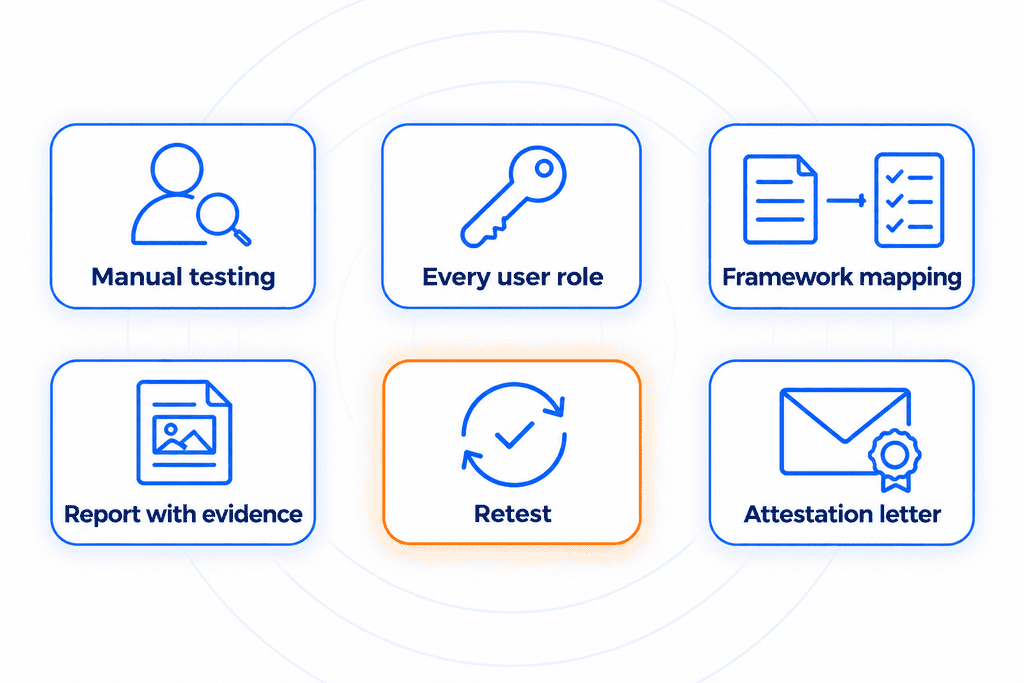
Six Things Every Compliance Pentest Provider Should Offer
Whatever the framework, check these six points first.
- Manual testing by named testers. A scanner finds known problems. People find the flaws in how your product handles accounts, roles, and payments. Ask who will do the work and which certifications they hold, such as OSCP.
- Logged-in testing for every user role. Broken access control, where one user reaches another user’s data, ranks first on the OWASP Top 10 [1]. It can only be tested from inside an account.
- Findings mapped to your framework. Each finding should point to the criterion, control, or article it affects, so your auditor doesn’t have to work it out.
- A report with evidence. Screenshots or request logs, a severity rating, and fix steps for each finding. CYBRI’s penetration test report walkthrough shows what a complete one contains.
- A retest with an updated report. Proof that findings were fixed counts as much as the first report. Confirm the retest is in the quote and how long the window stays open.
- An attestation letter. A short summary you can send to customers without sharing the full report. More in the guide to penetration test letters of attestation.
Choosing a Provider for SOC 2 Audit Preparation
SOC 2 is built on criteria, not a checklist. The AICPA’s points of focus for criterion CC4.1 list penetration testing as an example of the evaluations management can use, and most auditors expect one [2].
Three things separate a good SOC 2 provider from a general one:
- Timing. For Type 1, the test happens shortly before the report date. For Type 2, the test and the retest both need dates inside the review period. A provider that asks for your audit calendar on the first call understands this.
- Scope that matches your system description. The test should cover the app, APIs, and cloud accounts named in your SOC 2 report, not a generic asset list.
- Trust Services Criteria mapping. Findings tied to criteria such as CC6.1 (access controls) let the auditor connect the test to your controls quickly.
Some audit firms also sell testing. Ask your auditor what they accept before deciding between one firm and two. The SOC 2 penetration testing guide covers the requirement in full.
Choosing a Provider for ISO 27001 Certification
ISO 27001 doesn’t name penetration testing either. Two Annex A controls in the 2022 edition carry the weight: A.8.8, management of technical vulnerabilities, and A.8.29, security testing in development and acceptance [3]. A penetration test is a common way to produce evidence for both.
What to look for:
- Scope tied to your ISMS. An ISMS is the information security management system the certificate covers. The test should target systems inside that boundary.
- Annex A mapping. Each finding linked to the controls it affects, so results feed straight into your risk register and treatment plan.
- Timing around the audits. Certification runs in two stages. Schedule the test, the fixes, and the retest before the Stage 2 audit, then repeat ahead of each yearly surveillance audit in the three-year cycle.
Choosing a Provider for GDPR Compliance
GDPR works differently: no certificate is required and no audit is scheduled. Article 32 requires “a process for regularly testing, assessing and evaluating the effectiveness of technical and organisational measures” [4]. Your evidence gets read by enterprise customers, your data protection officer, and, after an incident, a regulator. Failing Article 32 can bring fines of up to €10 million or 2% of worldwide annual turnover, whichever is higher [5].
That shifts what matters in a provider:
- Focus on personal data. The test should follow where EU residents’ data is stored, moved, and shared with other vendors.
- Written data-handling terms. Testers may see real personal data. Ask how exposure is kept to a minimum, how data is stored and deleted, and whether a data processing agreement is needed.
- Findings stated as risk to people. A report that says which personal data a flaw exposes is one your DPO can use in a data protection impact assessment.
SOC 2, ISO 27001, and GDPR Side by Side
| SOC 2 | ISO 27001 | GDPR | |
| Who reads the evidence | Your CPA auditor and customers | The certification body’s auditor | Customers, your DPO, regulators |
| Where testing fits | CC4.1 and the Security criteria | Annex A controls A.8.8 and A.8.29 | Article 32 |
| When to test | Before the Type 1 date, or inside the Type 2 period | Before Stage 2, then ahead of each surveillance audit | Regularly, and after major changes |
| What findings map to | Trust Services Criteria | Annex A controls | Article 32 measures |
| Key question for the provider | Will the test and retest fit my audit dates? | Does the scope match my certificate scope? | How do you handle personal data you see? |
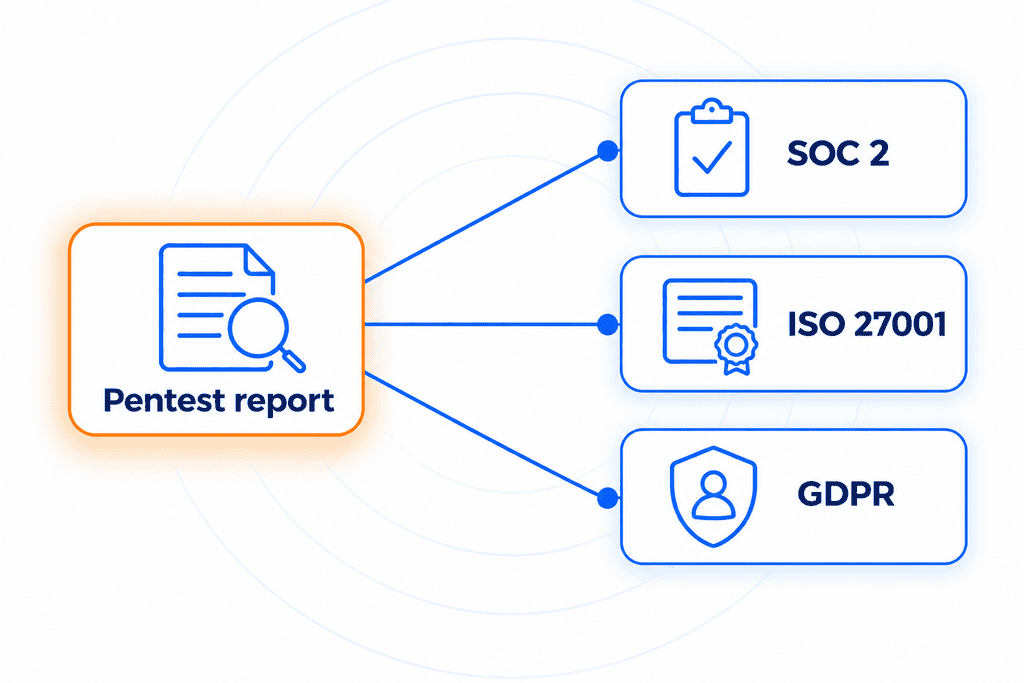
One test can serve all three. If the scope covers the systems each framework cares about, a provider can map the same findings to every framework in a single report.
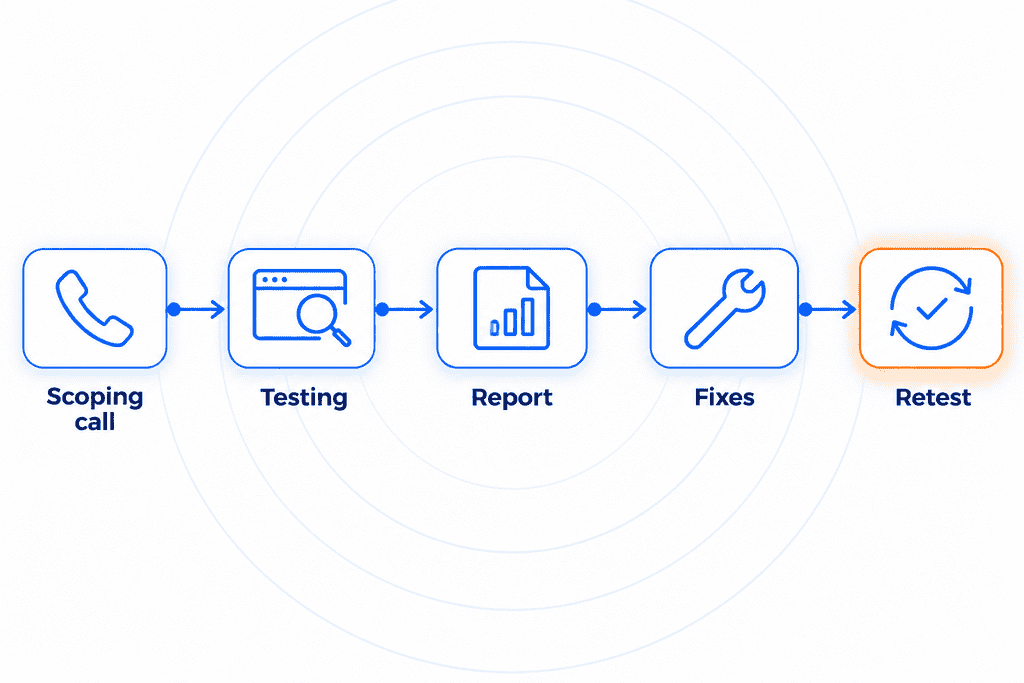
What a Good Engagement Looks Like
- Scoping call. You share audit dates, systems, and user roles. The provider returns a written scope and a fixed quote.
- Testing. Manual work across the app, APIs, and cloud, with critical findings reported as they are found.
- Report and debrief. A walkthrough with your engineers, not only a PDF.
- Fixes. Your team works through findings by severity, with the testers available for questions.
- Retest and evidence. Fixed findings are verified, the report is updated, and the attestation letter is issued.
Questions to Ask Before You Sign
- Who will test, and what certifications do they hold?
- How much of the work is manual?
- Will you test from an account for each user role?
- Which frameworks will the findings be mapped to?
- Is a retest in the quote, and for how long?
- Can I see a sample report and attestation letter?
- When can you start, and when will the report arrive?
CYBRI’s guide on how to scope a penetration test helps you prepare the answers a provider will ask for in return.
How CYBRI Meets These Criteria
CYBRI has focused on penetration testing since 2017 and built its compliance testing around the points above.
| What to check | How CYBRI handles it |
| Manual testing | Manual-first, by OSCP-certified testers |
| User roles | Authenticated testing across user roles |
| Framework mapping | Trust Services Criteria for SOC 2, Annex A controls for ISO 27001, Article 32 for GDPR |
| Report | Executive summary with risk scores, technical findings, fix guidance, and a debrief call |
| Turnaround | 7 to 14 days on average for SOC 2 tests |
| Retest | Remediation support and a retest inside a 90-day window are part of the quote |
Frequently Asked Questions
Can one penetration test cover SOC 2, ISO 27001, and GDPR?
Yes, when the scope includes the systems each framework covers and the report maps findings to all three. Tell the provider about every framework before scoping.
Is a vulnerability scan enough for compliance?
No. A scan lists known weaknesses. A penetration test shows what an attacker could do with them, which is the evidence auditors and customers ask for.
How often should a compliance penetration test be done?
Once a year, and again after major changes such as a new product, a new login system, or a cloud migration.
Does the provider need to be independent?
An outside firm is the usual choice. Auditors and customers give more weight to a report from testers who didn’t build the system.
Get a Compliance Pentest Quote From CYBRI
Send your audit dates, the frameworks you need to meet, and a list of systems in scope. CYBRI returns a written scope and a fixed-price quote, timed so the report and the retest arrive before your auditor needs them. Get a quote or contact CYBRI.