A web framework penetration test is a manual security check tuned to the framework your app is built on, since each one has its own safe defaults and its own ways to switch them off. Find your framework in the list below; its section is there whenever you want it. First, though, a few short sections cover the ground common to every stack: what a framework can and can’t protect, and how a frontend bug and a backend bug chain into something critical. Cost and process are at the end.
Jump to your stack:
Quick Answer
What is framework-specific penetration testing?
It’s a manual security test aimed at the weak points of whatever framework an app is built on. Every framework ships with sensible defaults and a handful of documented ways to switch those defaults off, so a tester goes looking for the switched-off ones before anything else.
Where do the most serious findings come from?
Usually from combining a frontend bug with a backend one. A source map gives up internal API routes, an exposed admin or debug endpoint hands over a signing key, and suddenly the tester is forging an admin token.
How long does a framework pentest take, and what does it cost?
A single target starts at $5,000 and runs from 5 business days. Web app, API, cloud, or AI testing starts at $9,500 from 10 business days, remediation testing included. The clock doesn’t start at signing; it starts when the tester can actually reach everything in scope.
Frontend, Full-Stack, and Backend: Why the Layer Matters
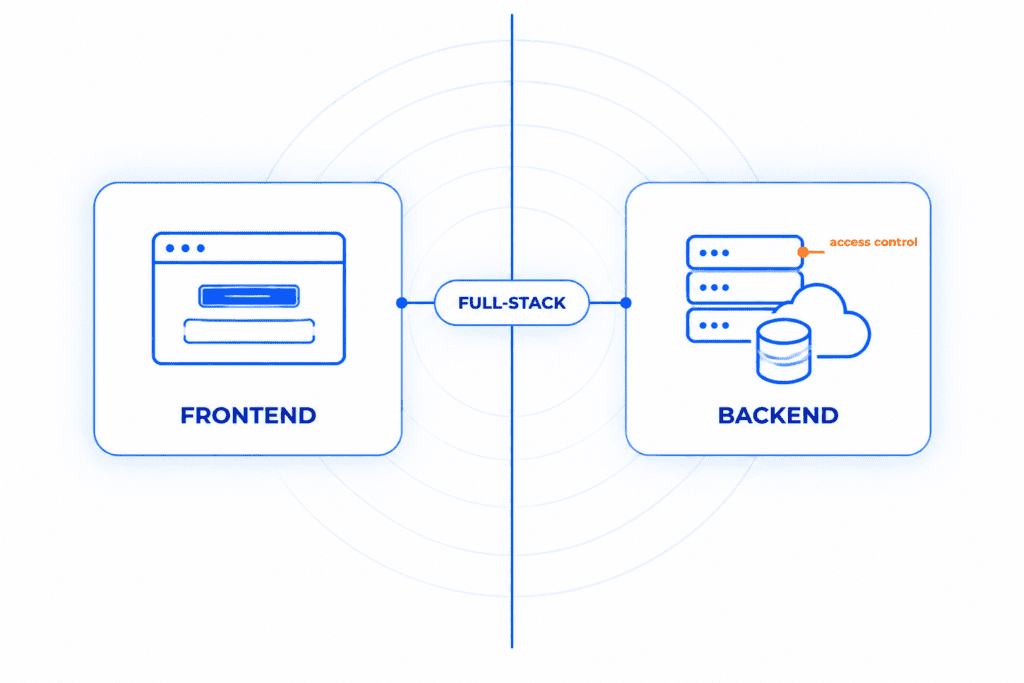
A framework runs either in the browser or on the server, and that location decides what it can protect. Knowing which side yours is on sets up everything in its section.
Frontend frameworks (Angular, Vue) run in the visitor’s browser. That code is fully in the user’s hands, so any check made there, hiding an admin button or a route guard, is advisory at best. Anyone can call the API directly and skip it.
Backend frameworks (ASP.NET Core, Spring Boot, Laravel, Django) run on the server, out of reach of the user. This is the only layer that can truly decide who reads or changes data, which is why real access control has to live here.
Next.js, the full-stack option here, does both. A frontend team ends up owning server code too, and inherits the server’s risks on top of the browser’s.
For a pentest it comes down to this: frontend bugs leak information and hijack sessions, but the findings that hand over data or whole accounts almost always land in the backend. Each framework’s section below starts from the layer it runs on.
How Stacks Chain: When Frontend and Backend Findings Combine
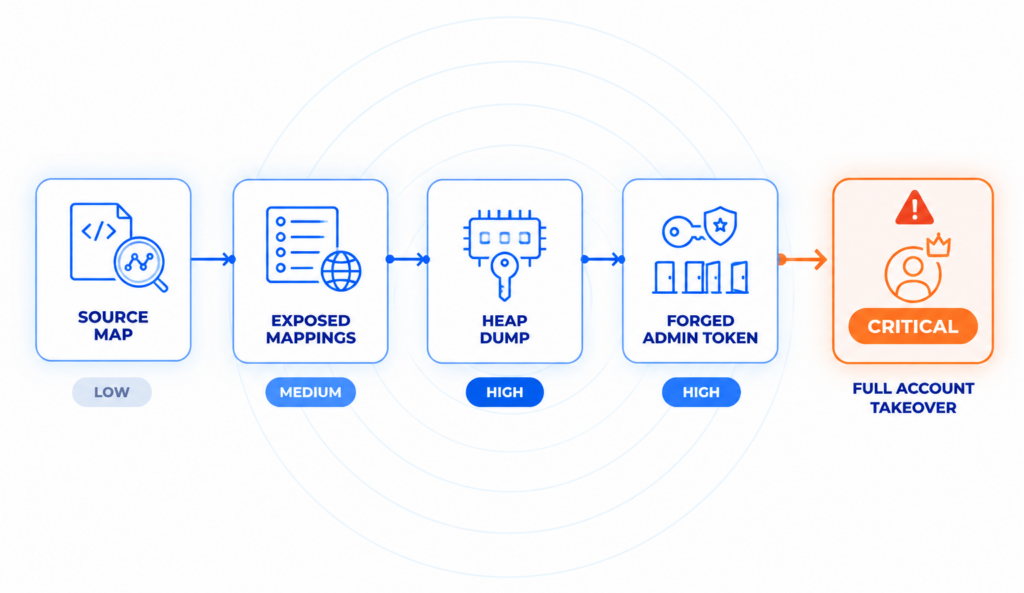
The most serious findings almost never sit in a single layer. They come from linking a small frontend leak to a backend weakness, which is why a frontend and the API behind it are worth testing as one engagement instead of two. On its own, each issue reads as a low or a medium and gets a quick fix or a pass. Chained, the same issues turn into a critical that empties accounts. Split the app across two vendors, or scope only one side, and no one sees the whole path. The pattern repeats across stacks; here is one common run.
A typical run on an Angular and Spring Boot app:
- The Angular bundle carries its source map, and that map names routes under /api/internal/ you’d never see in the interface.
- One look at /actuator/mappings confirms the routes are real and, worse, that Actuator is answering to the open internet.
- /actuator/heapdump hands over a copy of the server’s memory; grep through it and the JWT signing key drops out.
- The tester mints a token carrying an admin role, and every one of those internal routes waves it through.
On their own that’s a low (source map), a medium (exposed mappings), and a high (heap dump). Chained, they become a critical vulnerability that can empty every account in the system. The frameworks change, the shape doesn’t.
Angular Penetration Testing: Sanitizer Bypasses, XSRF, and Server-Side Rendering
Angular is Google’s TypeScript framework, common under large single-page apps and internal business tools. It has strong defaults: it escapes text and cleans HTML before showing it, so most cross-site scripting (XSS) findings come from the handful of functions a developer can call to switch that cleaning off. A tester looks for those first, along with any code that writes straight to the page and skips Angular’s safety net.
Angular can also render pages on the server. When it does, it has a server to defend as well, and testers check for one user’s data leaking into another user’s page and for server-side requests that can be pointed at internal systems.
Version matters too. AngularJS, the original version, lost support years ago, so an app still running it is a finding on its own.
Vue.js Penetration Testing: v-html, Template Injection, and Nuxt
Vue is a lighter frontend framework, popular with PHP and Laravel teams and for freshening up older sites. It escapes text by default. The usual weak spot is v-html, which drops in raw HTML with no cleaning, so testers check every place it shows user content, along with links that could carry a javascript: address.
The bug most specific to Vue happens when it runs on top of a page the server already built. Vue reads that page as a template, so user text the server thought it had safely escaped can still run as code. Vue’s own guidance is never to mount it on server-built content that includes user input.
Older Vue 2 apps add to the list. Vue 2 is past end of life, so its known issues stay unpatched, and running it in production is a finding on its own. Vue’s full-stack framework, Nuxt, adds a server, so its API routes, its handling of secrets, and its caching all need the same checks as any backend.
Next.js Penetration Testing: Middleware, Server Actions, and SSRF
Next.js is React with a server attached: it builds pages on the server and runs backend code next to the frontend. For testing, that means a frontend team now owns server code too. Its API routes and server actions are real backend endpoints, and they get tested like any API, for proper authorization, input checks, and rate limits.
The classic mistake is routing every login and permission check through one middleware layer. In 2025 a widely reported flaw let attackers skip that layer with a single request header, which is why testers confirm each route checks the user for itself instead of trusting the layer in front.
A server also opens the door to server-side request forgery, where the app is tricked into fetching internal addresses, and to secrets accidentally shipped into the browser bundle.
ASP.NET Core Penetration Testing: Authorization, Over-Posting, and Deployment
ASP.NET Core is Microsoft’s framework for building web apps in C#, common in enterprise APIs and often hosted on Azure. Its defaults are solid, so findings usually come from how the app was put together.
Authorization is first. Testers map every endpoint, looking for ones that forgot to require a login, or that check a user’s role but never check the record belongs to them, which lets one customer read another’s data. Over-posting is next, where the app copies a whole request onto its database record, so an extra field slipped into the request gets saved:
{ “displayName”: “John”, “isAdmin”: true }
After that come the classic backend issues: database queries built by gluing strings together, unsafe handling of saved objects, and configuration left loose, like debug pages or API docs exposed in production and secrets sitting in config files. How the app is deployed matters too. A mismatch between a front proxy and the .NET web server has let attackers smuggle a hidden request past security checks. For anything hosted on Azure, CYBRI’s Azure penetration testing page picks up the cloud side.
Spring Boot Penetration Testing: Actuator, Spring Security, and Data Binding
Spring Boot is the standard Java framework for APIs and microservices, common in banking, insurance, and government. Testing usually starts with its built-in monitoring endpoints. By default only a basic health check is public, but teams often open the rest for their monitoring tools, and that is where it gets risky. One of those endpoints returns a snapshot of the app’s memory, which can hold passwords, API keys, and the secret used to sign logins; others list the app’s configuration and every one of its routes.
This isn’t theoretical. A Signal-style messaging app used by US officials left that memory endpoint open, attackers downloaded dumps full of plaintext data, and US authorities later flagged it as actively exploited.
Testers also review the app’s security rules for gaps, like routes left open by mistake or permission checks that quietly never run, and check the code for the usual backend issues: unsafe data handling and database queries built from raw strings.
Laravel Penetration Testing: APP_KEY, Debug Mode, and Mass Assignment
Laravel is the most popular PHP framework, common under startups, agencies, and online stores. Testing starts with configuration. Laravel uses one secret key to sign sessions and encrypt cookies, so if that key leaks (committed to a public repo, left in an exposed file) an attacker can forge logins. Debug mode is the other big risk: left on in production, it prints detailed error pages that spill configuration and secrets, and in past versions that error page could be pushed into full server takeover.
In the code, Laravel escapes output by default but has an unescaped shortcut that becomes cross-site scripting the moment it’s fed user content. Testers also check for mass assignment, where the app copies a whole request onto its record so an extra field like an admin flag gets saved, and for database queries built from raw strings.
Django Penetration Testing: Debug Mode, SECRET_KEY, and Raw Queries
Django is the batteries-included Python framework, common under data-heavy products and internal tools. Configuration leads again. Debug mode left on in production turns every error into a detailed report that leaks settings and data. Django also uses one secret key to sign sessions and password-reset links, so a leaked key lets an attacker forge them.
Django’s database layer is safe by default, but testers look for the escape hatches that reopen SQL injection, raw queries and hand-built filters. Mass assignment shows up when a form or API exposes more fields than intended, letting a user set something like a staff flag. Django escapes templates automatically, so cross-site scripting through templates is rarer, but it turns up wherever untrusted input is marked safe by hand.
How the Test Runs and What It Costs
Most engagements run as authenticated grey-box testing. The tester signs in with real accounts and holds the API documentation, rather than swinging at the app blind from outside. Line up a test account for every user role, since that’s the only way to see what each role can reach. Source code is optional, but handing it over turns the engagement white-box, and a source code review is where the backend gets its deepest, most thorough checks. CYBRI offers that review as part of the test. If the cloud is in scope, a read-only role handles it.
Price tracks scope. One web application starts at $5,000 and runs from 5 business days. A web app, API, or cloud test starts at $9,500 from 10. Several connected services, a Next.js server fronting a separate backend API, for instance, tip over into the multi-app tier, from $20,000 and 15 business days. Testing days are counted from the point every in-scope asset is reachable, and the penetration testing timeline article covers the engagement end to end.
| Scope | From | Timeline |
| One web application | $5,000 | 5+ business days |
| Web app + API + cloud | $9,500 | 10+ business days |
| Several apps, APIs, and clouds | $20,000 | 15+ business days |
Findings come back ranked by CVSS 4.0 severity, each with steps to reproduce and a fix written for the framework the team is on. Find something critical and exploitable and it goes out the same day, not at the end. When the fixes are in, remediation testing checks that they actually hold.
The checklist in the React and Node.js guide covers the basics to have ready before the scoping call. For a framework test, add two things: the frameworks and versions in play, since an unsupported release is itself a finding, and whether the app renders pages on the server, because that puts a server into scope.
Not sure which tier fits your stack? Contact CYBRI and one scoping call settles the scope, price, and timeline.
Frequently Asked Questions
Do you test backend frameworks like Laravel and Django, or only JavaScript apps?
Both. This guide covers Angular, Vue, and Next.js on the frontend and full-stack side, and ASP.NET Core, Spring Boot, Laravel, and Django on the backend. A test scopes whatever your app runs on, the frontend, the backend, and the API between them.
Do you need access to our source code?
No, but it helps. Most tests run grey-box, with login accounts and API docs. Hand over the source and the engagement turns white-box, which lets the tester confirm backend issues faster and dig deeper. CYBRI offers that code review as part of the test.
Can a vulnerability scanner replace a framework penetration test?
No. A scanner catches exposed Actuator endpoints, absent security headers, and framework versions with known CVEs. What it can’t tell you is that one ASP.NET Core action is handing back another customer’s records, that a request body quietly sets isAdmin, or that three unremarkable findings add up to an admin takeover. The frontend penetration testing guide lays manual, automated, and hybrid testing side by side.
Does hosting on AWS, GCP, or Azure change what gets tested?
Yes. On AWS, GCP, or Azure you run the server yourself, so self-hosted-only flaws stay in scope, the kind a managed host like Vercel would handle for you. The 2025 Next.js middleware bypass, for instance, never touched Vercel apps but hit self-hosted ones. So the hosting gets tested alongside the code, and when the cloud environment is in scope, so are its identities, storage, and secrets.
Should we retest after a major framework upgrade?
Yes. Major versions move security behavior around, not just features. Spring Framework 6 quietly stopped matching trailing slashes by default, which shifts how security rules line up against routes, and Next.js 16 renamed middleware to “proxy.” A focused retest after the jump, or a continuous testing program, catches the rules that stopped applying without anyone noticing.
We’re on an old version (AngularJS, Vue 2, .NET 6, and the like). Is that a finding?
Yes. Once a framework passes end of life, new vulnerabilities in it stay unpatched unless the team pays for third-party extended support. The report calls out the out-of-date version directly, and the tester also works through the issues already public for that release.
Scope a Test for Your Stack
Tell CYBRI what your product runs on, frontend, backend, and the cloud underneath, and one scoping call turns it into a defined scope, a fixed quote, and a start date. The web application penetration testing page shows what’s covered, and the pricing page has the tiers. Know your stack has weak spots before an attacker does.