In a black box penetration test, the tester gets your company name and nothing else. No logins, no network diagrams, no source code. They start where a real outsider would: search engines, public records, old job posts, leaked password lists. From there they try to find a way in.
That makes black box testing very good at one thing. It shows what a stranger can see and break from the outside, which is exactly what a board member or a large customer means when they ask, “Could someone hack us?” It also has real limits. A tester with no login won’t see most of what sits behind your sign-in page, and a lot of the test budget goes into discovering things your team could have told them on day one. CYBRI’s guide to how black, gray, and white box testing compare covers that trade-off in detail.
This list is for buyers who have decided the outsider’s view is what they need. Each of the ten companies below is headquartered in the US and runs outside-in testing with people in charge.
- CYBRI: best for SaaS and fintech companies that want a manual-first test from the outside in, paired with gray box testing where a login gives better coverage
- Bishop Fox: best for established large companies that want external, social engineering, physical, and red team testing under one contract
- Mandiant (Google Cloud): best for large and regulated enterprises that want tests shaped by real breach investigations
- CrowdStrike: best for companies already running CrowdStrike Falcon that want to know if it catches an outside attacker
- IBM X-Force Red: best for global enterprises whose systems go past web and network into mainframes, hardware, or connected devices
- GuidePoint Security: best for large enterprises and government-facing organizations that want one security partner for testing and the wider program around it
- Kroll: best for organizations that want testing and incident response under the same retainer
- Rapid7: best for companies already on Rapid7’s platform that want red teaming against their external attack surface all year
- Triaxiom Security: best for mid-size companies that want a tightly scoped external black box test with a predictable process
- Secure Ideas: best for small and mid-size companies that want a boutique firm to test from the outside and then train their staff
When a Black Box Test Is the Right Call
Most security teams don’t need black box testing for everything. They need it for a few specific questions, and for those questions nothing else gives as honest an answer.
It Answers the Question Boards and Customers Ask
An outsider can’t see your code or your architecture. What they can see is surprisingly large anyway. A good black box tester begins with OSINT, short for open-source intelligence, meaning information anyone can collect from public sources: DNS records, certificate logs, employee names on LinkedIn, passwords from old breaches, a test server someone forgot to switch off years ago. That last one is a common find. Companies often learn about internet-facing systems they didn’t know they still had.
From there the tester tries the doors they’ve found. A login page with a weak password policy. A VPN appliance missing last month’s patch. A cloud storage bucket set to public by mistake. The final report shows what the internet sees when it looks at your company, which is the view leadership and enterprise customers worry about.
It Also Tests Whether Anyone Notices
A black box test can measure your response as well as your defenses. Red team engagements, where testers act like a real attacker over weeks instead of days, often start this way: no credentials, no warning to the people watching your alerts. The goal might be to reach a customer database without triggering the SOC (security operations center, the team or outsourced service that monitors for attacks).
Social engineering often belongs here too. A convincing phishing email or a phone call to the help desk is how many real breaches start, and a black box engagement is a natural place to test it. CYBRI’s list of adversary simulation services goes deeper into this kind of work.
Where It Falls Short
Black box tests are narrow by design. If your product is a web app where customers sign in, most of the risk sits behind that sign-in page, and a tester without an account may never reach it. Time is the other cost. Several days can go into reconnaissance that a short handoff from your team would replace, and systems with no public trail are hard for any outsider to find. For logged-in application testing, gray box testing (the tester gets normal user accounts) usually finds more per dollar. Many companies run both: black box for the perimeter, gray box for the app.
How These Companies Were Chosen
Every company on this list does outside-in testing as a regular part of its work and puts experienced people in charge of it. These points shaped the list:
- US headquarters. Every company on the list is headquartered in the United States.
- Proven outside-in work. External network tests, red team engagements, OSINT-led reconnaissance, or social engineering, described on the firm’s own pages. Several also offer a stated no-knowledge starting point.
- People lead the test. Scanners and AI tools can speed up discovery. A person still has to confirm each finding and decide where to push next.
- Senior, credentialed testers. Hands-on certifications such as OSCP, CREST accreditation for the firm, or a public record of research and security tools.
- Reports for two audiences. A summary leadership and auditors can read, plus technical steps engineers can follow. The checklist of what a pentest report should include is a useful yardstick.
- A path to confirm fixes. Ideally a retest, so the report shows which issues are closed. CYBRI’s guide to retesting explains how this usually works.
Crowdsourced platforms and AI-first products were left out. Plenty of them are good. This list is about firms where a known team plans and runs the attack.
The 10 Best Black Box Penetration Testing Companies in 2026
1. CYBRI
Best for: SaaS and fintech companies that want a manual-first test from the outside in, paired with gray box testing where a login gives better coverage
CYBRI was founded in New York City in 2017, and it runs black box testing for external networks and web applications, along with red team work and phishing simulations. Senior OSCP-certified testers lead each engagement, usually one or two people per project. Automated tools handle part of the groundwork. Everything after that, from confirming a finding to chaining two small issues into a real break-in, is done by hand.
What sets CYBRI apart on this list is how it scopes the work. Its own published guidance is upfront that a black box tester can’t reach what sits behind a login, and it points buyers to gray box testing for those parts of an app. For a buyer who isn’t sure which kind of test to order, that advice helps put the testing time where it counts.
Findings show up in Blue Box, CYBRI’s online platform, where developers can track fixes and message the testers while work is in progress. Reports include an executive summary and technical findings scored with CVSS (a standard 0 to 10 severity scale), mapped to SOC 2, ISO 27001, PCI DSS, HIPAA, and GDPR. A sample report is public. A 90-day remediation validation window lets testers confirm each fix and issue an updated report.
2. Bishop Fox
Best for: established large companies that want external, social engineering, physical, and red team testing under one contract
Bishop Fox, based in Tempe, Arizona, has been doing offensive security work since 2005. Its network practice covers external, internal, and wireless penetration tests, and its red team engagements can start from outside the company or from an “assumed breach” position, where testers begin as if they already hold one employee’s login. Physical penetration testing, social engineering, and purple teaming (red and blue teams working side by side) are all part of its red team offering.
That breadth is the reason large companies pick it. A single vendor can test the network edge, the phone lines, and the office lobby in one program. Clients get weekly status reports while testing runs, and each assessment closes with a report that pairs technical depth with a summary written for executives. Ransomware readiness reviews and incident response tabletop exercises round out the offering.
3. Mandiant (Google Cloud)
Best for: large and regulated enterprises that want tests shaped by real breach investigations
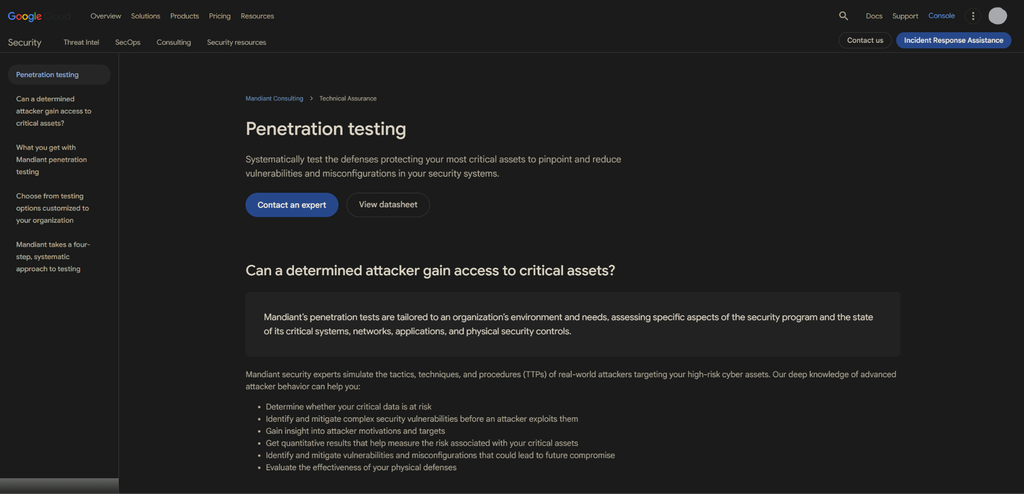
Kevin Mandia founded Mandiant in 2004, and the Reston, Virginia, firm became one of the best-known names in breach response. Google bought it in 2022, and its consulting services now sit inside Google Cloud. Mandiant’s own datasheet says its penetration tests can be performed black box, starting with zero knowledge of the environment, or white box. External tests target systems, services, and applications exposed to the internet, and the menu also covers social engineering, wireless, IoT devices, and industrial control systems.
The selling point is where the attack ideas come from. Mandiant’s incident responders work on major breaches around the world, and its testers use the same attacker techniques they see in that work. Red team assessments begin by agreeing whether the team should have some knowledge of your environment or none, and the team then works to compromise the company from the internet using only information available there. Reports include an executive summary, step-by-step technical details to reproduce each finding, a risk analysis, and both immediate and long-term recommendations.
4. CrowdStrike
Best for: companies already running CrowdStrike Falcon that want to know if it catches an outside attacker
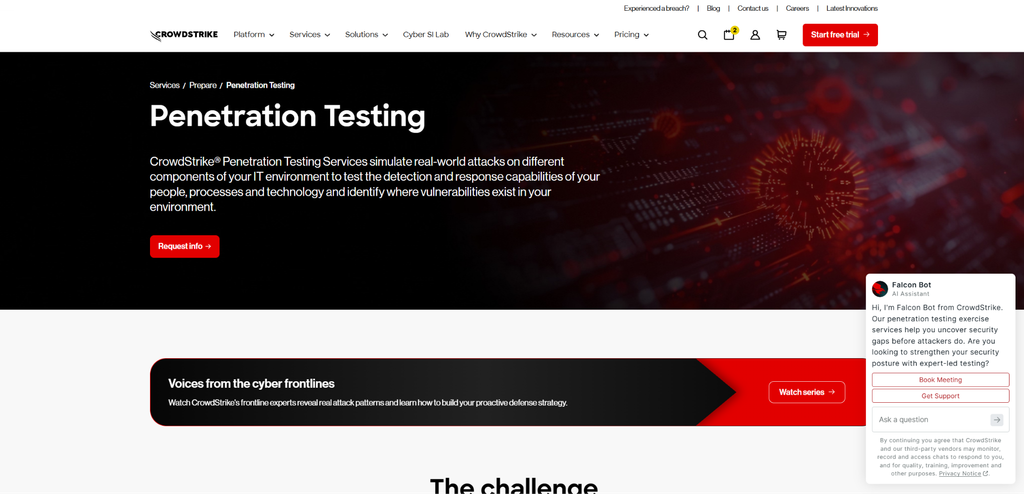
Most people know CrowdStrike for Falcon, its endpoint security product. Fewer know that the Austin, Texas, company, founded in 2011, also runs penetration tests and red team engagements through its services arm. Its external network test covers identification, enumeration, vulnerability discovery, and exploitation of internet-facing systems. Internal, web and mobile app, insider threat, and wireless tests are also offered.
Testers draw on CrowdStrike’s incident response, forensics, and red team experience, and they use real-world threat actor tools, guided by the company’s threat intelligence on how attackers operate. CrowdStrike describes the goal as testing the detection and response of your people, processes, and technology. For a Falcon customer, that means one engagement can show whether an outsider would get in and whether the tools and people watching your alerts would notice.
5. IBM X-Force Red
Best for: global enterprises whose systems go past web and network into mainframes, hardware, or connected devices
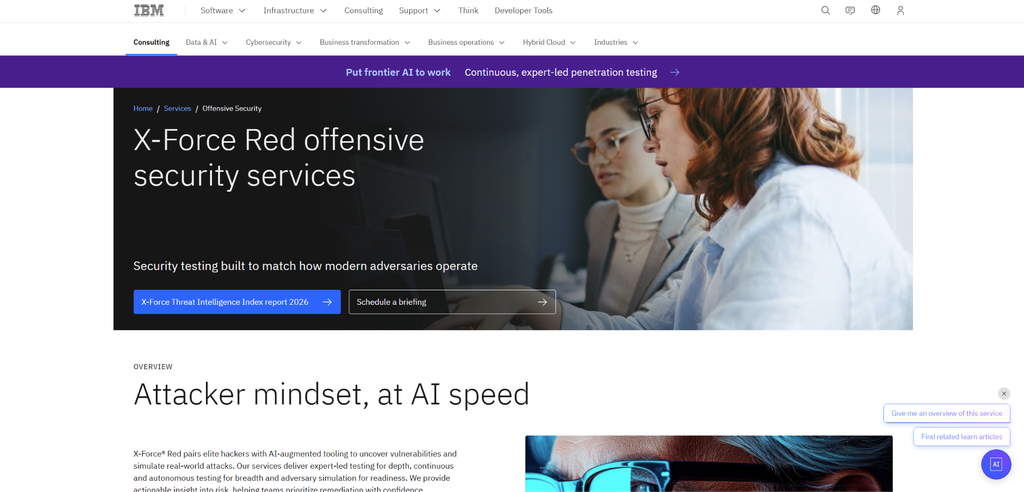
IBM launched X-Force Red at Black Hat USA in 2016 as a dedicated team of testers. Scope runs wide: applications, networks, cloud, AI systems, mainframes, and hardware, the mix many large banks and insurers still run on. Testing is expert-led, and IBM’s own description says practitioners validate findings and chain weaknesses together into real attack paths. Adversary simulation is a separate service line for longer, red team-style work, and engagements can be bought per project, as a subscription, or as a managed service.
IBM has published a case study from one of its black box operations. The client’s security team caught the phishing emails, and because the test was black box, the testers had little way of knowing what went wrong. They worked through it and went on to build the operation. Findings and remediation status live in Red Portal, which connects to existing ticketing and vulnerability management tools, so large teams can route each issue to its owner.
6. GuidePoint Security
Best for: large enterprises and government-facing organizations that want one security partner for testing and the wider program around it
GuidePoint Security was founded in 2011 and is based in Reston, Virginia. Its pentests are run by the Threat and Attack Simulation team, whose members come from Fortune 100 companies, the Department of War, and US intelligence agencies, and its penetration testing services are CREST accredited. The external test is described as a way to “discover what attackers see before they ever touch the network”: testers look for weak spots on the perimeter and map the open-source intelligence available to a determined attacker.
Testers combine manual exploitation with targeted tools, and engagements can be built around a specific worry such as ransomware, a supply chain compromise, identity attacks, or a misconfigured cloud account. GuidePoint also offers testing as an ongoing service, and its wider consulting and technology practice suits organizations that want the same partner involved after the report, when it’s time to fix what the test found.
7. Kroll
Best for: organizations that want testing and incident response under the same retainer
Jules Kroll founded his risk consulting firm in New York in 1972, and today its cyber practice holds CREST accreditation for penetration testing (CREST is an international body that vets testing firms and their methods). Kroll’s testers use the same tactics as real attackers, and engagements can cover external and internal networks, web apps and APIs, cloud, mobile apps, AI and LLM systems, and social engineering. Red team exercises test how well your team handles realistic adversary behavior across cloud, on-premises, and hybrid environments.
The detail that matters for many buyers is the retainer. A Kroll retainer gives you a pre-negotiated agreement for rapid incident response, plus service credits that can be applied to other work, including penetration testing and red teaming. The firm testing your defenses is the same one on call if something goes wrong.
8. Rapid7
Best for: companies already on Rapid7’s platform that want red teaming against their external attack surface all year
Rapid7 has been in business since 2000, is based in Boston, and maintains Metasploit, one of the most widely used penetration testing tools, which its own testers contribute to. Its consulting team runs external and internal network tests, web app, wireless, and IoT tests, social engineering, and red team attack simulations, and it describes the goal as assessing your security “from an outside perspective.”
For an ongoing outsider view, Vector Command is Rapid7’s continuous red team service. It is built to validate your external attack surface and test your defenses through red team operations that keep running as your environment changes, and an advanced tier carries the work past the perimeter into the internal network. Reports align to MITRE ATT&CK, a common catalog of attacker techniques, and findings show up inside Rapid7’s Command Platform. CYBRI’s list of continuous penetration testing services covers other firms that work this way.
9. Triaxiom Security
Best for: mid-size companies that want a tightly scoped external black box test with a predictable process
Triaxiom describes black box testing in plain terms: the tester starts knowing only the organization’s name and uses public sources to find its systems. The Charlotte, North Carolina, firm was founded in 2017, has run as a division of Strata Information Group since 2023, and is CREST accredited.
The external test is laid out step by step. Testers start with open-source reconnaissance, then move to port and vulnerability scanning, manual and automated exploitation attempts, and password attacks. The goal is to get through the perimeter and show what access an attacker would have inside. A scoping call, written proposal, and kickoff meeting covering the rules of engagement come first, so an IT team knows exactly when testing will happen and what will be touched.

10. Secure Ideas
Best for: small and mid-size companies that want a boutique firm to test from the outside and then train their staff
Secure Ideas is a Jacksonville, Florida, firm founded in 2010, with testing and teaching both at the center of its work. Its testers use the same tools and techniques as malicious hackers, and network tests cover both external and internal threats. Web app testing, red team and purple team work, and physical penetration tests are also offered. Secure Ideas is CREST accredited for penetration testing.
For buyers who need testing more than once a year, its PETaaS service combines ongoing advisory help with testing credits and a pre-arranged contract, so a new test can start without another round of procurement. The firm also runs security training, which helps when a report lands on a small team that has to fix the issues itself. If a true zero-knowledge start matters to you, say so at scoping.
How to Choose a Black Box Pentest Provider
Black box engagements vary more than most buyers expect. One is a focused external test that wraps up in a couple of weeks; another is a months-long red team that ends up in your server room. These points help line the shortlist up side by side:
| Criteria | What to look for |
| Starting knowledge | Agree in writing on what the tester receives: only your company name, a list of domains, or a set of IP ranges. A pure name-only start is the most realistic and the slowest. |
| Reconnaissance depth | Ask what public sources they search, including leaked credentials, code repositories, and forgotten subdomains. Good recon is where black box testing earns its fee. |
| Rules of engagement | Testing hours, systems that are off-limits, who to call if something breaks, and whether denial-of-service tests are excluded. |
| People and premises | Whether phishing, phone pretexting, or physical entry are included, and who in your company is told in advance. |
| Detection testing | Whether the test also measures how fast your SOC or managed security provider notices. If that matters, keep the circle of people who know about the test small. |
| Who does the testing | Named testers with hands-on certifications, and a clear split between what tools do and what people do. |
| Reporting | An executive summary, severity scores, steps to reproduce each finding, and an attack narrative showing how the pieces connected. |
| Retesting | Whether fixes are retested, how long the window stays open, and whether the report is updated afterward. |
| When to switch boxes | A provider willing to say when gray or white box testing would cover more for the same budget. |
Final Thoughts
Every company on this list can show you what an outsider sees, and the best pick depends on your size, your existing tools, and whether you also want your people and buildings tested. For a SaaS or fintech company, the most useful starting point is often a mix: black box testing on the external network and public-facing apps, gray box testing behind the login. CYBRI scopes that split honestly, puts OSCP-certified testers on every project, and retests fixes within 90 days with an updated report. A short call is enough to sort out which box fits which system, so contact CYBRI to talk it through.
Frequently Asked Questions
What is the difference between black box, gray box, and white box testing?
The difference is how much the tester knows at the start. In a black box test they know only your company name. In gray box they get regular user accounts and some basic information, so they can test what a logged-in customer could do. White box gives them full access, including source code and architecture documents. Black box shows the outsider’s view, while gray and white box cover more ground in the same time.
How long does a black box penetration test take?
An external black box test of a small or mid-size company usually needs one to three weeks of active testing, plus time for the report. Reconnaissance takes a larger share of that time than in other test types. Red team engagements that start black box run longer, often several weeks to a few months, because testers move slowly to avoid being caught.
Ready for a Black Box Pentest?
CYBRI runs manual-first black box tests of external networks and web applications, plus red team and phishing work, and recommends gray box testing wherever a login gives better coverage. OSCP-certified testers lead every project, findings appear in the Blue Box dashboard, and fixes are retested within 90 days with an updated report. Get a quote to scope a test for your company.