Smaller customers usually sign after a demo and a contract review. Enterprise customers add a security review. Their team sends a long questionnaire, and one line in it asks when your last independent penetration test was and what it found. If you sell B2B SaaS and store customer data, expect that question on nearly every large deal.
A pentest report, the written results of an authorized attack on your product, answers it fast. It needs to be recent and signed by a credible firm, and each reader should get the right version. This guide explains which part of the report goes to which buyer and how to keep it current.
Quick Answers
Why do enterprise buyers ask for a pentest?
Your product will hold their data, so a breach on your side becomes their incident. An independent test shows their security team that someone outside your company tried to break in and that you fixed what they found.
What should you send a prospect?
Start with the letter of attestation, a one- or two-page summary signed by the testing firm with no vulnerability details. If the reviewer wants more, share the executive summary under NDA. The full technical report rarely leaves the building.
How recent does the test need to be?
Most security reviewers expect a test from the last 12 months that covers the product they’re buying. A major release since then is a reason to test again.
Why Big Customers Ask
Banks, hospital networks, and large retailers run every new vendor through a third-party risk review before signing. The reviewer has one job: figure out how much of the company’s data will sit with you and what happens if you get breached. Standard questionnaires such as the Cloud Security Alliance’s CAIQ ask directly whether a vendor runs independent penetration testing, and plenty of enterprise teams write their own version with the same question.
Without a report, the deal doesn’t die. It slows. The reviewer sends follow-up questions, asks for a call with your CTO, or writes a clause into the contract requiring a test soon after signing. Each of those costs time. Meanwhile, the person inside the buyer’s company who pushed for your product has to keep defending that choice to their colleagues until the review is done. A report already sitting in the data room cuts that stretch short.
One Engagement, Three Documents
A finished pentest gives you three things to share, each with a different level of detail. Treat them as separate assets with separate rules.
| Document | What it contains | Who gets it |
| Letter of attestation | Testing firm, test dates, scope, method, count of issues by severity, signature | Anyone in a sales cycle; it can live in your trust center |
| Executive summary | Scope, method, testers, overall risk, summary of findings, compliance mapping | Security reviewers, under NDA |
| Technical report | Every finding with reproduction steps, evidence, and the fix | Your engineers and your auditor; a customer only in rare cases |
The split exists because the technical half is a set of instructions for attacking your product. A finding that walks step by step through how one customer could open another customer’s records helps your engineers fix the bug. Forwarded twice from a prospect’s inbox, it helps anyone who reads it. CYBRI’s report walkthrough explains each section of the full report.
The Letter Is Your Marketing Piece
Of the three, the letter of attestation is the one built to be shown around. It names the firm and the testers, says what was tested and when, and counts the issues at each severity level. No findings, no evidence, nothing an attacker could use. So it’s safe to post in a trust center (a page, public or behind a sign-in, where a vendor shares its security documents), attach to a proposal, or put in the security section of an RFP response before anyone asks for it.
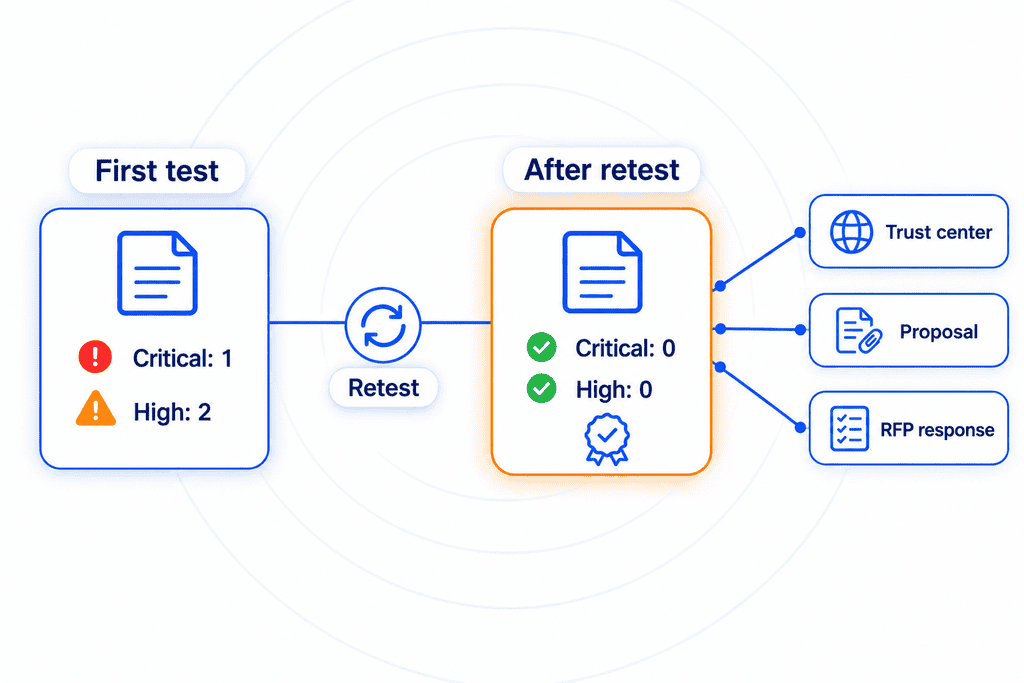
Timing matters more than most teams expect. A letter issued the day testing ends shows every critical issue still open. Once your team has fixed them and the testers have checked the fixes, ask for an updated letter that shows both states side by side. One critical and two high at the first test, zero of each after the retest, is a line a reviewer understands in seconds. It also reassures them more than a result with no findings at all, which can leave a reviewer wondering how deep the test went.
Keep the current letter in one shared place, with its expiry date visible, so nobody on the sales team sends last year’s version to a new prospect. CYBRI’s guide to letters of attestation shows the format.
The Executive Summary, Read Control by Control
Some reviewers want more than a letter, especially in banking and healthcare. The next step is the executive summary, shared under NDA.
Reviewers read it with a compliance framework in mind, and each framework has its own checklist item for security testing:
- SOC 2: criterion CC4.1, which expects regular checks that your controls work. A pentest is one of the examples it gives.
- ISO 27001: the controls for fixing vulnerabilities and testing security (A.8.8 and A.8.29).
- PCI DSS and HIPAA: their own sections on security testing.
A good executive summary links each result to those items. The reviewer can then tick the box without doing the work themselves. Your compliance lead can use the same page for the audit, so one test helps both sales and compliance.
Ask for this mapping when you first plan the test. It’s much easier to build into the report from the start than to add later.
When a Buyer Asks for the Full Report
Now and then a large customer insists on technical detail. A few options keep the deal moving without handing out attack instructions:
- A redacted copy that keeps each finding’s title, severity, and status but drops reproduction steps and hostnames
- A call where your team walks their security team through the findings, sharing your screen instead of sending the file
- The retest results, showing each finding marked fixed and verified
Check your contract with the testing firm first, since some firms restrict sharing the full report with third parties.
The Name on the Report
Enterprise security reviewers read a lot of pentest reports, and they can tell scanner output with a logo on it from a test run by people. They look for named testers with recognized certifications (OSCP, earned by breaking into practice systems under exam conditions, is the one most reviewers recognize). A documented method such as the OWASP testing guide matters, and so do findings backed by real evidence. Scope gets checked too. A test of your marketing site won’t help when the deal is for the platform behind the login.
Independence counts as well. A test run by the same engineers who built the system carries less weight than one from an outside firm, and PCI DSS requires an organizationally independent tester for that reason. The firm’s own reputation matters next. A report from an established testing company gets accepted with fewer follow-up questions than one from a name the reviewer has never seen. Choose a tester the way you’d choose an auditor, because every future buyer will see who signed it.
Keeping the Asset Current
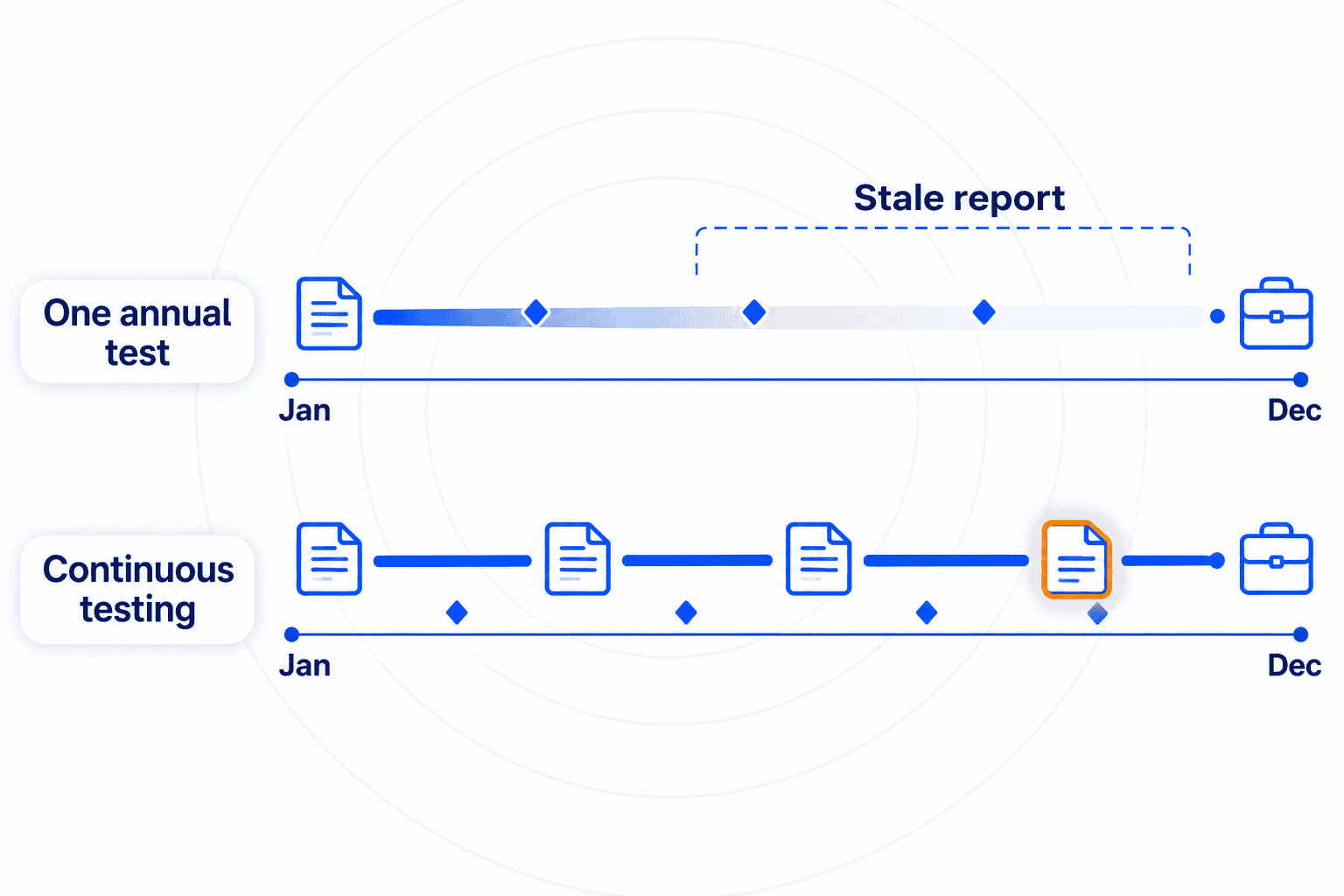
A pentest report carries a date, and it loses value as the product moves on. Twelve months is the usual shelf life in procurement. A major release, a new API, an AI feature, or a new cloud account can make the tested scope out of date sooner, and a sharp reviewer will notice when the report describes a product that no longer exists.
For a SaaS company that ships every week and sells to enterprises year-round, one annual test leaves gaps. A deal that closes late in the cycle gets a report that’s nearly stale. Continuous testing closes that gap by scheduling tests through the year, each with its own report and letter, so sales always has something recent to send. New features also get tested before an enterprise customer thinks to ask about them, which is the order you want.
What a Sales-Ready Pentest With CYBRI Looks Like
If a deal is waiting on a security review, the test can be scoped around the product that buyer is purchasing and the frameworks their reviewer reads. CYBRI reports are written for both audiences: a plain-language executive summary for leadership and reviewers, and technical findings your engineers can act on.
Every engagement includes:
- Senior, OSCP-certified testers working manual-first, named with their credentials in the report
- Authenticated testing across your user roles, where the data-exposure flaws enterprise reviewers worry about tend to hide
- Same-day alerts for critical issues
- A two-part report with findings scored on CVSS 4.0 (the standard severity scale) and an executive summary mapped to SOC 2, ISO 27001, or the frameworks on your list
- A letter of attestation for prospects and your trust center
- A walkthrough call with the testers
Remediation testing is part of the quote too: the testers check your fixes inside a 90-day window and issue an updated report.
On continuous and PTaaS programs, Blue Box, CYBRI’s testing platform, tracks findings and retests across the year, so current status is ready when the next questionnaire arrives.
To scope a test around an upcoming security review, contact CYBRI.
Frequently Asked Questions
Can the letter of attestation be posted publicly?
Yes, and many SaaS companies do, usually in a trust center. Some put it behind an email form or a click-through NDA, which also tells the sales team which prospects are reviewing them. Confirm the testing firm’s terms allow it before posting.
Does a pentest replace a SOC 2 report?
No. SOC 2 is an independent audit of your security controls (a Type 2 report covers how they worked over several months), and a pentest is one test of your product. Enterprise reviewers often ask for both, and SOC 2 auditors use the pentest as one piece of their evidence.
What if the test finds critical issues in the middle of a deal?
Fix them, get the retest, and send the updated letter. Reviewers expect a real test to find something. A report that shows criticals fixed and verified quickly reads as a responsive team. Sending a stale letter, or one with open criticals and no plan, does far more damage.
Turn the Next Security Review Into a Quick Yes
Bring the questionnaire that’s holding up your current deal, or a list of the products your enterprise buyers ask about. The first call works out what those reviewers need to see and sizes a test that delivers the letter and the mapped summary before the review closes. Book a scoping call with CYBRI.